Key takeaways
- AI Overviews are already cutting clicks, not eliminating them: Google users click a normal search result far less often when an AI summary appears, but the businesses that get cited still get calls.
- Good hvac digital marketing now has two audiences: the homeowner reading your page and the AI system deciding if it should quote it, so your content needs to answer clearly for both.
- Your website, reviews, and Google Business Profile are more important than ever: AI Overviews pull from real, credible sources, and thin or outdated sites simply don’t get picked.
When Google shows an AI Overview above the search results, people click through to a website in just 8% of visits, compared with 15% when no AI summary shows up. That single stat explains why so many Canadian HVAC owners are calling their marketing person with the same worried question: is this AI thing about to wreck how homeowners find us? It’s a fair question, and the honest answer sits somewhere between panic and denial. Good hvac digital marketing hasn’t stopped working, but it has changed shape, and contractors who ignore that shift are going to watch their competitors get quoted by name inside the answers Google now gives for free.
Still Writers has spent years learning industries most agencies skip past, and HVAC is one we know cold, from cold climate heat pumps in Winnipeg to gas furnace replacements in the GTA. We write for contractors across Canada and the U.S., and we’ve watched search behavior change faster in the last two years than in the decade before it. We’re not the only shop that does this work well, and plenty of generalist agencies can build you a nice looking site, though we’ve also seen why generic marketing agencies often fail Canadian HVAC contractors once the work gets specific. Where we’ve found our footing is in understanding what a homeowner types into Google at 9pm when their furnace dies, and what Google’s AI now shows them in response.
This article answers the questions we actually hear from Canadian HVAC owners about AI search and AI Overviews, not a generic explainer on what AI is. You’ll find:
- What an AI Overview actually is and how often it shows up for the kind of searches your customers run.
- If you still need a website and SEO now that Google answers questions directly on the results page.
- What happens to referral and repeat traffic when fewer people click through at all.
- How to actually get cited inside an AI Overview instead of losing the click to a competitor.
- A checklist for figuring out if your company is ready for this shift or still stuck in 2019.
What is an AI Overview, and is it really showing up for HVAC searches?
An AI Overview is the summary Google generates and places above the traditional blue links, built by pulling information from a handful of web pages and stitching it into one answer. You’ve probably seen it when you search something like “why is my furnace making a clicking noise” or “how much does a heat pump cost in Canada.” Instead of ten links, you get a paragraph or two, with a few small source links tucked underneath or to the side.
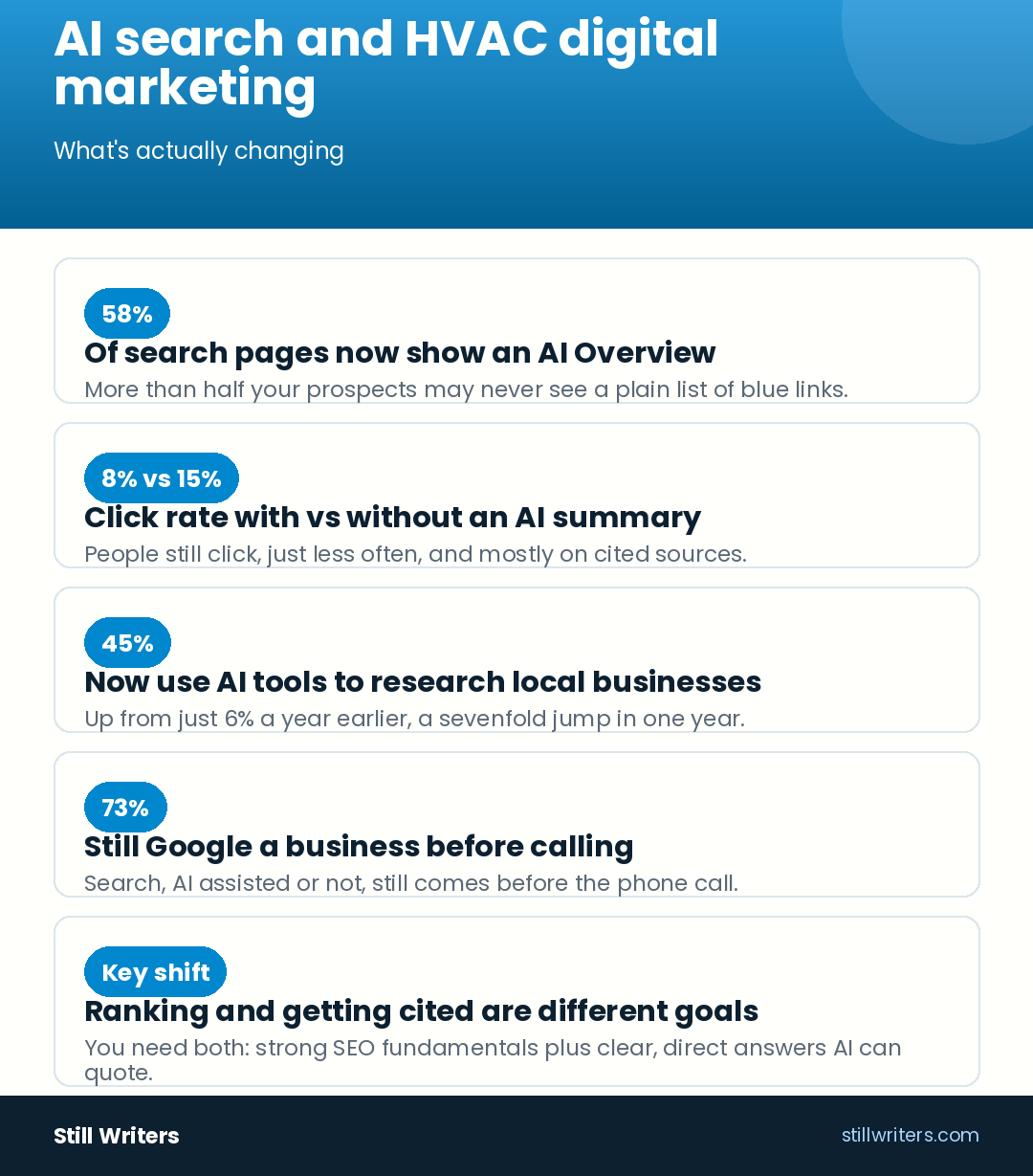
This isn’t a rare experiment anymore. AI Overviews now appear at the top of roughly 58% of search results pages, and the same reporting found organic click through rates can drop by as much as 61% when one shows up on a search. Semrush’s own research found AI Overview coverage of commercial intent searches grew 71% over a six month stretch, which tells you this trend is speeding up, not leveling off. HVAC searches sit right in the middle of the categories AI Overviews love: “how to” questions, comparisons, cost estimates, and troubleshooting, all of which are exactly what a homeowner types before they call a contractor.
How this differs from just ranking on Google
Ranking on Google and getting cited inside an AI Overview are two separate problems now. If your company has struggled for years to crack the first page, that’s still worth fixing, and we’ve covered why Canadian HVAC companies struggle to rank on Google in detail elsewhere. But even companies that rank well can get skipped by an AI Overview if their content doesn’t answer the exact question clearly enough near the top of the page. A page can sit at position three and still lose the AI citation to a competitor sitting at position seven, because Google’s summary system cares more about a clear, direct answer than about classic ranking signals alone.
| Statistic | Value | What it means for your HVAC company |
|---|---|---|
| Share of search pages showing an AI Overview | About 58% | More than half your prospects may never see a plain list of blue links. |
| Click drop when an AI Overview appears | Up to 61% | Fewer visitors reach your site directly from that search. |
| Click rate with an AI summary present vs. without | 8% vs. 15% | People still click, just less often, and mostly on cited sources. |
| Consumers now using AI tools to research local businesses | 45%, up from 6% a year earlier | Homeowners are asking AI directly which HVAC company to call. |
| Canadians who Google a business before calling or visiting | About 73% | Search, AI assisted or not, still comes before the phone call. |
The 45% figure is worth sitting with for a second, because it jumped from just 6% the year before. Homeowners aren’t only Googling “HVAC company near me” anymore. Some are typing that same question into ChatGPT or Google’s AI Mode and asking it to just tell them who to call.
Does this mean I don’t need a website or SEO anymore?
This is the question we hear most, and the short answer is no, you need your website more, not less. AI Overviews don’t invent answers from nothing. They pull from real web pages, and Google still has to crawl, understand, and trust a site before it can quote from it. Every contractor we’ve worked with who tried to cut their content budget after hearing about AI search ended up in the same spot: fewer citations, fewer clicks, and a Google Business Profile that homeowners couldn’t find enough proof behind.
Here’s the gap most owners don’t see until it’s pointed out. You might believe the goal is still “rank higher than my competitor.” The real goal now is “be the source Google trusts enough to quote.” Those overlap, but they aren’t the same target. A page that ranks fine but reads like thin marketing copy, with no real numbers, no local detail, and no clear answer near the top, is much less likely to get pulled into a summary than a shorter page that answers one specific question well. 53% of Canadians already say a website makes a business look more credible, and that trust signal matters just as much to an AI system trained to avoid citing sketchy sources.
Where your Google Business Profile fits in
Your Google Business Profile still does heavy lifting here too. AI Overviews and Google’s local map results often lean on the same trust signals: review volume, review recency, category accuracy, and how complete your profile is. If yours has been sitting untouched since you set it up, that’s worth fixing before you spend a dollar on new content. We wrote a full, honest breakdown of what actually moves the needle on a Google Business Profile for HVAC companies, and it lines up closely with what we’re now seeing feed AI-generated answers too.
If you want a plainer intro to what hvac digital marketing even covers before diving deeper into the AI side of things, our piece on what HVAC digital marketing is and if your company needs it is a good place to start.
Will AI Overviews kill my referral and repeat business traffic?
No, and this is where a lot of owners are worrying about the wrong thing. Referral traffic, the calls you get from past customers, neighbours, and word of mouth, has nothing to do with what Google’s AI shows a stranger searching cold. Repeat business runs on trust you’ve already built, and no algorithm change affects that relationship. What AI Overviews do affect is cold discovery, the moment a homeowner who has never heard of your company starts typing a question into Google.
That said, a few real risks are worth naming honestly:
- Fewer clicks on informational content: if you write blog posts explaining furnace maintenance or heat pump basics, expect fewer of those readers to click through, since the AI summary may answer their question on the spot.
- More pressure on review platforms: homeowners still lean on trusted third parties to vet a contractor before calling, and Canadian platforms like HomeStars and TrustedPros carry real weight in that decision.
- A shrinking window for weak websites: a slow, outdated, or thin site was already losing to competitors, and AI Overviews just make that gap show up faster.
- Local nuance getting flattened: AI summaries sometimes generalize advice that should differ between, say, an Alberta furnace and a coastal BC heat pump, which is an opening for contractors who write locally accurate content.
On that review platform point, we put together a straight comparison of HomeStars and TrustedPros against organic SEO and where your budget is best spent. Both matter now more than ever, because AI systems, like homeowners, treat a page full of real reviews as a stronger signal than a page with none.
How do you actually get cited inside an AI Overview?
Getting quoted by an AI Overview comes down to writing content the way you’d answer a customer standing in front of you, not the way a keyword tool tells you to write. That means a direct answer near the top of the page, followed by the detail that backs it up. It means real numbers instead of vague claims, and it means covering one topic fully instead of stuffing five topics into one page hoping something sticks.
The shift from ranking tactics to answer clarity
Traditional SEO tactics still matter, but the priorities have moved. Whitespark’s annual Local Search Ranking Factors report, put out by the Edmonton-based team that tracks this closely, still points to reviews, proximity, and Google Business Profile completeness as the backbone of local visibility. Layer AI Overviews on top of that foundation, and the winners are the contractors whose pages already answer questions plainly enough for a summary tool to lift a sentence straight out.
| Focus area | Traditional SEO approach | AI visibility approach |
|---|---|---|
| Content structure | Long pages built around a keyword | Short, direct answers near the top, detail below |
| Success metric | Ranking position | Getting cited or quoted inside an answer |
| Proof points | Backlinks and keyword density | Real numbers, named sources, and clear expertise |
| Local signals | City name mentions | Genuine local detail, like climate, rebates, and code differences |
| Reviews | Nice to have for trust | A core signal both Google and AI systems weigh heavily |
This is also where certification and training context helps. Mentioning your team’s HRAI credentials, or provincial licensing where it applies, gives an AI system a concrete, checkable detail to associate with your name instead of a vague claim of expertise. The same logic applies to local SEO strategy generally. If you operate across more than one province, our breakdown of local SEO versus national SEO for HVAC companies operating across Canada covers how to structure that without diluting either.
Regional detail matters more here than most owners expect. A page about heat pump rebates that only mentions the federal Greener Homes program misses half the picture for a homeowner in British Columbia stacking CleanBC incentives on top, or a Quebec homeowner asking about Hydro-Québec’s programs in French. An AI Overview built from a generic, U.S.-style article won’t have that nuance. Your locally written page can.
Is your company ready for AI search, or still stuck in the old playbook?
Most Canadian HVAC companies fall into one of two camps right now. Some have a website that hasn’t changed much since 2018, thin service pages, no blog, a handful of reviews. Others have invested steadily in content and reviews for years and are already showing up inside AI Overviews without fully realizing it. Figuring out which camp you’re in is the first real step.
- Check if your site answers common questions directly: search a question a real customer would ask and see if your page gives a clear answer in the first few sentences.
- Audit your Google Business Profile completeness: missing hours, categories, or photos are easy fixes that carry real weight.
- Look at your review volume and recency: a company with three reviews from 2021 reads very differently to both homeowners and AI systems than one with fresh monthly reviews.
- Review your content for real local detail: generic advice that could apply to any province anywhere doesn’t stand out, and it doesn’t get cited.
- Track clicks instead of rankings alone: a page can rank well and still lose traffic to an AI Overview, so watch actual visits and calls, not position alone.
If your site is losing visits despite decent rankings, that’s often a conversion and clarity problem as much as an AI one. We covered that exact pattern in why your HVAC website gets clicks but not calls. Once you’ve run through the checklist above, the next move is usually a conversation, not another audit. If you want a wider view of what’s actually working across the industry right now, our review of marketing your HVAC company in Canada is a useful companion read. You can see our full range of services or just reach out and talk through where your company stands right now.
Frequently asked questions about AI search and HVAC digital marketing
Does my HVAC company still need a website if Google shows AI Overviews? Yes. AI Overviews pull their answers from real websites, so a thin or outdated site actually loses visibility now, along with clicks. A strong, locally detailed site is what gives you a shot at being the source Google quotes.
How do you get an HVAC business mentioned inside a Google AI Overview? Write content that answers one specific question clearly near the top of the page, back it up with real numbers and local detail, and keep your reviews and Google Business Profile active. Those three things together give an AI system something concrete to cite.
Will AI Overviews replace my Google Business Profile and reviews? No, they lean on them. Review volume, recency, and profile completeness feed both the local map pack and many AI-generated local answers, so keeping your profile current matters more, not less.
Should I stop doing SEO and just focus on AI search? No. Traditional SEO fundamentals, like site speed, mobile usability, and clear service pages, still form the foundation AI visibility is built on top of. Treat AI visibility as an added layer, not a replacement strategy.
How long does it take to see results from AI-visibility content? Most contractors see early movement in three to six months, similar to traditional SEO timelines, though citations inside AI Overviews can sometimes appear faster once a page clearly answers a specific question well.
Make your HVAC digital marketing ready for AI search
You came here worried that AI Overviews might quietly replace your website, and the honest picture is more nuanced than that fear suggests. It’s a real shift, but it rewards the contractors willing to write clearly and keep their proof points current.
Here’s the short version of what you now know:
- AI Overviews cut clicks, but citations still convert: being the quoted source still earns you the call.
- Your website and reviews matter more, not less: AI systems need real, trustworthy sources to pull from.
- Referral and repeat business are unaffected: this shift changes cold discovery, not relationships you’ve already built.
- Local, specific content wins: generic advice doesn’t get cited the way locally accurate detail does.
- Rankings and citations are two different goals now: you need both, not one instead of the other.
We’ve built content strategies for HVAC contractors from Nanaimo to Halifax, and the pattern holds everywhere: the companies willing to answer real customer questions plainly, in writing, are the ones showing up when it counts. We’ve made mistakes early in a niche before too, and we know the difference between an agency that copies a template and one that actually learns your trade. If you’d rather have that conversation than keep wondering, we’re an easy call away.
What should you read next?
If you want to keep learning before you pick up the phone, here are three places to start.
- Best HVAC SEO strategies for Canadian contractors in 2026: a broader look at the SEO fundamentals that still support everything discussed here.
- Questions Canadian HVAC companies ask before hiring a marketing agency: useful once you’re ready to compare who might actually help you execute this.
- Best HVAC blog content ideas to fill your 2026 content calendar: practical topics to start writing the kind of clear, citable content this article describes.
If you’re not ready to talk to us yet, those three resources are a solid place to keep learning at your own pace.