
Key takeaways
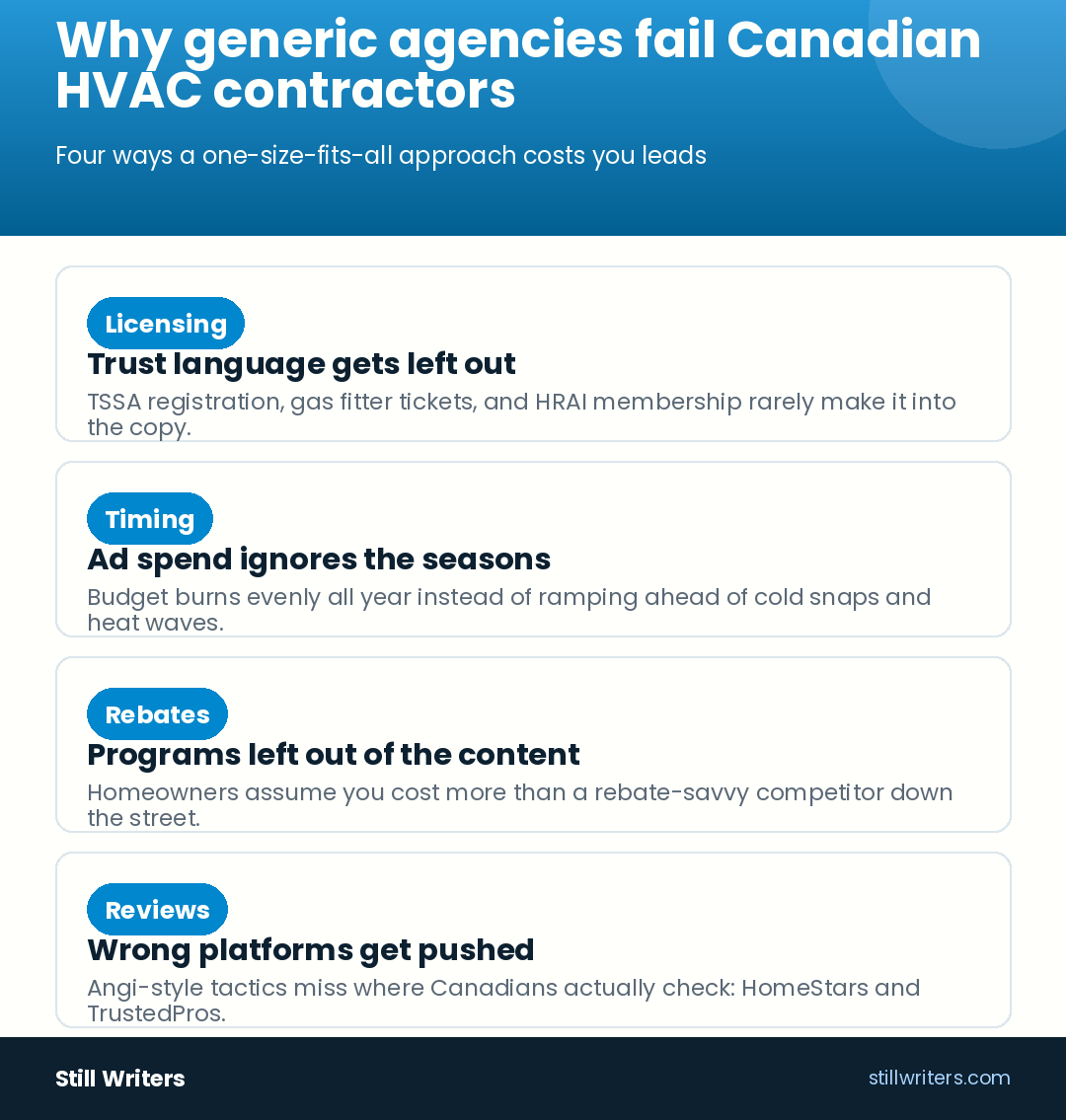
- Generic agencies skip the licensing language that builds trust, leaving out TSSA, gas fitter tickets, and HRAI membership because the writer doesn’t know what those terms mean.
- They spend your ad budget on the wrong months, treating a seasonal trade like an evergreen business instead of ramping spend ahead of cold snaps and heat waves.
- They copy a US playbook onto a Canadian business, pushing Angi-style reviews instead of HomeStars and TrustedPros, skipping provincial rebates, and ignoring French content in Quebec.
Your phone should ring the second a furnace quits during a Calgary cold snap or a Halifax nor’easter, but if your hvac marketing company can’t tell a gas fitter ticket from a general contractor license, that call goes to a competitor instead. Roughly 73% of Canadian shoppers Google a business before they ever pick up the phone, and what they find there was written by someone who may have never set foot near a furnace. If the person writing your website copy has spent the morning writing for a dentist and the afternoon writing for a roofer, your content reads like it was built for forty industries at once, because it was. That’s the real cost of hiring a generic agency. You don’t just get slower growth. You get marketing that quietly tells homeowners you don’t fully know your own trade, in a market where trust decides who gets the call.
At Still Writers, we’ve built campaigns for HVAC contractors from Nova Scotia to British Columbia, and we’ve watched the same pattern play out again and again. A company switches from a broad agency to one that studies the trade, and call volume climbs within a few months, not because the ads got flashier, but because the content finally speaks the customer’s language instead of a template built for any home service business. We’re not the only shop that gets HVAC right. Plenty of specialists out there do solid work. The problem is that too many Canadian contractors are still stuck with agencies who never learned the difference between a furnace tune-up and a full system replacement, let alone a provincial rebate program.
What actually counts as a generic marketing agency?
A generic marketing agency serves every industry that will sign a contract. It might run ads for a law firm on Monday, a dental office on Tuesday, and your heating and cooling business on Wednesday. There’s nothing wrong with versatility by itself. The trouble starts when that agency treats HVAC the same way it treats every other client, with no interest in the trade’s own language, licensing structure, seasonal swings, or the way homeowners actually decide who to call when a system breaks down. If a company sells itself only as a general hvac marketing company without showing any real trade knowledge in the sales conversation, that’s usually a warning sign rather than a selling point.
Talk to contractors in Red Deer, Mississauga, or Moncton and you’ll hear a similar story. The agency talked a great game on the discovery call, mentioned “local SEO” and “lead generation” a dozen times, then delivered a blog that could have promoted a plumber, an electrician, or a lawn care company with a few words swapped out. That’s the gap between an agency that sounds confident and one that actually understands the work your technicians do every day.
Why versatility alone isn’t enough
A marketing team can be skilled at writing, at running ads, and at technical SEO, and still fail your HVAC business if nobody on that team has ever learned what separates a heat pump from a furnace, or why a homeowner cares about a red seal certification. Skill in marketing and knowledge of the trade are two different things. Generic agencies usually have plenty of the first and almost none of the second, and homeowners can tell the difference even if they can’t name it. It shows up as vague copy, generic stock photos of ductwork that doesn’t match your service area, and blog posts that never mention a single brand of equipment you actually install.
Why does trade licensing language trip up generic agencies?
HVAC work touches gas lines, electrical systems, and refrigerant, so licensing isn’t a minor detail. It’s the thing that tells a homeowner you’re safe to let into their basement. Ontario homeowners look for TSSA registration. Technicians across the country reference their gas fitter ticket level, from a G2 up to a G3. Many companies list membership with HRAI, the national trade association for the HVAC and refrigeration industry, as a signal of legitimacy. A generic copywriter usually doesn’t know any of this exists, so the website ends up saying “certified technicians” without ever naming what they’re certified in.
That vagueness costs you exactly when it matters most, the moment a homeowner is scanning your service page trying to decide if you’re the safe choice or the risky one. Generic content also tends to blur together services that are actually very different, treating a maintenance visit the same as a full furnace replacement, when those two jobs involve completely different urgency, cost, and decision process for the customer. This kind of vague, undifferentiated writing is part of a bigger pattern we’ve covered in our piece on why Canadian HVAC companies struggle to rank on Google in the first place.
Generic copy versus copy that actually understands the trade
| What a generic agency does | What happens because of it | What an HVAC-focused agency does instead |
|---|---|---|
| Writes “certified technicians” with no detail | Homeowners can’t tell if you’re licensed for gas work | Names your TSSA registration, gas fitter ticket level, and HRAI membership directly |
| Spreads ad spend evenly across the year | Money burns on furnace ads in July and AC ads in January | Shifts spend ahead of each season’s real demand curve |
| Leaves rebate programs out of the content entirely | Homeowners assume you’re pricier than a rebate-savvy competitor | Builds current rebate programs into landing pages and calls to action |
| Pushes Google reviews and sometimes Angi | Misses where Canadian homeowners actually check contractor reviews | Builds out HomeStars and TrustedPros profiles alongside Google |
| Reuses one blog template for every trade | Content reads like it was written for a plumber, not an HVAC company | Writes content built around real HVAC service calls and equipment |
If you want a full checklist to run through before you sign with anyone, we’ve laid out the questions Canadian HVAC companies should ask before hiring an agency in a separate piece. This article is about what happens after the contract is signed, when the gaps in trade knowledge start showing up in your results.
Why do generic agencies burn budget in the wrong months?
HVAC demand isn’t steady. It spikes hard around cold snaps and heat waves, then drops off in the shoulder seasons when the weather is mild and nobody’s system is failing. A generic agency, especially one used to working with retail or professional services clients, tends to treat every month the same. It spends a flat budget on search ads year round, aiming for consistency instead of matching the actual rhythm of when Canadians search for HVAC help.
That mismatch gets expensive fast. Since Google handles roughly 86% of all search traffic in Canada, most of your paid budget is competing for space on one platform, and search costs for “furnace repair” or “AC installation” climb steeply the moment demand spikes. An agency that isn’t tracking your regional weather patterns will still be spending a flat rate in April, when an Alberta contractor’s real opportunity is the weeks right before the first heat wave, or in October, when an Atlantic Canada contractor’s opportunity is the first cold snap that pushes an aging oil furnace past its limit.
What a seasonally aware budget actually looks like
An agency that understands the trade shifts spend ahead of predictable demand instead of reacting after the fact. That means building up ad visibility a few weeks before the first real heat wave typically hits Ontario, or before the first hard freeze usually arrives on the Prairies. It also means using the quiet shoulder months differently, putting more budget into content, reviews, and reputation work instead of ads nobody is searching for yet. We’ve written more about this exact pattern in our piece on why HVAC lead generation dries up every shoulder season, and it’s worth reading if your lead flow feels unpredictable throughout the year.
What do generic agencies typically get wrong about Canadian rebates?
- They only know the federal picture. Many agencies mention energy efficiency in passing but never reference programs like the Canada Greener Homes Initiative, which has helped drive heat pump adoption across the country, including close to 274,000 heat pump installations funded through federal rebate programs, most of them cold climate units built for real Canadian winters.
- They miss provincial layering entirely. Ontario has run rebate programs through Enbridge Gas and the Ontario Energy Board over the years, Quebec homeowners can access rebates through Hydro-Québec, and generic agencies rarely mention either by name, let alone keep the details current.
- They leave rebates out of landing pages. A homeowner comparing three quotes will pick the contractor whose page clearly explains what rebate money is available, not the one who says nothing and leaves the math to guesswork.
- They don’t track rebate deadlines or program changes. Rebate programs open, close, and change eligibility rules regularly, and content that isn’t updated quickly becomes actively misleading instead of just outdated.
What does a US playbook dressed up as a Canadian strategy look like?
A lot of generic agencies got their start working with American clients, or they built their whole process around US marketing conventions and never adjusted it. The result is a strategy that looks reasonable on paper but is quietly wrong for a Canadian HVAC business. The clearest sign is review platform strategy. American agencies push Angi and HomeAdvisor because that’s what US homeowners use. Canadian homeowners lean on different platforms entirely, and treating them the same is a real miss. We break down the difference in more detail in our comparison of HomeStars and TrustedPros versus organic SEO, but the short version is that a review strategy built for the wrong platforms wastes effort your competitors are putting somewhere that actually matters.
The second sign is tone and language. A generic agency writing for a Calgary contractor might use American spelling, reference Fahrenheit and Celsius inconsistently, or write copy that assumes a US insurance and permitting system. The third and biggest sign shows up in Quebec, where French language content is a real requirement for a meaningful share of the market, not a nice extra. An agency that ships English only content, or worse, runs it through a translation tool without a French speaker reviewing it, is leaving a large piece of the Quebec market on the table before the campaign even starts. Our article on if Quebec needs a different marketing approach covers exactly how this plays out for HVAC companies specifically.
How this plays out across the country
| Region | What matters locally | The generic agency’s typical miss |
|---|---|---|
| Alberta | Cold climate heat pump adoption is rising, and shoulder season sits right before the short AC season | Runs AC focused content on a US Sun Belt schedule that doesn’t match the local calendar |
| Ontario | The GTA is Canada’s largest and most competitive HVAC market, with a history of Enbridge and OEB rebate programs | Publishes one generic “energy efficiency” blog with no Ontario program names in it |
| Quebec | French language content and Hydro-Québec rebate awareness reach a real share of the buying public | Ships English only content or a machine translated version nobody reviewed |
| Atlantic Canada | Heavy historical reliance on oil heat makes the move to heat pumps a bigger relative change than elsewhere | Uses cookie cutter “upgrade your AC” messaging that ignores the oil to electric conversation completely |
How do you know your current agency doesn’t understand HVAC?
- Your website never names your certifications. If it just says “licensed and insured” with no gas fitter ticket, TSSA number, or HRAI mention, the writer likely doesn’t know those details matter.
- Your leads don’t spike during cold snaps or heat waves. A campaign tuned to your trade should show clear jumps in calls right around predictable weather events.
- Your blog reads like it was written for any trade. Swap “HVAC” for “plumbing” in a few sentences and see if the post still makes sense. If it does, that’s a problem.
- Your landing pages never mention a rebate program. Not the federal ones, not the provincial ones, nothing at all.
- Your review requests only mention Google. HomeStars and TrustedPros never come up, even though they’re where a large share of Canadian homeowners actually check contractors.
- Your Quebec content has never been reviewed by a French speaker. If you serve Quebec and this is true, you’re likely missing a real part of your addressable market.
If any of that sounds familiar, it might be time to look at what a switch would actually cost you. Our breakdown of what an HVAC marketing agency in Canada actually charges is a good place to start. When you’re ready to talk through your specific situation, you can reach out to our team directly, or take a look at our HVAC marketing services to see how a trade-focused approach differs from what you might be getting now. An Alberta contractor working the Calgary market, for example, needs a completely different seasonal plan than a company working the Maritimes, and a generic agency rarely builds that distinction into the strategy at all.
Frequently asked questions about generic HVAC marketing agencies
What makes an HVAC marketing company different from a generic marketing agency? An HVAC-focused company understands trade licensing terms, seasonal demand patterns, provincial rebate programs, and the review platforms Canadian homeowners actually use. A generic agency applies the same playbook to every client, no matter the industry.
Can a generic agency still run good HVAC ads? Sometimes the ad mechanics are fine, but the targeting, timing, and messaging usually miss the mark because the agency doesn’t understand your seasonal demand curve or your customer’s real decision process.
How do I know if my agency understands provincial rebate programs? Check your own landing pages. If they never mention federal programs like the Canada Greener Homes Initiative or your province’s specific rebates, your agency likely isn’t tracking them.
Does my Quebec facing HVAC business need bilingual marketing? If you serve Quebec homeowners, French language content reaches a real, meaningful part of that market. Skipping it usually means skipping a big chunk of your potential leads.
What should I do if I think my current agency is a bad fit? Start by reviewing your last few months of content and ad spend against your actual call volume. If the two don’t line up with your busy seasons, it’s worth a conversation with a team that specializes in HVAC.
Choosing an HVAC marketing company that actually gets it
You came into this because something felt off, maybe flat leads during a season that should be busy, maybe a website that reads like it belongs to a different trade entirely. That feeling is usually right.
Here’s the short version of what generic agencies tend to get wrong:
- They skip licensing language homeowners actually look for.
- They spend ad budget evenly instead of matching your real seasonal demand.
- They ignore provincial rebate programs that could be closing the deal.
- They push the wrong review platforms and skip bilingual content in Quebec.
- They write content that could apply to any trade, not yours specifically.
We’ve spent years working with contractors across the country, learning the language of the trade from real service calls, rather than from a marketing brief alone. That background across construction and marketing, paired with experience running campaigns from coast to coast, is what lets us write content that sounds like it came from someone who actually understands a heat pump installation. You deserve marketing that speaks your customer’s language and respects the seasons your business actually runs on. If that’s not what you’re getting right now, it’s worth a conversation.
What should you read next?
If you want to keep learning before you pick up the phone, here are three places to start.
- Agency vs. DIY marketing: what it actually costs Canadian HVAC contractors to go it alone: a clear look at the real tradeoffs if you’re weighing outside help against handling marketing in house.
- What is HVAC digital marketing, and does your company actually need it?: a good primer if you’re still working out what a real HVAC marketing strategy should include.
- Questions Canadian HVAC companies ask before hiring a marketing agency: a practical list to run through before you sign with anyone new.
If you’re not ready to talk to us yet, these three resources are a solid place to keep learning while you decide what’s next.