
Key takeaways
- A full year of topics beats sporadic posting, because Google and homeowners both notice when a blog publishes on a predictable rhythm tied to real service demand.
- Six content pillars cover any month of the year, so seasonal maintenance, rebate explainers, comparisons, FAQs, local topics, and trust building posts rotate through a 2026 calendar without repeating yourself.
- Regional adaptation matters more than inventing new ideas, since the same topic, like heat pump versus furnace, needs different details in Calgary, Vancouver, the GTA, Quebec, and Atlantic Canada.
Seventy three percent of Canadians Google a business before calling or walking in. If your HVAC blog has three posts from 2023 and nothing since, that research trip usually ends on a competitor’s website instead of yours. Building a real content calendar is one of the more practical hvac marketing tips a Canadian contractor can act on this year, but most owners get stuck at the same question every time they sit down to write. What do you actually cover, month after month, without repeating yourself or running dry by March? This article answers that question with a full year of concrete topics, organized by season, so you can fill a 2026 calendar in one sitting instead of staring at a blank page every week.
We’re not the only content agency that understands HVAC well, but we’ve built our process around it for years, writing for contractors from Halifax to Nanaimo and dozens of markets in the U.S. along the way. That breadth taught us something specific. The questions a homeowner in Fort McMurray asks about a furnace rarely match the ones a homeowner in Victoria asks about a heat pump, and a good content calendar has to account for that instead of copying a generic template. Every industry we’ve written for has forced us to learn its language fast, and HVAC has been no exception.
Why a seasonal blog calendar beats generic HVAC marketing tips
Most HVAC blogs fail for a simple reason. They publish whatever crosses the owner’s mind, whenever there’s spare time, instead of matching what customers are actually searching for that month. A homeowner searching for emergency heating help in January doesn’t care about your July air conditioning tips, and Google tends to notice when a blog’s content ignores seasonal search demand too. The fix isn’t complicated. Group your topics into a small number of repeatable pillars, then slot each pillar into the months when it actually matters to your customers.
The six content pillars every Canadian HVAC blog needs
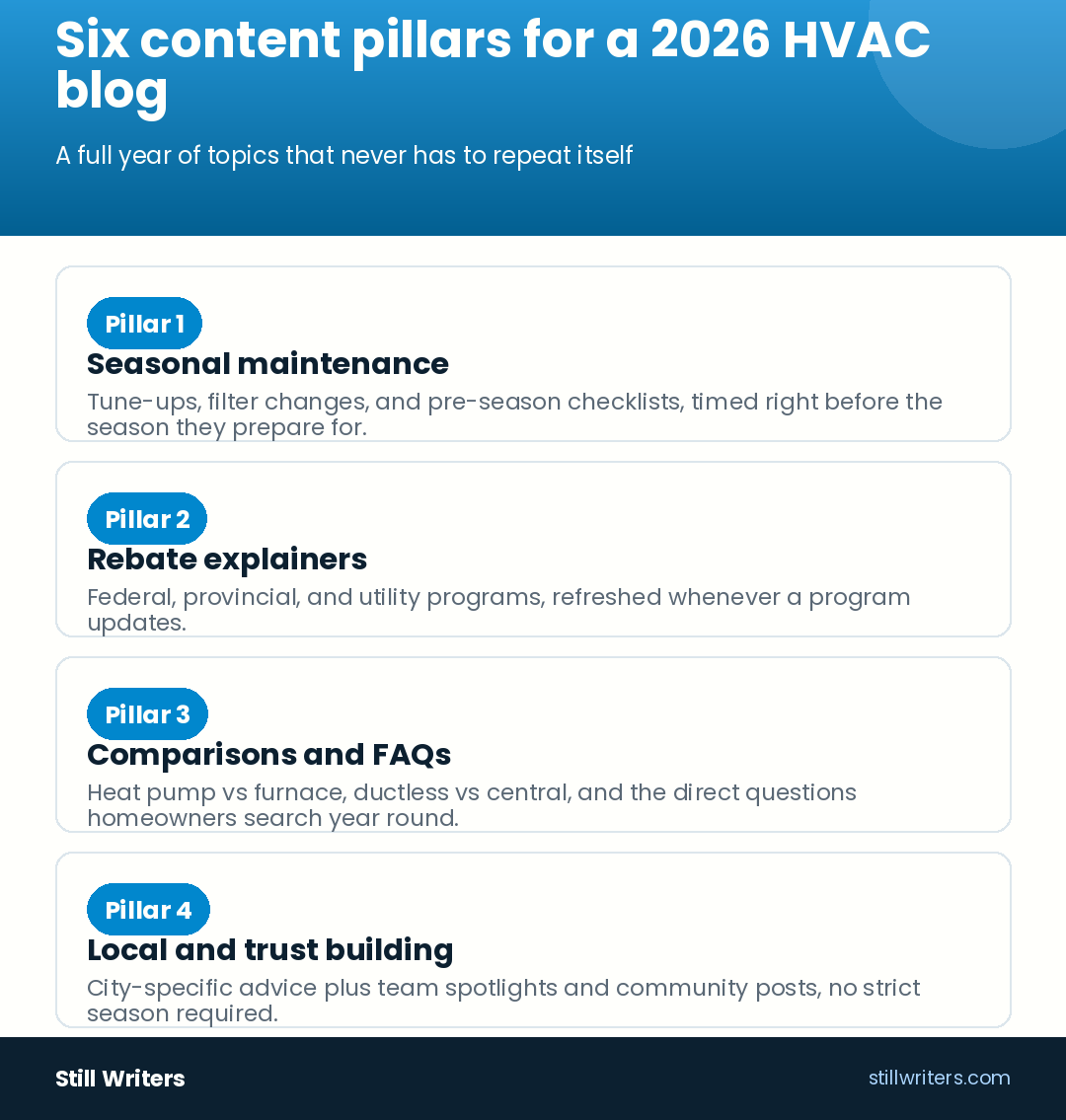
Every topic idea in this article falls into one of six buckets. Once you know the buckets, you can keep generating fresh topics for years without repeating yourself.
| Content pillar | What it covers | When it works best |
|---|---|---|
| Seasonal maintenance | Tune-ups, filter changes, pre-season checklists | Right before the season it prepares for |
| Rebate explainers | Federal, provincial, and utility rebate programs | Whenever a program updates, or a season starts |
| Comparisons | Heat pump vs furnace, ductless vs central, repair vs replace | Anytime, mostly evergreen traffic |
| FAQ posts | Direct answers to common customer questions | Anytime, steady search volume |
| Local and regional | City specific advice, climate quirks, local rebates | Ongoing, one city or region at a time |
| Trust building | Team spotlights, behind the scenes, community involvement | Monthly or quarterly, no seasonal tie |
If you already have a broader marketing plan and just need to know where a content calendar fits inside it, our guide on how to build an HVAC marketing plan covers the structure and the tracking. This article sticks to the topics themselves, month by month, so you can start writing today instead of planning around it.
What should you publish from January through March?
Winter is when most Canadian homeowners think about their furnace for the first time all year, usually because it just stopped working. Close to 274,000 heat pump installations across the country have been funded through federal rebate programs, and cold climate units built for extreme temperatures made up most of those. That means the heat pump versus furnace question is no longer a coastal conversation. Homeowners in Calgary and other Prairie cities are asking it too, especially right after a cold snap makes the evening news.
Winter and early spring topic ideas
- Furnace troubleshooting: a post titled “why won’t my furnace turn on” that walks a homeowner through the checks to try before calling for emergency service.
- Cold climate heat pump comparison: explain how a modern heat pump performs against a gas furnace once temperatures drop below minus twenty, with real numbers if you have them.
- Rebate explainer: break down which federal and provincial rebates apply to a furnace or heat pump replacement this winter, and how much paperwork is actually involved.
- Emergency call FAQ: answer the five questions your dispatcher hears most during a cold snap, including how fast a technician can actually get there.
- Team spotlight: introduce the technician who takes the after hours emergency calls, and describe what a typical January night looks like for them.
- Filter and maintenance reminder: a short, practical post on how often to change a filter during peak heating season and why it affects your bill.
What works from April through June?
Spring is the quiet season for a lot of Canadian HVAC companies, and it’s exactly when a content calendar earns its keep. Our article on why HVAC lead generation dries up every shoulder season digs into why the phone goes quiet this time of year. These topics keep your blog, and your rankings, active while call volume catches back up.
- AC pre-season checklist: give homeowners a simple checklist for running their air conditioner for the first time each spring, before the real heat arrives.
- Heat pump installation guide: explain what a heat pump install actually involves, from the site visit to the final inspection, for a homeowner in Vancouver or anywhere layering CleanBC rebates onto federal ones.
- Duct cleaning FAQ: answer if duct cleaning is worth the cost and how often it’s actually needed, since this question gets searched constantly and rarely gets a straight answer.
- Repair or replace comparison: help a homeowner decide if an aging system is worth repairing again or replacing this spring.
- Behind the scenes post: show what a typical spring install day looks like for your crew, from truck loadout to final cleanup.
- Local rebate roundup: list every provincial and utility rebate active in your service area this spring, and update the post every year instead of writing a new one.
What fills the calendar from July through December?
The back half of the year covers three different jobs at once. Summer months bring cooling questions, fall brings pre-season heating prep, and the last quarter brings rebate program updates as budgets reset. A big, competitive market like the GTA needs a steady stream of comparison and FAQ content just to hold rank against dozens of other contractors, while a smaller Atlantic Canada market can win with far less volume if the content actually speaks to local conditions.
Summer topics (July to September)
- AC troubleshooting during a heat wave: cover the most common reasons an air conditioner stops cooling properly on the hottest day of the year.
- Ductless mini split comparison: explain when a ductless system makes more sense than a central air retrofit, especially for older homes without existing ductwork.
- Noise and permit FAQ: answer the questions homeowners ask about outdoor unit noise limits and permits before they commit to an install.
- Customer story: profile a real install, with the homeowner’s permission, focused on what almost went wrong and how your team handled it.
Fall and early winter topics (October to December)
- Heating tune-up reminder: push a pre-season maintenance post before the first real cold snap, timed to beat the rush your competitors will also be chasing.
- Rebate program updates: republish your rebate explainer with the new year’s numbers, since programs shift and homeowners search for current figures, not last year’s.
- Bilingual content note: if you serve Quebec, this is the season to check that your rebate and maintenance posts exist in proper French, not a rushed translation. Our piece on if Quebec needs a different marketing approach covers what that actually requires.
- Oil to heat pump conversion story: for Atlantic Canada, a post walking through what it looks like to switch a home off oil heat resonates in a way generic content never will.
- Community involvement post: recap a local sponsorship, food drive, or charity event your company took part in that quarter.
How do you avoid running out of ideas after month three?
- Match topics to your service mix: don’t write ten posts about ductless systems if you rarely install them, prioritize what actually pays your bills.
- Audit before you plan: check your current blog before adding new posts, so you don’t publish the same maintenance checklist twice under a different title.
- Assign a realistic frequency: one solid post every two weeks beats four rushed posts that never get proofread properly.
- Decide who’s actually writing: a full time technician rarely has spare hours to write consistently, so know your options before committing to a monthly schedule. Our breakdown of what HVAC content writing actually costs in Canada is a good place to start if outsourcing is on the table.
- Review results quarterly: pull your top performing posts every three months and build follow up topics from what already works.
A calendar full of good ideas still needs someone to execute it every single week, which is where most owners lose momentum by February. If you’d rather hand the writing off, our content and SEO services are built specifically for HVAC companies across Canada, and you can contact us to talk through which of these topics would move the needle fastest for your business.
Frequently asked questions about HVAC blog content ideas
How many blog posts should an HVAC company publish each month? Two to four well researched posts per month is a realistic target for most small and mid sized Canadian HVAC companies. Consistency matters more than volume, so a company that reliably publishes twice a month will usually outrank one that posts eight times and then goes quiet for three months.
Do I need to cover every rebate program in my province? No, you only need to cover the programs your actual customers ask about most. Start with federal programs plus your one or two biggest provincial or utility rebates, then expand once those posts are ranking and bringing in calls.
Can the same blog topic work in more than one Canadian region? Yes, most of the topics in this article work anywhere in Canada, you just need to adjust the details. A heat pump versus furnace comparison for Calgary should mention extreme cold performance, while the same comparison for Vancouver can focus more on rebate stacking and milder winters.
What if I don’t have time to write these posts myself? Most contractors don’t, which is normal given how busy a service business gets. You can outsource the writing to a specialist familiar with HVAC, keep the technical review in house, and still publish consistently without pulling technicians off the truck.
Does Quebec need different blog content than the rest of Canada? Quebec needs original French language content for a meaningful share of homeowners, rather than a translated afterthought. If you serve Quebec, budget for genuine French content alongside English, since a literal translation often misses the local phrasing homeowners actually search for.
Turn these HVAC marketing tips into your 2026 calendar
You came here because a blank content calendar is worse than no calendar at all, and guessing at topics every single week burns time you don’t have.
Here’s a quick recap of what this article covered:
- Six pillars: seasonal maintenance, rebate explainers, comparisons, FAQs, local topics, and trust building posts cover any month of the year.
- Winter topics: lean into emergency troubleshooting, cold climate heat pump comparisons, and rebate explainers.
- Shoulder season topics: keep your blog active with checklists, install guides, and behind the scenes posts while the phone is quieter.
- Summer and fall topics: mix AC troubleshooting, pre-season tune-up reminders, and regional rebate updates.
- Regional adaptation: matters more than inventing new ideas, since the same topic can serve Calgary, Vancouver, the GTA, Quebec, and Atlantic Canada with small adjustments.
We’ve been writing for HVAC companies long enough to know a content calendar only works if someone actually keeps it running past February, and that’s usually where owners need the most help. Our team has sat in enough truck cabs and dispatch offices across Canada to know which topics turn into phone calls and which ones just sit there collecting dust. We’d genuinely like to hear what’s slowing your content down, so click below and talk it through with a real person on our team.
What should you read next?
If you want to keep learning before you pick up the phone, here are three places to start.
- The best HVAC marketing ideas Canadian contractors are actually using in 2026: a broader look at marketing tactics beyond blog content, useful once your calendar is running.
- Google Business Profile for HVAC companies: an honest review: pairs well with trust building blog posts, since reviews and local search work together.
- Why generic marketing agencies fail Canadian HVAC contractors: a good read if you’re weighing if you should hand this calendar to an agency at all.
If you’re not ready to talk to us yet, these three resources are a solid place to keep learning.