
Key takeaways
- Google Business Profile is genuinely strong at first impressions, since photos, reviews, and hours are what a homeowner checks before they ever open your website.
- The Q&A section is the platform’s biggest blind spot, most HVAC owners never check it, and a competitor or a random stranger can answer a question about your business before you do.
- Messaging and service area targeting are the two most underused tools, and both sit unused on a huge share of Canadian HVAC profiles while calls and leads slip past them.
It’s 9 pm on a Tuesday in Mississauga and a furnace just died. The homeowner does not pull out a phone book. They open Google, type “furnace repair near me,” and pick from whatever shows up in the map pack. That single moment is why 73% of Canadian shoppers Google a business before they call it. Google Business Profile is the free listing sitting behind that decision, and if you’re collecting HVAC marketing tips that don’t cost anything to start, this is usually the first one anyone hands you. What almost nobody tells you is what the tool is actually like to run week to week, where it earns its reputation, and where it quietly lets good leads walk to a competitor instead.
Still Writers didn’t start out as a marketing company. Our roots are in construction, and that background shapes how we look at a tool like Google Business Profile. We’ve spent real time around HVAC crews in Ontario and British Columbia, not stuck staring at dashboards, and we’ve watched contractors run this platform well and watched others let it sit untouched for months. Plenty of agencies can get your listing set up and verified. What we bring to this review is knowing which parts of the platform actually change a homeowner’s mind when they’re comparing three companies at 9 pm on a Tuesday.
What does Google Business Profile actually do for an HVAC company?
Google Business Profile, often still called GBP or by its old name Google My Business, is the free listing that shows up when someone searches your business name or a local service term like “AC repair Burnaby.” It’s the panel on the right side of a Google search, the pin on Google Maps, and the three listings in the local map pack above the organic results. For an HVAC company, it’s often the very first thing a homeowner sees about you, before your website, before a review site, before anything else.
That first impression matters more for HVAC than for a lot of other trades. A homeowner calling about a broken air conditioner in July isn’t browsing. They’re comparing two or three companies fast, and they’re making a judgment call in under a minute based on your photos, your star rating, your hours, and how recently you’ve posted anything. This review isn’t going to walk through how GBP affects your map pack ranking or your local SEO. Our article on why Canadian HVAC companies struggle to rank on Google already covers that ground, and our guide to HVAC SEO strategies treats GBP completeness as one signal among several. Here, we’re judging the tool itself. What’s it actually like to use, feature by feature, if you run an HVAC company in Canada?
Who this review is for
This is written for the owner or office manager who already has a profile claimed and verified and wants an honest read on the real value they’re getting out of it, not a setup tutorial. If you haven’t claimed your profile yet, that’s step one before any of this applies, and it’s worth doing today rather than putting it off.
How good is Google Business Profile’s actual toolkit?
Break GBP into its individual features and the picture gets more interesting than “it’s free, so use it.” Some parts genuinely earn their keep for an HVAC business. Others are half built for a trade like heating and cooling, where the difference between an emergency call and a routine maintenance visit matters a lot to the person searching.
Photos and posts
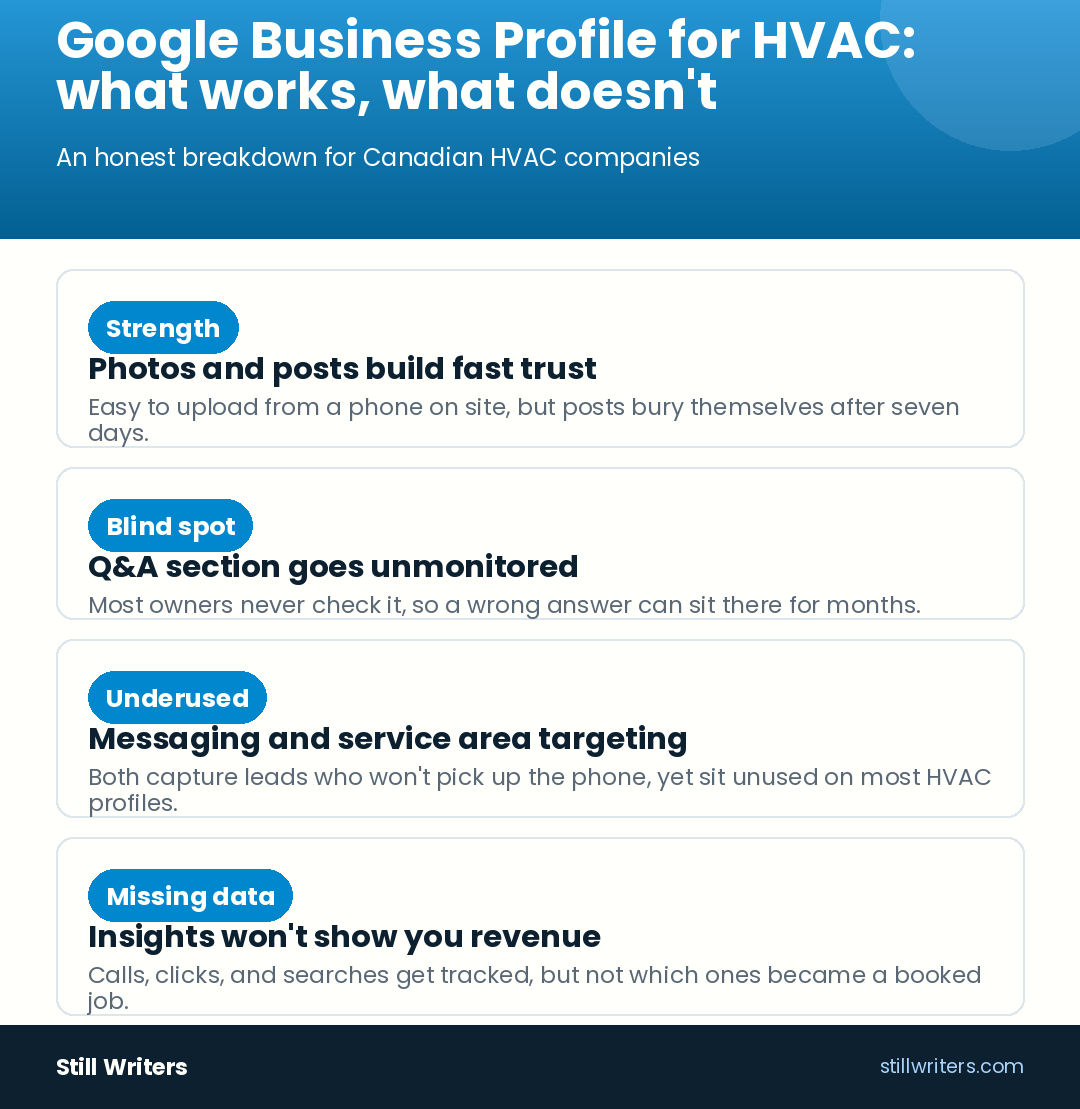
Photos are the strongest part of the whole platform for HVAC. A profile with real job photos, a technician in a branded uniform, a clean truck, before and after shots of an install, does more to build trust in ten seconds than a paragraph of text ever could. Homeowners in the GTA and the Lower Mainland are both used to scrolling through listings quickly, and a profile full of stock-looking icons or nothing at all reads as a red flag. The posts feature, which lets you publish short updates like seasonal offers or maintenance reminders, works fine but gets ignored by most contractors after the first month. That’s a shame, since a Post about a spring AC tune-up special published right before a heat wave in Vancouver actually shows up in front of people actively deciding who to call.
Categories and service area targeting
Categories are where GBP starts showing its age for a trade this specific. You can pick a primary category like “HVAC contractor” and a handful of secondary ones, but the options don’t let you separate “24 hour emergency furnace repair” from “annual maintenance plans” in any way a homeowner searching at midnight would actually notice. Service area targeting, where you define which cities and neighbourhoods you cover instead of showing a fixed storefront address, works reasonably well for HVAC companies that don’t have walk-in customers. A company based in Surrey that also services Burnaby, Richmond, and parts of Vancouver can set that up in a few minutes. The problem is almost nobody revisits it. Crews expand into new areas, or drop a zone that’s become too far to service profitably, and the profile never gets updated to match.
| Feature | What it does well | Where it falls short |
|---|---|---|
| Photos | Builds trust fast, easy to upload from a phone on site | No prompts or reminders to keep them current |
| Posts | Free way to promote seasonal offers to active searchers | Buried after seven days, most owners stop posting after month one |
| Categories | Simple to set, helps Google understand your trade | No way to flag emergency versus maintenance service |
| Service area targeting | Good fit for HVAC companies without a storefront | Rarely updated as a crew’s coverage area changes |
| Q&A | Lets homeowners get quick answers before calling | Owners rarely monitor it, so wrong answers can sit for months |
| Messaging | Captures leads who won’t pick up the phone | Turned off or ignored on a large share of HVAC profiles |
| Insights | Shows calls, direction requests, and website clicks | Never tells you which of those turned into a booked job |
That table alone should tell you something. Google Business Profile isn’t a single tool with one rating. It’s seven or eight smaller tools bolted together, and an HVAC company that leans into three of them while ignoring the rest is leaving real value on the table. Compare that to how HomeStars and TrustedPros handle the same trust-building job, and you start to see where GBP genuinely wins and where it doesn’t.
Where HVAC companies quietly waste Google Business Profile
None of these mistakes are dramatic. They’re small habits that add up over a year, and they show up again and again when we look at a new HVAC client’s profile for the first time, from a two-truck company in Kelowna to a twenty-tech operation in the GTA.
- Ignoring the Q&A section: anyone can post a question on your profile, and anyone can answer it, including someone who has never used your services. We’ve seen a competitor’s crew member answer a question about pricing on a rival’s profile with numbers that were flat wrong, and the owner didn’t notice for weeks.
- Leaving categories stale: a company that added heat pump installation two years ago but never updated its secondary categories is invisible to homeowners specifically searching for that service, even with a strong overall profile.
- Treating emergency and maintenance service as the same thing: GBP gives you no clean way to separate a 2 am no-heat emergency from a scheduled spring tune-up, which means the burden falls on your photos, posts, and business description to make that distinction clear.
- Never turning on messaging: a real share of homeowners, especially younger ones, would rather text a question than call. If messaging is off or unanswered for hours, that lead often goes to the next listing down.
- Uploading photos once and never again: a profile with five photos from your launch year and nothing since looks stale next to a competitor posting fresh job photos every month.
What does Google Business Profile’s insights and analytics tab actually tell you?
The Insights tab is where GBP tries to earn its place as a real business tool, more than a plain listing. It shows you how many people called your number directly from the profile, how many asked for directions, how many clicked through to your website, and what search terms people used to find you. For a small HVAC company without a dedicated analytics setup, that’s genuinely useful information handed to you for free.
What the numbers can and can’t tell you
Here’s the honest limitation. Insights tells you activity happened. It never tells you what that activity turned into. A call from your profile might be a homeowner booking a $400 furnace repair, or it might be a wrong number, a telemarketer, or someone comparing prices who hung up after ten seconds. GBP can’t tell those apart, and neither can you unless you’re tracking calls separately through your own phone system or CRM. The annual Local Search Ranking Factors report from Whitespark, an Edmonton-based authority on this exact space, backs up what most contractors learn the hard way: profile activity and revenue are related, but they’re not the same number, and treating them as interchangeable leads to bad decisions about where to spend.
| What Insights shows you | What it does not show you |
|---|---|
| Number of calls placed from your profile | If the call turned into a booked job |
| Direction requests to your service area | Which neighbourhood actually converted best |
| Website clicks from the profile | What happened once someone reached the site |
| Search terms people used to find you | Revenue attached to any of those searches |
A two-truck company in Kamloops we spoke with once assumed their profile was dead weight because call volume looked flat month over month. Once they started tagging calls by source in their booking software, they found the profile was quietly driving their highest-value emergency calls, just fewer of them than routine maintenance leads coming from other channels. The lesson isn’t that Insights is useless. It’s that Insights alone can’t tell you the full story, and you need something on your end to close the loop.
How do you know if your Google Business Profile is actually working for you?
Run through this checklist honestly. If you’re missing more than two or three of these, the profile is probably underperforming for reasons that have nothing to do with your rankings.
- Photos updated in the last 90 days: if your most recent upload predates last winter, it’s time.
- Messaging turned on and answered within a couple hours: a delayed reply is often as bad as no reply at all.
- Q&A checked at least monthly: set a calendar reminder if you have to.
- Categories reviewed twice a year: especially after adding a new service like heat pumps or ductless mini splits.
- Service area matches your real coverage: not what it was three years ago.
- Business description mentions emergency availability if you offer it: since categories won’t do that job for you.
If working through that list feels like more than your office has time for, that’s a normal thing to hand off. Our services cover exactly this kind of ongoing profile management alongside the rest of your marketing, and our pricing page lays out what that actually costs. If you’d rather just ask someone directly, our contact page is the fastest way to get a real answer instead of guessing.
Frequently asked questions about Google Business Profile for HVAC companies
Is Google Business Profile worth the time for a small HVAC company? Yes, mostly because it’s free and it’s often the first thing a homeowner sees about you. The time cost is small compared to the trust it builds, if you actually keep it updated instead of setting it up once and forgetting it.
How often should an HVAC company post updates on Google Business Profile? Aim for at least twice a month, more during peak season like a summer heat wave in the Lower Mainland or a cold snap in the GTA. Seasonal offers and maintenance reminders tend to perform better than generic company news.
Can a competitor really answer questions on my Google Business Profile? Yes. The Q&A section is open to anyone with a Google account, including people who have never used your services. That’s why checking it regularly matters more than most owners assume.
Does Google Business Profile replace the need for a website? No. It’s a strong first impression, but a homeowner who’s seriously comparing companies will usually click through to your site before booking. If your site isn’t converting once they get there, our article on why your HVAC website gets clicks but not calls is worth reading next.
Is messaging on Google Business Profile actually used by homeowners? More than most HVAC owners expect, especially with younger homeowners who’d rather send a quick message than sit on hold. Leaving it off or unanswered means missing that group entirely.
Where Google Business Profile fits your HVAC marketing tips
You came into this looking for an honest read on a tool you’ve probably already claimed and mostly ignored since. The short version is that Google Business Profile earns its reputation in some areas and completely misses the mark in others.
Here’s the recap:
- Photos and posts genuinely build trust fast, when kept current.
- Categories and service area targeting need regular upkeep, not a one-time setup.
- The Q&A section is a blind spot most owners never check, and that’s a real risk.
- Messaging captures leads that a missed call would lose entirely.
- Insights shows activity, not revenue, so pair it with your own call tracking.
We’ve built our approach around one idea: the tools that matter most for HVAC companies are usually the ones getting the least attention, not the flashiest new platform. We’ve taken companies from a handful of weekly site visits to hundreds within months by fixing exactly this kind of neglected basics, across markets in both the U.S. and Canada. That work isn’t glamorous, and plenty of HVAC owners could do a version of it themselves with enough time. If you’d rather have someone who does this daily take it off your plate, we’d genuinely like to talk with you about it.
What should you read next?
If you want to keep learning before you pick up the phone, here are three places to start.
- HVAC lead generation tools reviewed: what’s worth using in 2026: a wider look at the other platforms and tools competing for your leads alongside Google Business Profile.
- Best HVAC SEO strategies for Canadian contractors in 2026: covers how GBP completeness fits into your broader ranking strategy, which this review deliberately left aside.
- Best HVAC marketing services in Vancouver (and what to expect elsewhere): useful if you’re deciding between managing your profile yourself or bringing in help.
If you’re not ready to talk to us yet, those three articles are a solid place to keep learning.