
Key takeaways
- Clicks and calls are different problems. Your Google Business Profile can already be working while your website quietly turns people away.
- Trust and speed decide the call, not more traffic. A slow homepage or a missing license badge costs you the lead before a visitor even scrolls.
- Small, specific fixes convert better than a full redesign. A visible phone number, a clear service area, and real job photos often move the needle faster than a new site.
Your phone should be ringing more than it is. Seventy three percent of Canadian shoppers Google a business before they call or walk in, and if your HVAC company already shows up in those searches, you have already won half the fight. The problem shows up after that. A visitor lands on your homepage, looks around for ten seconds, and leaves without calling. That gap between traffic and phone calls is what most hvac contractor marketing advice skips over. Everyone talks about getting found. Almost nobody talks about what happens after someone actually lands on your page, and that second half is where most of the lost jobs are hiding.
At Still Writers, we have worked with contractors from Nova Scotia to British Columbia, plus a long list of trades companies across the U.S., and one pattern keeps repeating. A good marketing partner can learn the language of any trade fast, from furnace tonnage to gas fitter certification, and that grasp is what separates useful website copy from generic filler. Plenty of agencies do solid work in this space, and we are not the only shop that gets this right. What we have found, again and again, is that the sites converting best treat the homepage like a first phone call, not a brochure.
How HVAC contractor marketing loses homeowners after the click
You probably already know your Google Business Profile shows up for searches like “furnace repair Calgary” or “AC installation Edmonton.” Whitespark’s Local Search Ranking Factors report, published by the Edmonton based company that tracks what actually moves local map pack rankings, points to reviews and proximity as the biggest levers. If you already appear there, the visibility problem is mostly solved.
The conversion problem is different, and it lives entirely on your website. It plays out in the ten to fifteen seconds after someone clicks through. A homeowner in Red Deer with a dead furnace in January is not browsing. They are scanning for three things fast: a phone number, proof you are legitimate, and proof you cover their address. If any of those three things take more than a glance to find, they hit the back button and call the next name on the list.
This has nothing to do with your ranking. Plenty of companies rank fine and still lose the call. HVAC contractor marketing usually gets measured by traffic and rankings, but neither one puts money in your account. Booked jobs do, and booked jobs come from what happens on the page itself.
The ten second test
Open your own website on your phone and give yourself ten seconds. Can you find a phone number without scrolling? Can you tell if you serve Airdrie or Lethbridge, instead of only the city in your address? Can you tell this company is licensed and insured before you scroll past the first screen?
Most HVAC sites fail at least one of those checks. That is not a ranking problem, and no amount of extra content fixes it on its own. A better set of website fundamentals closes that gap faster than another six months of link building ever will.
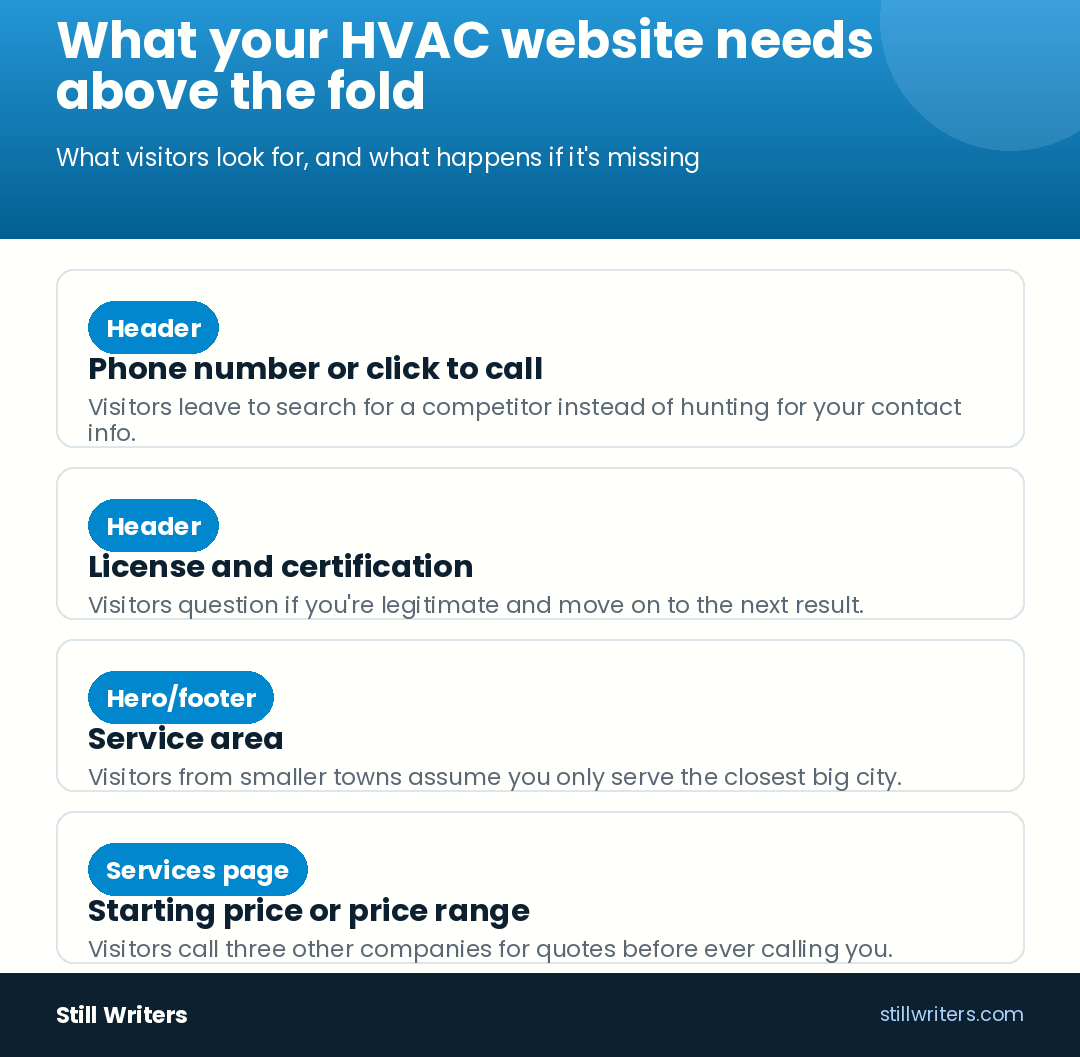
Contractors in Calgary and Edmonton compete against a dozen other companies for the exact same search terms. The table below shows what homeowners scan for first, and what a missing element usually costs you.
| What visitors look for | Where it usually lives | What happens if it’s missing |
|---|---|---|
| Phone number or click to call button | Header, above the fold | Visitors leave to search for a competitor instead of hunting for your contact info. |
| License and certification (HRAI, gas fitter ticket) | Header or hero section | Visitors question if you’re legitimate and move on to the next result. |
| Service area | Hero section or footer | Visitors from smaller towns assume you only serve the closest big city and skip your form. |
| Starting price or price range | Services page or quote form | Visitors call three other companies for quotes before ever calling you. |
| Real job photos and reviews | Homepage, above the fold | Visitors see stock photography and assume you’re new, small, or hiding something. |
Companies serving Calgary or Edmonton often assume their market is too competitive to fix with small changes. In practice, the contractors who move a phone number into the header and add a real license badge tend to see calls climb within weeks, with no new content required.
Why do visitors bounce before they ever call?
Speed is the first filter. Google’s own research shows that the chance of a mobile visitor leaving jumps 123 percent as a page’s load time goes from one second to ten. Plenty of HVAC websites still run heavy image sliders, autoplay video backgrounds, and huge unoptimized photos that push load time well past a couple of seconds. A homeowner standing in a cold basement does not wait around for a homepage to finish loading.
Trust is the second filter. Fifty three percent of Canadians say a website makes a business look more credible, and that cuts both ways. A slow, generic, or outdated site can make an established company look shaky, even if the crew behind it has done great work for fifteen years. A sharp, fast, honest site does the opposite work for a company that is only a year or two old.
Above the fold decides the call
Above the fold means what a visitor sees before they scroll, and on a phone that is a small amount of space. If your license number, your reviews, and your phone number all live near the bottom of the page, most visitors never see them. People decide if you look legitimate within the first glance, and a stock photo of a smiling actor in a hard hat does not help that decision. Real photos of your own crew on a real job in Red Deer or Medicine Hat tell a homeowner more in two seconds than a full paragraph of copy ever could.
What actually needs to change on your homepage
- Phone number placement: Put it in the header, in a large font, with a working click to call link on mobile.
- Trust badges above the fold: Show your HRAI membership, your gas fitter license number, and your review score before anyone has to scroll.
- Clear service area: List the specific towns and cities you cover, instead of only the city listed in your address.
- Straightforward pricing: Give a starting price or a typical range for common jobs like furnace replacement or AC installation.
- A simple booking path: Offer one clear way to request a quote, instead of three competing forms and a maze of menus.
- Real job photos: Replace stock photography with pictures from actual installs, even if they were taken on a phone.
If you want a model for what transparent pricing looks like, our own pricing page lays out ranges instead of hiding behind a quote form. Homeowners notice that kind of openness, and it tends to earn a call instead of a bounce.
How does this play out for real Alberta contractors?
Picture two furnace companies, both ranking on page one for “furnace repair Calgary.” The first has a homepage with a rotating banner, no visible phone number, and a contact form buried in the footer. The second has a phone number in the header, a badge showing HRAI membership, and three photos from yesterday’s install in Airdrie. Given the same amount of traffic, the second site turns more visitors into calls. Nothing about their Google ranking explains that difference. It comes down to what the visitor sees in the first few seconds.
The same pattern holds outside Alberta. A company in Vancouver, competing in one of Canada’s most saturated HVAC markets, faces the exact same fork. Homeowners searching for a heat pump installer see a dozen similar looking sites in one search. The one that answers “can I trust you” and “do you serve my street” the fastest gets the call, regardless of which province it happens in.
Why a full redesign is not always the answer
A full website rebuild sounds like the obvious fix, and sometimes it genuinely is. Most of the time, the actual problem is smaller and cheaper to fix. Moving a phone number higher on the page, adding a license number to the header, and swapping in three real photos for stock ones can lift call volume within a month. Save the full rebuild for when your site’s structure itself is broken. Do not reach for one just because the site is underselling work you already do well.
A quick checklist before you spend another dollar on traffic
- Phone number: Visible in the header on both desktop and mobile, with a working click to call link.
- Licensing proof: Your HRAI membership and gas fitter license number appear above the fold.
- Service area: A specific list of the cities and towns you serve, updated if you have expanded.
- Reviews: Recent reviews or a review score visible near the top of the homepage.
- Pricing clarity: A price range or starting cost for your most requested services.
- Booking path: One clear quote request form, tested on a real phone instead of only a desktop screen.
- Real photos: Actual job photos in place of stock imagery on your homepage.
If you want a second opinion on your homepage before you touch anything else, our team can walk through it with you. Our lead generation guide covers how conversion fits into the bigger strategy, and you can always reach out through our contact page if you want a second set of eyes on what is holding your site back.
Frequently asked questions about hvac contractor marketing
Why is my HVAC website not converting even if it ranks well? Ranking well means Google trusts your site enough to show it to searchers. Converting well means a visitor trusts you enough to pick up the phone. Those are different jobs, and a site can win one without winning the other. If your click to call button, license info, and pricing are hard to find, expect fewer calls even with strong rankings.
What is a click to call button and why does my HVAC site need one? A click to call button lets a mobile visitor tap your phone number and start a call immediately, without dialing it manually. Most HVAC searches happen on a phone, often from someone standing next to a broken furnace or a dead AC unit. Removing that extra step can measurably increase how many visitors actually call.
Should I show my prices on my HVAC website? You do not need an exact quote, but a starting price or a typical range helps visitors decide if you are a fit before they call three other companies. Homeowners in Calgary and Edmonton routinely compare several contractors before choosing one, and a company that hides pricing can look like it has something to hide.
Do I need real job photos instead of stock photography? Yes. Stock photos of actors in hard hats are easy to spot, and they quietly signal that a company is either new or does not want to show its actual work. Real photos of your crew on a real job, even taken on a phone, build more trust in a few seconds than paragraphs of copy manage in a full scroll.
What trust signals matter most for Canadian HVAC companies? Your HRAI membership, your gas fitter license number, and recent customer reviews matter most. These need to sit above the fold on your homepage, not buried on an about page three clicks deep. A clear service area listing the specific cities and towns you cover also matters, since many visitors will not call if they are not sure you serve their address.
Make your HVAC contractor marketing convert to calls
You came here because your website gets attention and the phone still is not ringing enough. That gap is fixable, and it rarely needs a full rebuild to close.
- Visibility and conversion are two separate problems, and fixing one does not fix the other.
- Slow load times and hidden phone numbers cost you calls before a visitor even reads your copy.
- Trust signals like your HRAI membership, license number, and reviews need to sit above the fold.
- A clear service area and simple pricing information stop visitors from guessing and moving on.
- Real job photos build more trust in two seconds than a paragraph of stock copy ever will.
We have spent years building websites and content for HVAC companies ranging from small two truck operations to multi crew shops, and the ones that convert best treat every page like a conversation with a nervous homeowner, not a portfolio piece. We will not pretend every agency gets this right on the first try, including us with our very first HVAC client. What we can tell you is that the fix is usually smaller and cheaper than you expect. If you want a straight answer about what is holding your site back, click below and talk to a marketing expert.
What should you read next?
If you want to keep learning before you pick up the phone, here are three places to start.
- Why do Canadian HVAC companies struggle to rank on Google?: Read this one if you are not confident your site shows up in searches yet, since that is a separate problem from the conversion issues covered here.
- The best HVAC marketing ideas Canadian contractors are actually using in 2026: A broader look at the tactics contractors are using to grow beyond just fixing their homepage.
- What is HVAC digital marketing, and does your company actually need it?: A good starting point if you are still deciding how much to invest in marketing at all.
If you are not ready to talk to us yet, these three resources are a solid place to keep learning first.