

Key takeaways
- HVAC keyword research needs two separate lists, one for informational searches like “why is my furnace short cycling” and one for transactional searches like “furnace repair Kelowna,” and most contractor sites only build for the second.
- Technical problems quietly cap good content, so a slow page or a missing schema tag can hold back a site that already has strong writing on it.
- The map pack runs on different signals than the regular organic results, and platforms like HomeStars and TrustedPros feed both if you set them up right.
Type “why is my furnace making a clicking noise” into Google right now and there’s a decent chance you won’t click a single result. Google’s AI Overview now sits at the top of roughly 58% of search results pages, and organic clicks can drop as much as 61% when one shows up. If your HVAC SEO marketing plan only chases traffic on broad informational terms, you’re building a house on ground that’s already shifting. The homeowners still clicking through to a website are the ones close to picking up the phone, and if your site isn’t built to catch them at that exact moment, a competitor down the street will. This article skips the general marketing advice and gets into the actual SEO mechanics, keyword strategy, technical fixes, content structure, and local ranking factors, that decide if you show up at all.
We’ve spent years writing for HVAC companies specifically, from small two truck operations to multi crew companies running across several provinces. That focus matters more than it sounds like it should. HVAC has its own vocabulary, its own buying cycles, and its own certifications, like HRAI training, that a generalist copywriter or a general SEO tool won’t flag. We’ve worked with contractors from British Columbia to Alberta and plenty of markets south of the border too, and we’re not the only shop that does this work well. What we bring is a habit of learning a trade fast enough to write pages that actually match how a real HVAC customer searches, not how a template assumes they search.
How do you build a keyword list for HVAC SEO marketing that actually converts?
Most HVAC websites are built around one kind of keyword: the transactional kind. Things like “furnace repair” or “AC installation near me.” Those matter, but they’re only half the picture. A real keyword strategy splits your terms into buckets based on what the searcher actually wants, then builds a different type of page for each bucket.
Informational keywords come from someone trying to understand a problem before they’ve decided to call anyone. Things like “why does my heat pump freeze up in winter” or “is a heat pump worth it in a cold climate.” These searches don’t want a phone number. They want an answer, and a blog post that gives a clear, honest one earns trust before the sale even starts. Transactional keywords come from someone ready to book. “Emergency furnace repair” and “heat pump installation Kelowna” belong on service pages built to convert, not on blog posts.
Where provincial rebate programs create keyword gaps
Rebate keywords sit in their own category, and most HVAC company sites ignore them completely. Homeowners search things like “CleanBC heat pump rebate 2026” or “Alberta furnace rebate” because rebate rules change often and government pages are dense and hard to read. Federal programs under the Canada Greener Homes Initiative stack on top of provincial ones, so a homeowner in Edmonton and a homeowner near Victoria are searching for two different sets of terms even though they want the same result: a lower bill on a new system.
A dedicated, plain language page that explains a specific rebate, who qualifies, and what it’s worth, ranks faster than almost anything else you can write. It targets a real, specific search with almost no competition from other HVAC contractors, since most of them never bother writing it.
| Search intent | Example keyword | Best page type |
|---|---|---|
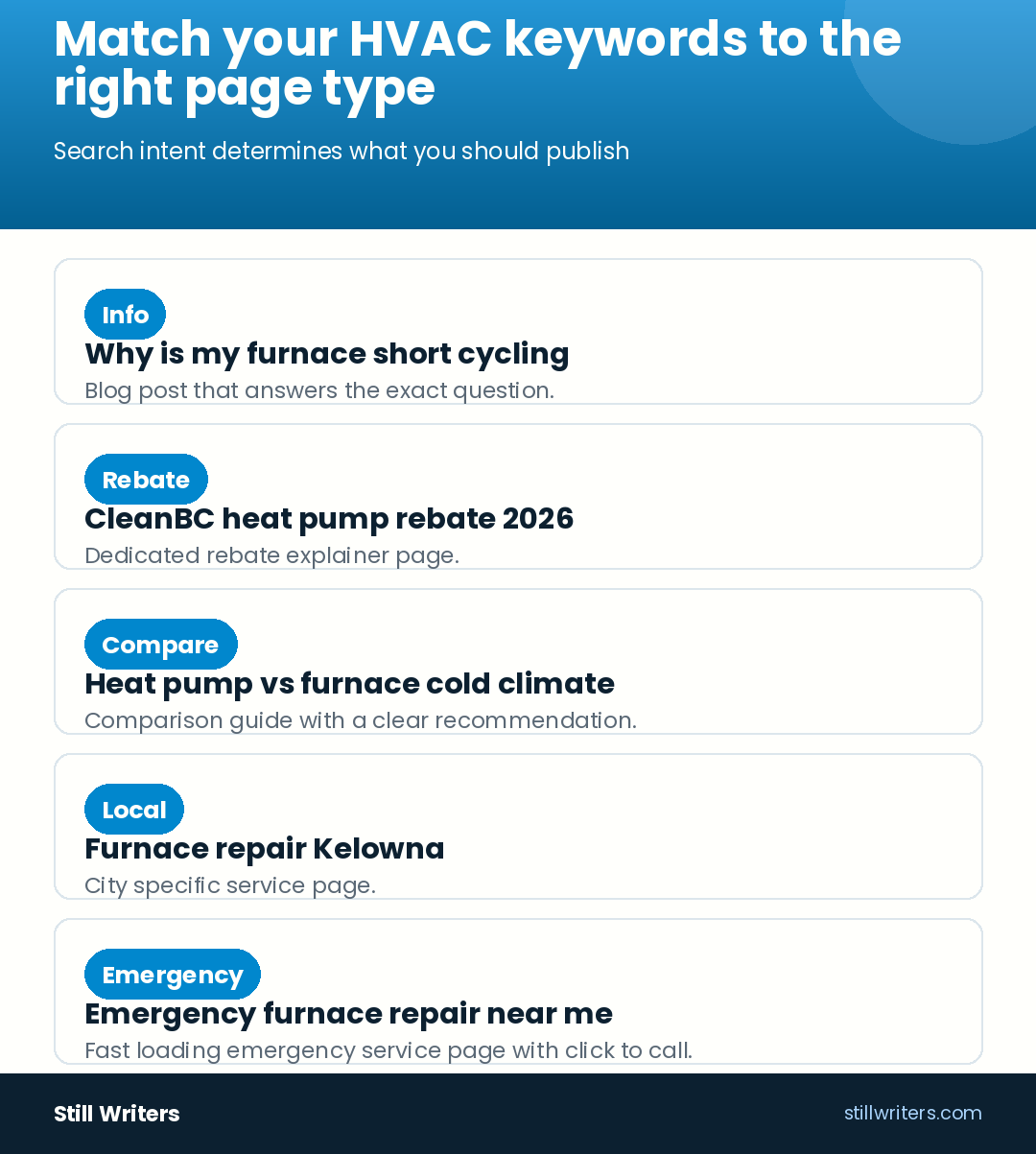
| Informational | Why is my furnace short cycling | Blog post that answers the exact question |
| Rebate informational | CleanBC heat pump rebate 2026 | Dedicated rebate explainer page |
| Commercial investigation | Heat pump vs furnace cold climate | Comparison guide with a clear recommendation |
| Local transactional | Furnace repair Kelowna | City specific service page |
| Emergency transactional | Emergency furnace repair near me | Emergency service page, fast loading, click to call |
Once you have both buckets mapped out, the next job is linking them together so Google understands how your site fits together as a whole. Our content writing services in Canada page walks through how we build that structure for HVAC clients from the ground up.
What technical SEO problems are quietly capping your rankings?
You can write the best furnace repair page in the country and still lose the ranking to a competitor with a faster, cleaner site. Technical SEO is the part of HVAC SEO marketing that never shows up on the page itself, but it decides if Google trusts your site enough to rank the content you worked hard on.
Site speed is the first place to look. Most local searches happen on a phone, often from someone standing in a cold basement staring at a dead furnace. If your page takes five seconds to load on that connection, they’ve already tapped back to Google and clicked the next result. Roughly 72% of Canadians research a purchase on Google before buying, and a slow site loses a chunk of that traffic before a single word gets read.
Mobile friendliness matters just as much. A site that looks fine on a laptop but forces someone to pinch and zoom on a phone is fighting itself. Buttons need to be big enough to tap, text needs to be readable without zooming, and your phone number needs to be one tap away, not buried in a footer.
Schema markup basics for HVAC sites
Schema markup is a bit of code that tells Google exactly what your page is about, in a format search engines read directly instead of guessing. For an HVAC company, three types matter most. LocalBusiness schema tells Google your address, hours, and service area. Service schema tells Google exactly what work you do, like furnace repair or heat pump installation. FAQ schema lets your questions and answers show up directly in the search results, sometimes above a competitor’s regular listing.
None of this is decorative. Whitespark’s Local Search Ranking Factors report, published by the Edmonton based local SEO firm, consistently points to structured, consistent business information as one of the strongest signals behind who shows up in the map pack. A site with clean schema markup gives Google fewer reasons to guess, and fewer reasons to guess means fewer reasons to rank someone else instead.
How should you structure content so it matches search intent?
Good keyword research falls apart if the page itself doesn’t match what the searcher expects to find. Structure is where a lot of HVAC sites lose people they already earned a click from.
- Answer the question in the first two sentences: a reader deciding if this is their answer shouldn’t have to scroll past three paragraphs of company history first.
- Use subheadings that describe the section, not a clever phrase: a heading like “Common causes of furnace short cycling” tells both the reader and Google exactly what’s coming.
- Break long sections into smaller pieces: a wall of text on a phone screen gets skipped, no matter how good the advice inside it is.
- Put a table or list where numbers are involved: costs, timelines, and comparisons are easier to scan as a table, and Google often pulls list and table content straight into search results.
- Keep transactional pages short and direct: someone searching “furnace repair” wants proof you do the job and a way to contact you, not a 1,500 word essay.
What actually moves the needle in the local map pack?
The map pack, the block of three local listings above the regular search results, runs on a mix of factors that don’t perfectly line up with what makes a regular web page rank. Proximity to the searcher plays a role you can’t control directly, which is exactly why service area pages matter so much. A page built specifically for a city you serve gives Google a real, relevant reason to show your business to someone searching from that area, even if your office sits a town over.
Where HomeStars and TrustedPros fit into the technical picture
Most HVAC contractors think of HomeStars and TrustedPros purely as review sites. From an SEO standpoint, they’re also citation sources. A complete, consistent profile on both platforms tells Google your business name, address, and phone number match across the web, which is a trust signal search engines weigh heavily for local rankings. A mismatched address or an old phone number sitting on one of these profiles can quietly work against you, even if your own website is technically perfect. Our article on HomeStars and TrustedPros vs. organic SEO gets into how to weigh these platforms against your website investment overall.
| Local ranking factor | What it signals to Google | Where you control it |
|---|---|---|
| Google Business Profile completeness | Category and service relevance | Your GBP dashboard |
| NAP consistency (name, address, phone) | Trust and legitimacy | Your website, HomeStars, TrustedPros, local directories |
| Proximity to the searcher | Distance relevance | Indirect, through city specific service pages |
| Review count, recency, and keywords in the text | Prominence | Your review request process |
| Citations and backlinks from local sites | Authority | HomeStars, TrustedPros, local business associations |
A company in Calgary chasing the map pack needs a different mix of these signals than a company in a smaller market like Nanaimo, where there’s simply less competition to out rank. Bigger metros need every signal firing at once. Smaller markets can often rank with a clean, consistent profile and a couple of strong service pages.
What HVAC SEO marketing mistakes quietly stall progress?
A lot of HVAC SEO work stalls, not because the strategy is wrong, but because a few common mistakes eat away at the results before they ever show up. Run through this list before you start, or before you troubleshoot a site that isn’t moving.
- One page trying to rank for everything: a homepage stuffed with every service and every city dilutes your relevance for all of them instead of ranking well for any single one.
- No internal linking strategy: pages that sit isolated, with no links pointing to or from them, tell Google they’re less important than pages woven into your site’s structure.
- Treating French content as an afterthought: if you serve any part of Quebec, a properly translated page targets real French search volume you’re currently invisible to. Think of it as a ranking opportunity first and a courtesy for existing customers second.
- Ignoring page speed after launch: a fast site at launch can slow down over a year as plugins, images, and scripts pile up, so speed needs a regular check, not a one time fix.
- Chasing rankings without matching content to intent: a page that ranks but answers the wrong question still won’t get the click, or won’t convert if it does.
If any of this sounds like where your site is stuck right now, our HVAC content and SEO services are built around fixing exactly these gaps, and a conversation through our contact page is a good place to start. If your rankings have been stuck for a while and you’re not sure why, our article on why Canadian HVAC companies struggle to rank on Google covers the deeper, structural reasons behind it.
Frequently asked questions about HVAC SEO marketing
What HVAC keywords should you target first? Start with the transactional keywords tied to your core services and your service area, like “furnace repair” plus your city name. Add rebate and comparison keywords once your core pages are solid, since those bring in searchers earlier in their decision.
Does site speed really affect your HVAC rankings? Yes. Google factors page speed directly into rankings, and a slow site also loses visitors before they read your content, which hurts your rankings indirectly too. Mobile speed matters most, since the majority of local HVAC searches happen on a phone.
What is schema markup, and does my HVAC site need it? Schema markup is code that describes your business, services, and content in a format search engines read directly. HVAC sites benefit most from LocalBusiness, Service, and FAQ schema, since these help Google match your pages to local and question based searches.
What is a content cluster, and why does it help HVAC sites rank? A content cluster is a group of related pages, usually one main page and several supporting blog posts, all linked together around one topic like heat pumps or furnace maintenance. Google reads that structure as a sign you cover the topic thoroughly, which helps every page in the cluster rank better.
Does French content actually help SEO in Quebec, or just conversions? Both. A properly translated page targets real French language search volume that an English only page never shows up for, on top of converting better with French speaking homeowners once they arrive.
Turn HVAC SEO marketing into your next signed job
You came here because generic marketing tips weren’t answering the real question: what actually makes an HVAC site rank in Canada. The tactics above are the technical and strategic pieces that sit underneath every visible marketing idea.
Here’s a quick recap of what you just read:
- Build two keyword lists, one informational and one transactional, and match page type to each.
- Provincial and federal rebate keywords are an easy, low competition win most contractors skip.
- Site speed, mobile friendliness, and schema markup decide if your good content ever gets seen.
- The map pack runs on its own mix of signals, and HomeStars and TrustedPros feed into it as citation sources as much as review platforms.
- French content in Quebec is a keyword opportunity first, a courtesy translation second.
We’ve watched this play out with real clients more than once. One Canadian HVAC company’s organic traffic climbed from a handful of visits a week to over 900 site visits within six months, once the technical fixes and the content structure both got addressed at the same time, not one without the other. That pattern holds across every market we’ve worked in, from small BC towns to bigger Alberta cities. You don’t have to guess which piece of this to fix first. Talk to a marketing expert on our team, and we’ll help you find it.
What should you read next?
If you want to keep learning before you pick up the phone, here are three places to start.
- Why do Canadian HVAC companies struggle to rank on Google?: pairs directly with this article if you want to understand the specific gaps holding a site back.
- The best HVAC marketing ideas Canadian contractors are actually using in 2026: a good next step once your SEO foundation is solid and you want to build visibility everywhere else too.
- HVAC lead generation tools reviewed: what’s worth using in 2026: useful if you want to see how SEO fits alongside other lead sources.
If you’re not ready to talk to us yet, these three articles are a solid place to keep learning.