
Key takeaways
- An HVAC marketing plan is a written document, not a mental checklist, and it lays out your goals, your target customers, your channels, and how you’ll track results.
- Most plans fail before they start, because owners skip the step where they look honestly at what’s already working and jump straight to picking new channels.
- You don’t need a 40 page document, a one or two page plan with clear goals, a simple channel mix, and a monthly tracking habit beats a binder nobody opens again.
Ask ten HVAC company owners if they have a marketing plan, and most will point to a sticky note on their monitor or a folder of half finished ideas on a laptop. That’s not a plan, that’s a wish list. A real HVAC marketing plan is a document that ties your goals, your budget, and your channels together so you’re not reinventing your strategy every time the phone goes quiet. Without one, you end up reacting instead of planning: chasing referrals during a slow month, then panic buying ads the second a competitor shows up above you on Google. Close to 72% of Canadians research a purchase on Google before they buy, which means the company with a plan for showing up there consistently wins the call, not the company that happens to run one ad the week someone searches.
At Still Writers, we’ve written marketing plans for HVAC companies ranging from two truck operations in Atlantic Canada to multi crew shops in the Greater Toronto Area, plus HVAC clients south of the border. That range taught us something simple: the plan matters more than the size of the budget behind it. We’re not the only shop that can help you build one, plenty of good agencies and consultants do solid work here too, but we’ve learned how fast this industry moves and how to build a plan that survives a Tuesday morning no heat call just as easily as a quiet July afternoon.
What is an HVAC marketing plan, exactly?
An HVAC marketing plan is a written document that spells out who you’re trying to reach, what you want to happen, which channels you’ll use, and how you’ll know if it’s working. It’s different from just “doing marketing.” Posting on social media once a week or boosting a Facebook post here and there isn’t a plan, it’s activity without direction. If you’ve already decided HVAC digital marketing is worth investing in, the plan is the next step. It turns that decision into an actual roadmap your team can follow.
Why a written plan beats word of mouth alone
Word of mouth built plenty of HVAC companies, and it still matters. But referrals slow down when the economy slows down, when a competitor moves into your area, or when your best referral source retires. A written plan gives you something referrals can’t: a repeatable system that keeps bringing in calls in a busy month or a slow one. It also gives you a document you can hand to a new office manager or a marketing partner so nothing lives only in your head.
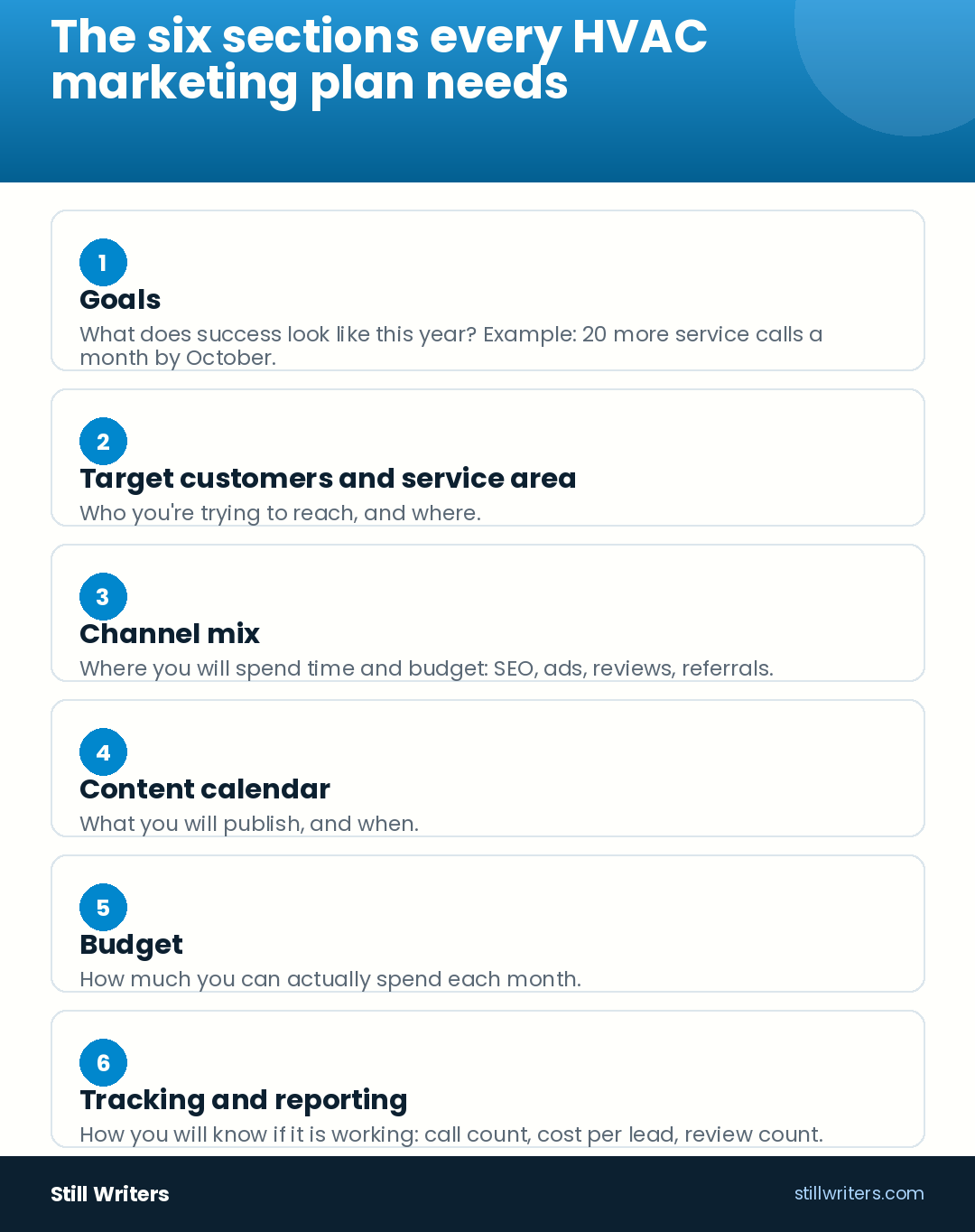
| Plan section | What it answers | Example |
|---|---|---|
| Goals | What does success look like this year? | 20 more service calls a month by October |
| Target customers and service area | Who are you trying to reach, and where? | Homeowners within 40 km of your shop in the Fraser Valley |
| Channel mix | Where will you spend time and budget? | SEO, Google ads, review generation, referral program |
| Content calendar | What will you publish, and when? | Monthly blog post, seasonal maintenance reminders |
| Budget | How much can you actually spend? | $2,000 a month split across SEO and ads |
| Tracking and reporting | How will you know it’s working? | Monthly call count, cost per lead, review count |
Every one of those rows is a section you’ll fill in as you read through this guide, and by the end you’ll have a plan you can actually use instead of a table full of good intentions.
What goals should your plan start with?
Start with the business result you actually want, not the marketing tactic. “Get more Instagram followers” isn’t a goal, it’s a vanity number. “Book 15 more heat pump installs before the fall rebate season ends” is a goal, because it ties straight to revenue. Pick one or two goals for the year, not ten. A small HVAC company that tries to grow residential maintenance plans, chase commercial contracts, and rank for every city in the province at once usually ends up doing all three poorly.
Turning a vague goal into a number you can track
Give every goal three things: a number, a deadline, and a way to measure it. “Grow the business” becomes “add 25 net new service calls a month by the end of Q3, tracked through call tracking numbers on the website.” That kind of goal tells you if the plan is working within weeks, not months. It also makes it obvious which channel is pulling weight and which one isn’t.
Who are you actually trying to reach?
- Residential versus commercial: decide if you want more furnace and AC calls from homeowners or more contract work from property managers and builders, since the marketing looks different for each.
- Service area radius: map out how far you’ll actually travel for a job, then build your content and ad targeting around that radius instead of an entire province.
- Seasonal focus: decide which season drives most of your revenue, heating, cooling, or a mix, and weight your plan toward the months that matter most.
- Local competition: look at who else shows up for your target area. A company competing in Vancouver’s HVAC market needs a different plan than one working a smaller town with two competitors.
- Customer type by value: a maintenance plan customer who calls you every year is worth more long term than a one time repair, so decide how much of your plan should focus on repeat business.
How do you audit what you already have?
Before you add anything new, look honestly at what’s already there. A surprising number of HVAC companies build a marketing plan around new tactics while ignoring a five year old website or a Google Business Profile nobody has touched in years. Since 53% of Canadians say a website makes a business look more credible, an outdated site is quietly costing you calls before a single ad ever runs.
What to check first
Start with your website. Does it load fast on a phone, and does it make it obvious how to call you? A lot of companies get plenty of visitors but few calls, which is a sign the website itself needs work, not the traffic. If that sounds familiar, this breakdown of why HVAC websites get clicks but not calls is worth reading before you finalize your plan.
Next, check your Google Business Profile. Is the category right, are your hours current, do you have photos from recent jobs? Local ranking research from Whitespark’s annual Local Search Ranking Factors report consistently points to review signals and Google Business Profile completeness as two of the biggest factors in map pack rankings, the local results that show up when someone searches for an HVAC company near them.
Finally, look at your reviews and your competitors. Count how many reviews you have on Google, HomeStars, and TrustedPros, and compare that number to the top three companies ranking above you. If you’re behind, that gap alone might explain part of your ranking problem.
Which channels should you choose for your budget?
You don’t need every channel, you need the two or three that fit your budget and your goals. Google handles roughly 86% of all search traffic in Canada, which is why SEO and Google ads are almost always worth a spot in the plan, but how much you lean on each depends on how fast you need results and how much you can spend.
| Channel | Typical monthly cost (CAD) | Best for |
|---|---|---|
| SEO / organic search | $1,500 to $5,000+ | Long term growth, lower cost per lead once it’s built up |
| Google ads / local service ads | Budget dependent, often $1,000 to $3,000 plus ad spend | Fast results, good for a slow month or a new service area |
| Review generation | Low cost, mostly time | Trust and local rankings, works alongside SEO |
| Referral program | Low cost, reward based | Repeat customers and word of mouth growth |
These figures line up with what general Canadian digital marketing cost data shows for SEO and content marketing services. If your budget is tight, put most of it toward one channel you can do well instead of spreading it thin across four. Reviews deserve a specific mention here. A lot of HVAC owners assume reviews just happen on their own, but building a steady flow of them takes a simple ask built into your process. If you’re deciding where review platforms fit against your website’s own search rankings, this comparison of HomeStars and TrustedPros against organic SEO is a good next read.
How do you build a content calendar you’ll actually use?
A content calendar doesn’t need to be complicated. Most HVAC companies do fine with one blog post a month and a handful of seasonal reminders sent by email or posted to Google Business Profile. Tie your topics to what’s actually happening in your market that month.
In Ontario, spring is a good time to write about AC tune ups before the first heat wave hits. In Alberta, late summer content about furnace inspections gets ahead of the first cold snap. In Atlantic Canada, where oil heat is still common, content explaining the switch to heat pumps speaks to a bigger change than it would in a market that’s already mostly on gas or electric. In Quebec, French language content isn’t optional if you want to reach a meaningful share of homeowners searching in French. Build a simple 12 month grid: one column for the month, one for the seasonal theme, one for the piece of content, and one for the channel you’ll post it on. For more topic ideas built specifically for this market, this roundup of HVAC marketing ideas Canadian contractors are using in 2026 is a solid starting point.
How do you set up tracking and reporting?
A plan without tracking is just a guess dressed up nicely. Decide upfront how you’ll measure each goal, then check it on the same schedule every month.
What to track and how often
At minimum, track your monthly call volume, where those calls came from, your Google Business Profile views and calls, your review count, and your cost per lead for any paid channel. A simple call tracking number on your website and your ads makes it obvious which channel actually produced the call instead of which one got the click. Plenty of tools exist to help with this now, and picking the right one matters more than picking the most expensive one. If you want a rundown of what’s actually worth paying for, this review of HVAC lead generation tools in 2026 covers the options in more detail. Set a recurring 30 minute block once a month to look at the numbers against your goals, and adjust the plan if something isn’t pulling its weight.
What does a simple HVAC marketing plan template look like?
Here’s a template you can copy into a document today and fill in yourself. Skip the fancy design and just answer each line honestly.
- Goal: write one sentence with a number and a deadline.
- Target customer: describe who you want more of, residential or commercial, and by service.
- Service area: list the towns or neighborhoods you actually want calls from.
- Audit results: note your website’s biggest weakness, your review count, and your top two competitors.
- Channel mix: pick two or three channels and how much budget goes to each.
- Content calendar: list this month’s topic and next month’s topic, minimum.
- Tracking method: name the exact numbers you’ll check and on what day of the month.
- Review date: pick a recurring date to revisit the whole plan, once a quarter works for most companies.
Fill that out and you have a working plan, not a wish list. If you’re deciding if you should build this yourself or bring in help, this look at what DIY marketing actually costs Canadian HVAC contractors lays out the tradeoffs plainly. If you’d rather have someone build your plan with you, our team can walk through your HVAC marketing services options based on your actual numbers, not a generic template, or you can reach out to us directly if you want a second set of eyes on what you’ve drafted.
Frequently asked questions about HVAC marketing plans
What is an HVAC marketing plan? An HVAC marketing plan is a written document that lists your goals, your target customers, the channels you’ll use, and how you’ll track results. It turns marketing from a list of random tasks into a plan your whole team can follow. Most HVAC companies do fine with a plan that’s one or two pages long.
How long should an HVAC marketing plan be? It doesn’t need to be long. A one or two page document with clear goals, your service area, your channel mix, and a tracking method covers everything most HVAC companies need. Longer plans work fine too, but length isn’t what makes a plan effective, clarity is.
How much should an HVAC company budget for marketing? Budgets vary a lot based on your goals and your market, but many small Canadian HVAC companies start somewhere between $1,500 and $5,000 a month split across SEO, ads, and review generation. Your specific number should come from your goals, not the other way around. Start with what you can afford consistently, since a small budget spent every month beats a bigger one spent for six weeks and then dropped.
How often should you update your marketing plan? Review your plan once a quarter at minimum, and update your goals once a year. Marketing plans aren’t set in stone. If a channel stops working or a competitor changes the local market, your plan should change with it.
Do you need a marketing plan if you already get enough referrals? Referrals are great when they’re steady, but they tend to slow down during a recession, a slow season, or if your best referral source retires or moves. A written plan gives you a backup that doesn’t depend on any one person remembering to mention your name. Even companies with strong referral networks benefit from having a plan for the months referrals dry up.
Ready to build your HVAC marketing plan?
You came here because “someday I’ll get organized with marketing” wasn’t working anymore. A real plan turns that someday into a document you can act on this week.
Here’s what you learned along the way:
- Start with one or two clear, numbered goals instead of a vague wish to grow.
- Define exactly who you want to reach and how far you’ll travel for a job.
- Audit your website, Google Business Profile, and reviews honestly before adding anything new.
- Pick two or three channels that fit your budget instead of spreading yourself thin.
- Track your numbers every month so you know what’s actually working.
We’ve spent years writing for HVAC and construction companies, which means we already understand the difference between a maintenance plan pitch and an emergency no heat call before you have to explain it to us. We’ve taken client websites from a handful of visitors a week to hundreds within months by pairing a written plan with content that actually answers what homeowners are searching. Plenty of the plans we’ve built started as a napkin sketch, not a polished document, and that’s fine, a plan gets better once it’s written down. If you want a second set of eyes on your plan, or you’d rather we build the whole thing with you, click below and let’s talk it through.
What should you read next?
If you want to keep learning before you pick up the phone, here are three places to start.
- What does HVAC marketing cost in Canada in 2026?: a closer look at real budget ranges to help you fill in the budget section of your plan.
- What should a small Canadian HVAC company budget for digital marketing?: practical guidance if your budget is smaller than the national averages suggest.
- Why do Canadian HVAC companies struggle to rank on Google?: useful background if SEO is going to be a big part of your channel mix.
If you’re not ready to talk to us yet, these three resources are a solid place to keep learning.