
Key takeaways
- Budget 5 to 10 percent of gross revenue for marketing, a range that fits most small service businesses, HVAC shops included.
- A one or two truck shop pulling in $400,000 a year can expect to land between $1,700 and $3,300 a month once the budget settles into that range.
- Free and low cost moves come first, so a claimed Google Business Profile and a working website deserve your first dollars before a cent goes to paid ads.
Picture this. You just closed out the month, revenue looked decent, and now you’re staring at a blank line in your spreadsheet labeled marketing. Do you put down $200? $2,000? Nothing at all until the phone rings less? If you run a one or two truck HVAC company in Manitoba or Nova Scotia, the stakes feel different than they do for the ten truck operation across the province. You can’t afford to guess your way through digital marketing for HVAC companies, but you also can’t afford to pull cash away from payroll and parts. This article gives you a real framework for deciding what to spend, based on what you actually bring in, not on what some agency’s price sheet says you should pay.
Still Writers has spent years learning how to write and market for trade businesses fast, from small Prairie shops to crews running trucks in bigger metros on both sides of the border. We’re far from the only content team that understands the trades. Plenty of good agencies and freelancers do solid work for HVAC contractors across Canada. What we bring is a habit of digging into a new market quickly, figuring out how local customers search and what makes them pick up the phone, then building a plan sized to a company’s real revenue instead of a one size fits all template.
How much should a small HVAC company budget for digital marketing?
Start with the number on your own income statement, not a competitor’s ad spend. The U.S. Small Business Administration’s own research shows there’s no single universal figure, but it points out that business to consumer service companies, the closest match to a residential HVAC shop, spend an average of 11.8 percent of revenue on marketing. Product companies and industrial suppliers spend far less. Service businesses that depend on repeat calls and referrals, like HVAC, plumbing, and electrical, tend to sit higher because every new customer costs more to win.
For a small Canadian HVAC company, a practical range is 5 to 10 percent of gross revenue. That’s wide on purpose. A shop that’s already got a strong base of repeat customers and referrals can lean toward the lower end. A shop trying to grow past its current ceiling, or one that just lost a big commercial contract, should lean toward the higher end for a while.
Why a percentage beats a flat dollar number
A flat number sounds simple, but it doesn’t flex with a slow month or a busy one. Percentage based budgeting scales with you. If July brings in double what January did, your marketing budget grows with it automatically, and you never end up spending money you don’t have. This matters even more for the smallest operators. Government data shows that 88.4 percent of Canadian businesses have fewer than 20 employees, and 59.1 percent are micro-enterprises with just 1 to 4 employees. If your HVAC company fits that description, cash flow swings hit you harder than they hit a 40 person operation with a controller on staff. A percentage based rule protects you from overcommitting during a slow shoulder season.
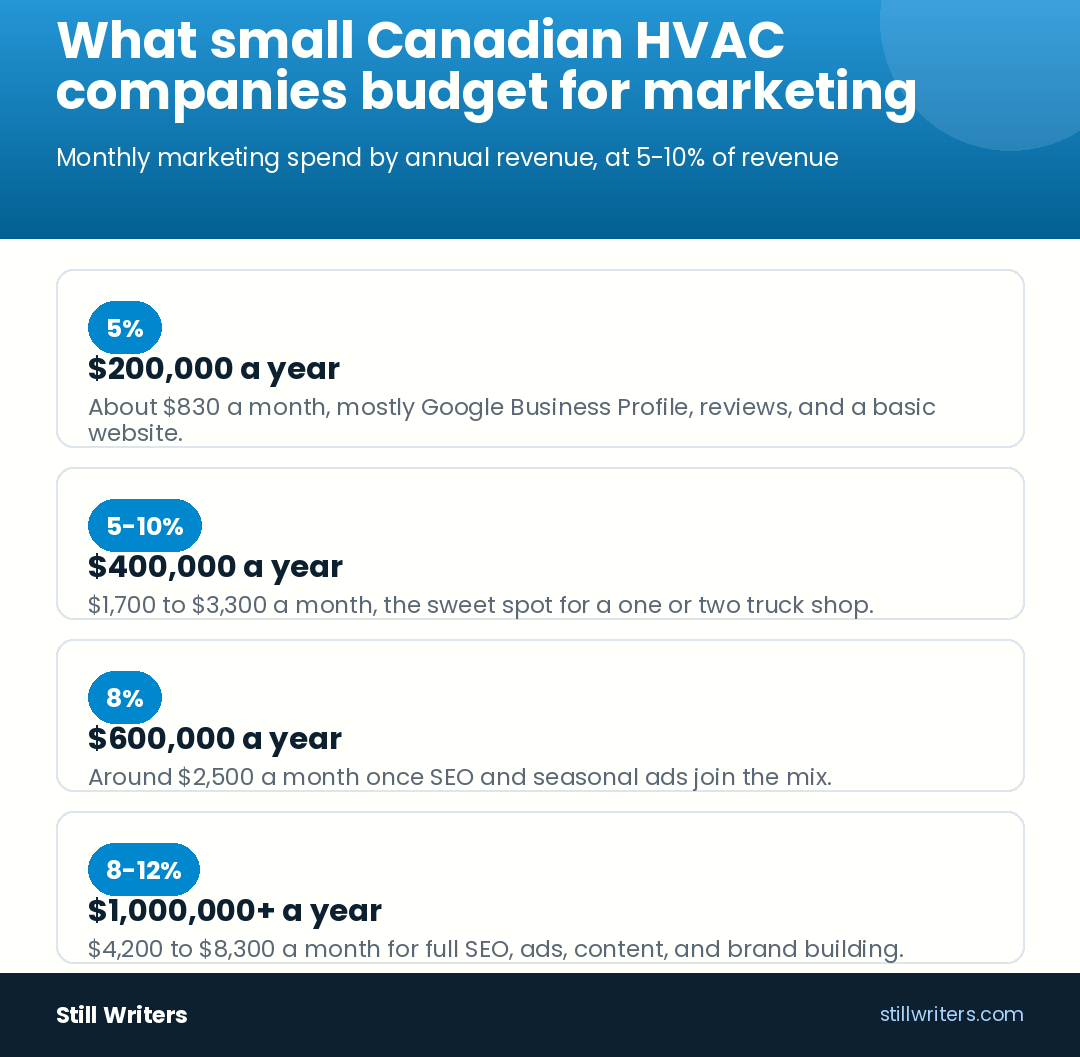
| Annual revenue | 5 percent (monthly) | 10 percent (monthly) |
|---|---|---|
| $200,000 | $830 | $1,670 |
| $400,000 | $1,700 | $3,300 |
| $600,000 | $2,500 | $5,000 |
| $1,000,000 | $4,200 | $8,300 |
Notice how this framework works from the ground up, starting with your own revenue, rather than starting with what an agency charges and working backward. Our general breakdown of what HVAC marketing costs in Canada covers typical market rates for SEO, ads, and content, and our pricing page shows what real packages look like once you’re ready to compare your own number against the market.
What does that look like in real dollars for a one or two truck shop?
Numbers on a table only mean something once you attach them to a real business. Take a two truck HVAC company outside Winnipeg doing about $450,000 a year in furnace and AC service calls. At 5 percent, that’s roughly $1,875 a month. At 8 percent, closer to $3,000. For a shop that size, $2,000 to $2,500 a month is a realistic middle ground, enough to keep a Google Business Profile active, run a handful of Google ads during shoulder season, and pay a freelancer or small agency for basic website upkeep and a few blog posts a month.
A Nova Scotia example
Now picture a one truck heating and cooling company near the South Shore in Nova Scotia doing $220,000 a year, mostly oil to heat pump conversions and service calls. That’s a smaller pool of cash to work with. At the low end of the range, 5 percent, the budget is around $900 a month. That’s tight, but it’s enough to keep local listings accurate, collect reviews after every job, and maybe run a small Facebook or Google ad during the busiest weeks. It is not enough for a full SEO retainer, and that’s fine. A one truck operation doesn’t need the same marketing stack as a company running five crews in Halifax.
The same math applies no matter the province. A shop outside Edmonton doing $700,000 a year has more room to work with than a shop just starting out in a small town, but the percentage stays roughly the same. What changes is what that percentage buys.
What should a small HVAC company spend its first dollars on?
If your budget is small, order matters more than the total amount. Some moves cost almost nothing and pay off fast. Others need a bigger budget behind them before they’re worth trying. Research backs this up. Roughly 73 percent of Canadian shoppers Google a business before they call or walk in, which means your free listings and basic web presence do more heavy lifting than most owners assume.
- Claim and complete your Google Business Profile: it costs nothing, and it’s often the first thing a homeowner sees when they search for heating or cooling help near them.
- Ask every happy customer for a review: a steady stream of recent reviews on Google, HomeStars, or TrustedPros builds trust faster than almost anything else you can buy.
- Get your website’s basics right: a clear phone number, your service area, and real photos of your trucks and crew go a long way. A website matters for credibility too, since 53 percent of Canadians say a website makes a business look more credible.
- Track every call and job source: a simple spreadsheet showing which jobs came from referrals, Google, or a review site tells you what to fund next.
- Save paid ads for last: once the free wins are in place, a small, targeted ad budget for shoulder season goes further because your listing and reviews already back it up.
None of this requires a big retainer. It requires an hour or two a week and a habit of asking customers for reviews on the spot. Once those fundamentals are solid, a small budget for paid search or social ads starts to earn its keep instead of getting wasted on a business that doesn’t look trustworthy yet.
How should the marketing budget change as your company grows?
A budget that made sense at $200,000 in revenue won’t fit at $800,000. As a small HVAC company grows, both the percentage and what it buys should shift. Early on, cash is tight and every dollar competes with payroll, parts, and truck repairs. Later, once cash flow is steadier, it makes more sense to invest ahead of growth instead of just keeping up with it.
| Stage | Typical annual revenue | Marketing focus | Typical percent of revenue |
|---|---|---|---|
| Startup, one truck | Under $250,000 | Google Business Profile, reviews, basic website | 3 to 5 percent |
| Established, two to three trucks | $250,000 to $750,000 | Website upkeep, local SEO, seasonal ads | 5 to 8 percent |
| Growing, four or more trucks | $750,000 and up | Full SEO, paid ads, content, brand building | 8 to 12 percent |
A company moving from the established stage into the growth stage often starts working with an agency for the first time, rather than handling everything in house or with a single freelancer. That’s a different decision than the budgeting question this article covers, and our piece on what it actually costs Canadian HVAC contractors to go it alone versus hiring an agency walks through that trade off in detail. For now, just know that as revenue climbs past the half million mark, most owners find the flat percentage approach starts feeling more comfortable than it did in the early days.
What changes besides the number
Growth also changes who you’re trying to reach. A one truck shop mostly needs residential homeowners nearby. A four truck shop in a bigger market might be chasing property management contracts or new construction work too, which usually means a bigger website, more content, and a longer sales cycle. The budget has to stretch to cover that broader mix, past a simple repeat of the same tactics.
What mistakes do small HVAC companies make when setting a marketing budget?
Most of the budgeting mistakes we see aren’t about spending too little or too much. They’re about spending inconsistently, or spending on the wrong thing at the wrong stage. Watch for these before you lock in a number.
- Treating marketing as a line item that gets cut first: cutting spend the moment a slow month hits often makes the next slow season worse, not better.
- Copying what a bigger competitor spends: a company running fifteen trucks in a major metro has a different customer acquisition math than a two truck shop in a smaller town.
- Spending on ads before the basics are solid: paid traffic to a thin website or an unclaimed Google Business Profile burns money fast.
- Never revisiting the number: a budget set two years ago at a lower revenue level probably doesn’t fit anymore.
- Assuming every dollar needs to go to one channel: spreading a small budget across a mix of reviews, local SEO, and a little paid search usually beats putting it all in one place.
If you want a second opinion on where your current spending stands, our services page outlines what a full marketing plan can look like for a company your size, and our contact page is the fastest way to get a real answer instead of a guess. You can also browse the full hub of Canadian HVAC marketing resources we’ve built for contractors working through the same questions in markets from Manitoba to British Columbia.
Frequently asked questions about small HVAC marketing budgets
How much should a small HVAC company spend on marketing each month? Most small HVAC companies do best somewhere between 5 and 10 percent of gross revenue. For a shop doing $400,000 a year, that works out to roughly $1,700 to $3,300 a month, though the right number depends on how established the business already is.
Is 5 to 10 percent of revenue too much for a one truck HVAC business? Not usually, but at the smallest revenue levels the actual dollar amount is often small too. A one truck shop doing $200,000 a year at 5 percent is spending around $830 a month, which mostly covers reviews, a basic website, and a small ad budget during busy weeks.
What should I do if I can’t afford any marketing budget yet? Start with the free moves first. Claim your Google Business Profile, ask every customer for a review, and make sure your website has clear contact information and your service area listed. These cost time, not money, and they build the foundation everything else depends on.
Should I hire an agency or handle marketing myself on a small budget? It depends on your revenue stage and how much time you have. A one or two truck shop can often manage the basics alone, while a growing company usually benefits from outside help once the budget and the workload both get bigger than one person can handle.
How do I know when it’s time to increase my marketing budget? Watch your lead volume and your close rate over a few months. If calls are drying up in your shoulder season, or you’re turning away work because your pipeline is thin, that’s usually the signal to move toward the higher end of your budget range.
Digital marketing for HVAC companies: your budget
You came here trying to figure out a real number, not another list of what marketing costs in general. Hopefully this gives you something to actually work from.
Here’s the short version of what we covered:
- Aim for 5 to 10 percent of gross revenue, adjusted for how established your company already is.
- A small shop’s real dollar budget is often smaller than owners expect, and that’s fine at the early stage.
- Free and low cost moves like Google Business Profile and reviews come before paid ads.
- The budget, and what it buys, should grow as revenue climbs past each stage.
- Consistency across slow and busy seasons beats a bigger number spent unevenly.
We’ve helped HVAC companies at every one of these stages figure out a number that actually fits their business, from one truck operations in small Atlantic and Prairie towns to growing companies running crews across multiple provinces. We know the trades because we’ve spent real time in them, and we’d rather give you an honest answer about what fits your revenue than sell you a bigger package than you need. If you want to talk through what your specific budget should look like, we’re happy to walk through it with you.
What should you read next?
If you want to keep learning before you pick up the phone, here are three places to start.
- What does HVAC marketing cost in Canada in 2026?: a full look at market rates for SEO, ads, and content, useful once you know your budget and want to see what it can buy.
- Agency vs. DIY marketing: what it actually costs Canadian HVAC contractors to go it alone: helpful once your budget is set and you’re deciding who should manage it.
- The best HVAC marketing ideas Canadian contractors are actually using in 2026: practical tactics to spend that budget on once the fundamentals are in place.
If you’re not ready to talk to us yet, these three resources are a solid place to keep learning.