
Key takeaways
- Organic search and your Google Business Profile still carry the most weight, since roughly 73% of Canadians research a business on Google before they call it.
- Paid ads earn their keep only with tight tracking, since HVAC Local Services Ads averaged about $51 USD per lead in early 2026 for companies that watched their numbers closely.
- Reviews and referrals are the cheapest leads you already own, yet most Canadian HVAC companies barely ask for either one.
Ask five HVAC owners where their best jobs came from last month and you’ll probably get five different answers. That’s the honest problem with hvac company marketing right now: everyone has an opinion, plenty of people are selling something, and almost nobody agrees on what actually works in 2026. You’ve likely tried a few tactics already, maybe a website refresh, a few months of Google Ads, a push for more reviews, and you’re still not sure which ones paid for themselves. This article is our attempt at a straight answer, channel by channel, based on what we’ve watched work for real Canadian HVAC companies and what the published data backs up.
Here’s our angle. We write for trades companies across Canada and the U.S., and HVAC is one of the niches we’ve spent the most time learning inside out, refrigerant rules, rebate cycles, shoulder season swings, all of it. That focus means we’ve watched dozens of Canadian HVAC clients try the tactics below, some for the first time, some for the fifth time with a different agency. Plenty of good marketing shops exist in this industry, and we’re not here to pretend we invented content marketing. We just have enough reps at this point to tell you honestly which channels are earning their budget in 2026 and which ones are running on fumes.
Here’s what we’re covering, tactic by tactic, with real numbers where we have them:
- SEO and organic content: still the backbone for most companies, but slower than people want it to be.
- Google Business Profile and reviews: probably your highest-leverage channel, and most companies half-manage it.
- Paid search and Local Services Ads: worth it for some companies, a drain for others.
- Email, referrals, and lead-gen platforms: cheap, underused, and often ignored completely.
- What’s overhyped right now: the tactics getting more attention than they’ve earned.
What actually moves the needle in hvac company marketing today?
Before we break down any single channel, it helps to see the whole board at once. Here’s our overall verdict on the seven tactics Canadian HVAC owners ask us about most, based on client accounts and published data. If you want the deeper math behind any of these, we’ve covered what hvac marketing actually costs in Canada and what a small company should budget for it elsewhere in this series.
| Marketing tactic | Our verdict | Why it lands here |
|---|---|---|
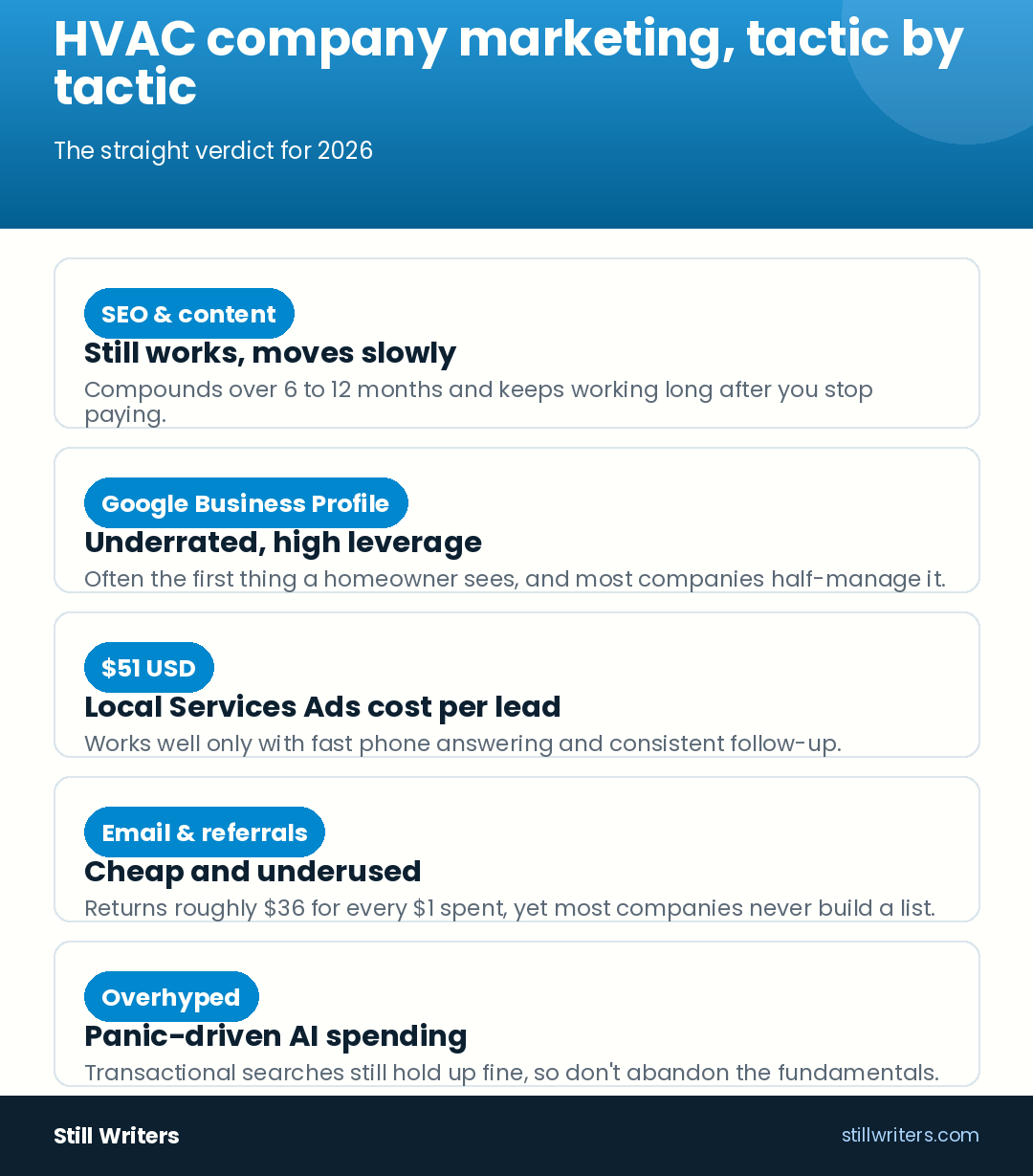
| SEO and blog content | Still works, moves slowly | Organic traffic tends to compound over 6 to 12 months instead of weeks, and Google handles about 86% of all Canadian searches, so ranking still matters more than most owners assume. |
| Google Business Profile | Underrated, high leverage | It’s usually the first thing a homeowner sees after searching, and the reviews shown there shape the call more than almost anything else on the page. |
| Paid search and Local Services Ads | Works if you track it closely | HVAC Local Services Ads averaged about $51 USD per lead in early 2026, with a 44% book rate on those leads. |
| HomeStars and TrustedPros profiles | Worth claiming, not worth relying on | Good for trust signals, but you’re usually bidding against three or four other companies for the same homeowner. |
| Email and referral programs | Cheap and underused | Email marketing still returns roughly $36 for every dollar spent, and most HVAC companies never build a list at all. |
| Organic social media | Mostly a branding play | It rarely drives a direct call by itself, but it keeps your name visible between service calls. |
| Print, radio, and flyers | Mostly retired | Still works in small towns with little online competition, but the cost per call is hard to justify almost everywhere else. |
Notice a pattern. The channels that pay off long term (SEO, Google Business Profile, referrals) tend to be the ones companies neglect, and the channels people obsess over (paid ads, social) tend to be the ones that stop the second you stop paying. We’ll dig into each one, including where a smaller company should focus first if it can only tackle one or two at a time. If you want the full idea list rather than the verdict, our roundup of HVAC marketing ideas Canadian contractors are using covers more ground tactic by tactic. This piece is the honest scorecard for what’s on that list.
Does SEO still work for hvac companies in Canada?
Yes, but not the way most sales calls describe it. SEO doesn’t get you to page one in a month, and anyone promising that is selling you something else. What SEO actually does is build a library of pages that answer the exact questions a homeowner types into Google before they call anyone, “furnace making a knocking noise,” “heat pump vs furnace Alberta,” “how much does duct cleaning cost.” Over time, those pages start showing up, and they keep showing up without you paying per click.
Why so many Canadian HVAC sites still don’t rank
Most HVAC websites we review have five or six service pages and nothing else. That’s a business card, not an SEO strategy. Google rewards sites that clearly answer a lot of specific questions, and a homeowner site with 40 or 50 useful pages will usually beat a competitor’s six-page site over time, even in a competitive market like Calgary or the Greater Toronto Area. We’ve written at length about why Canadian HVAC companies struggle to rank on Google, and thin content is the number one reason, ahead of backlinks or technical issues.
There’s also a newer wrinkle worth naming honestly. AI Overviews now show up on roughly 58% of search results pages, and informational queries lose the most clicks to them. That sounds scary, but it mostly affects broad “what is a heat pump” style searches, not “HVAC company near me” or “emergency furnace repair Edmonton” searches, which are exactly the ones that turn into paying jobs. We’ve broken down the AI search question in more detail in our piece on AI search and Google’s AI Overviews if you want the full picture.
What a decent SEO program actually costs
SEO services in Canada typically run $1,500 to $5,000 or more per month, with content marketing on its own landing in a similar range. That’s a real number, not a scare tactic, and it explains why a lot of small companies try SEO for three months, don’t see a flood of calls, and quit right before the compounding effect kicks in. If your site gets traffic but the phone stays quiet, the problem usually isn’t SEO at all, it’s why your website gets clicks but not calls, which is a conversion problem, not a ranking problem. And if you’re deciding where to put your first dollar, our comparison of website redesign versus content marketing lays out that tradeoff in more detail.
Is your Google Business Profile actually working for you?
This is the section most owners skip past because it feels too simple to matter. That’s a mistake. Your Google Business Profile is usually the very first thing a homeowner sees after they search, before they ever click through to your site, and it shapes if they call you or the next name on the list. About 53% of Canadians say a website makes a business look more credible, and your Google Business Profile is doing the same trust-building work in a smaller, faster package.
Whitespark, a Canadian company based in Edmonton, publishes an annual Local Search Ranking Factors report that’s become the closest thing this industry has to a rulebook for what actually moves map pack rankings. Review signals, proximity, and profile completeness all show up near the top every year, and none of them cost money to fix.
Where most companies leave this channel half done
- Photos go stale, with the same five truck pictures uploaded three years ago instead of current job photos.
- Review requests happen inconsistently, only after a great job instead of as a habit built into every completed ticket.
- Negative reviews sit unanswered, which tells every future customer you don’t respond to problems.
- Service areas and categories are outdated, so Google shows you for the wrong city or the wrong type of job.
- Q&A sections sit empty, leaving an open space competitors sometimes fill with their own answers.
The other piece of this puzzle is HomeStars and TrustedPros, the two Canadian platforms homeowners lean on to check a contractor before hiring. They’re worth claiming and keeping current, but they shouldn’t be your whole reputation strategy, since you’re sharing that shelf space with every competitor bidding on the same lead. We compare the two approaches directly in HomeStars and TrustedPros versus organic SEO, and if you want a deeper look at the Google Business Profile piece specifically, we did a full honest review of Google Business Profile for HVAC companies earlier in this series.
Where do paid ads and lead-gen sites actually pay off?
Paid channels get the most attention in sales calls because they’re the easiest to demo. Someone shows you a dashboard, points at a lead count, and it feels like proof. The problem is that a lead count alone doesn’t tell you if the lead turned into a paid job, and it definitely doesn’t tell you what happens the month you stop paying.
Comparing the real cost and timeline across channels
| Channel | Typical monthly cost (CAD) | Time to see results | Verdict |
|---|---|---|---|
| SEO and content marketing | $1,500 to $5,000+ | 4 to 12 months | Best long-term value, slow start |
| Google Business Profile and reviews | $0 to $500 | 1 to 3 months | Highest return for the effort |
| Google Ads and Local Services Ads | $1,000 to $4,000 | Days to weeks | Fast, stops the moment you stop paying |
| HomeStars or TrustedPros membership | $100 to $600 | Weeks | Fine as a supplement, not a strategy |
| Email and referral programs | $0 to $300 | 1 to 2 months | Underused, very cheap to run |
Local Services Ads have gotten better in the last year or two. HVAC campaigns averaged that $51 USD figure per lead we mentioned earlier, with a 44% book rate and a strong return on ad spend, but only when someone answers the phone fast and follows up hard on every lead. Hand that same ad spend to a company with slow follow-up and the math falls apart quickly. If you’re comparing tools that manage this process, our review of HVAC lead generation tools breaks down which platforms are worth the subscription fee.
Where email and referrals fit into the picture
This is the channel almost nobody uses well, which is exactly why it’s worth a second look. You already have a list, every customer you’ve ever serviced, and most companies never email them again after the invoice goes out. A simple seasonal reminder, a maintenance plan renewal, or a quick referral ask costs almost nothing and reaches people who already trust you. It’s one of the clearest examples in how Canadian HVAC companies generate leads without buying them, and it deserves more budget than it usually gets. Deciding between building this in house or hiring it out comes down to the same tradeoff covered in agency versus DIY marketing costs.
What’s overhyped and what’s a waste of money right now?
This is the part of the review that gets us the most pushback, because some of these tactics have loud, confident champions. We’re calling it straight anyway.
- Chasing every new social platform: a HVAC company doesn’t need a presence everywhere. Pick one or two platforms your actual customers use and post consistently instead of spreading thin across five.
- Buying huge blocks of paid leads with no follow-up plan: leads without a fast callback system are money burned. Fix response time before you increase spend.
- Panic-driven “AI will replace SEO” spending: some companies are dumping their content budget into AI-specific tools out of fear rather than data. Transactional searches still hold up fine, so don’t abandon the fundamentals.
- Generic agencies that don’t understand the trade: a marketing shop that’s never dealt with a rebate season or a TSSA requirement will waste your budget learning on your dime. That’s a real, common failure mode we’ve documented in why generic marketing agencies fail Canadian HVAC contractors.
- Ignoring rebate season entirely: federal and provincial heat pump rebates create a predictable spike in search interest every year, and companies that don’t plan content around it miss an easy, cheap win covered in why rebate season creates a marketing blind spot.
- Treating one province’s strategy as universal: what works in the Lower Mainland doesn’t automatically translate to Quebec or Atlantic Canada, especially around language and rebate programs, which we cover in local SEO versus national SEO for companies operating across Canada.
If you’re trying to decide if you should hire this out at all, our list of questions Canadian HVAC companies ask before hiring a marketing agency is a good gut check before you sign anything, and our services page lays out exactly how we approach this work if you’d rather see it firsthand. You can also reach out through our contact page any time you want a second opinion on a proposal you’ve already received.
Frequently asked questions about hvac company marketing
What is the most effective hvac company marketing tactic in Canada right now? Google Business Profile optimization paired with a steady review request habit tends to deliver the fastest, cheapest return, since it costs little and shapes the first impression a homeowner gets. SEO content is the strongest long-term investment, but it takes months to build momentum.
How much should a small hvac company budget for marketing? Most small Canadian HVAC companies land somewhere between $1,500 and $5,000 a month once you combine SEO, content, and profile management, with paid ads on top if you add them. Our detailed budget breakdown for small companies walks through how that splits by channel.
Do Google reviews actually help hvac companies win more calls? Yes. Reviews are one of the strongest local ranking factors according to Whitespark’s ongoing research, and they’re often the deciding factor when a homeowner is comparing two similar companies side by side.
Is paid advertising worth it for hvac companies in 2026? It can be, especially Local Services Ads, but only for companies with fast phone answering and consistent follow-up. Without that, you’re paying premium prices for leads that go cold.
Do hvac companies in Quebec need a different marketing approach? Generally yes. French-language content is a real requirement for a meaningful share of that market, not a nice extra, and provincial rebate programs through Hydro-Quebec differ from what’s offered elsewhere. We go deeper on this in bilingual versus English-only marketing for Quebec.
Getting hvac company marketing right this year
You came here because you’re tired of guessing which tactic deserves your next dollar, and honestly, that instinct to question the hype is the right one to have.
Here’s the short version of everything above:
- SEO still works, it just takes months to compound, so don’t quit at week eight.
- Your Google Business Profile is your cheapest high-impact channel, and it’s probably half-managed right now.
- Paid ads reward fast follow-up and punish slow follow-up, so fix your callback process first.
- Email and referrals are nearly free, and almost nobody in this industry uses them well.
- Generic, one-size-fits-all approaches waste money in a country with provincial rebate programs, bilingual markets, and cold-climate installation quirks that a generic playbook won’t catch.
We’ve built this whole 30-article series because Canadian HVAC companies keep getting sold the same generic American playbook, dressed up with a maple leaf. Our team has spent years learning the actual details, the TSSA requirements, the rebate calendars, the difference between an Alberta shoulder season and an Atlantic Canada one, because that context changes which tactic pays off first. We’d genuinely rather tell you a channel isn’t worth it yet than take your budget and figure that out together. If any of this sounds like a conversation worth having, go ahead and click below and talk to a real marketing expert about your company specifically.
What should you read next?
If you want to keep learning before you pick up the phone, here are three places to start.
- What does HVAC marketing cost in Canada in 2026?: a full cost breakdown by channel if the tables above left you wanting more detail.
- Google Business Profile for HVAC companies: an honest review: the deep dive on the single highest-leverage channel covered in this piece.
- Best ways Canadian HVAC companies generate leads without buying them: practical detail on the referral and email strategies most companies skip.
If you’re not ready to talk to us yet, those three articles are a solid place to keep learning at your own pace.