Key takeaways
- Most multi-province HVAC companies need both strategies at once, since local pages win the map pack while national content wins the research phase.
- A separate local page and Google Business Profile per service area beats one generic “we serve everywhere” page, because each region has its own rebates, competitors, and search behavior.
- Quebec service areas need real French content, not a translated afterthought, and skipping this step quietly costs you calls in that market.
Picture a company we’ll call Northline Comfort. It installs and services furnaces and heat pumps out of a home base in Surrey, with crews covering Calgary, the Greater Toronto Area, and the Montreal region. Four provinces, four sets of rebates, four sets of local competitors, and one website trying to do all the work. If you run an HVAC business like this, you already know the question that keeps coming up in marketing meetings: do you build separate local pages for every city you serve, or invest in one strong national site and let it rank everywhere? Google handles roughly 86% of all search traffic in Canada, so getting this decision right on the platform that matters most is not optional. Get it wrong and you either bury your Calgary crew under generic copy that never shows up in a local pack, or you spend a fortune building forty city pages that dilute your domain instead of strengthening it. The real answer sits in the overlap between local SEO and national hvac web marketing, and that’s what this article breaks down.
We’ve spent years writing content for HVAC companies that operate in exactly this kind of spread-out setup, from single-city shops to crews running four provinces deep. Other agencies can build you a nice looking site or run your ads, and plenty do solid work. What we’ve noticed writing for multi-location contractors specifically is that the companies who win aren’t the ones who pick local or national. They’re the ones who understand which job each layer does, then build content for both at the same time instead of treating it as an either-or decision.
What’s the real difference between local and national hvac web marketing?
Local SEO means building pages, listings, and signals tied to a specific place. A Calgary heating page, a Vancouver Google Business Profile, reviews from Richmond customers naming their neighborhood. It’s built to win the map pack and the “near me” searches that show up when someone’s furnace dies on a Tuesday night. National SEO means building authority and content that ranks no matter where the searcher is. Think guides on how heat pumps handle cold Canadian winters, comparisons of financing options, or explainers on rebate programs that apply across the country. It’s built to catch people earlier, before they’ve picked a contractor or even decided what they need.
Why multi-province companies can’t just pick one
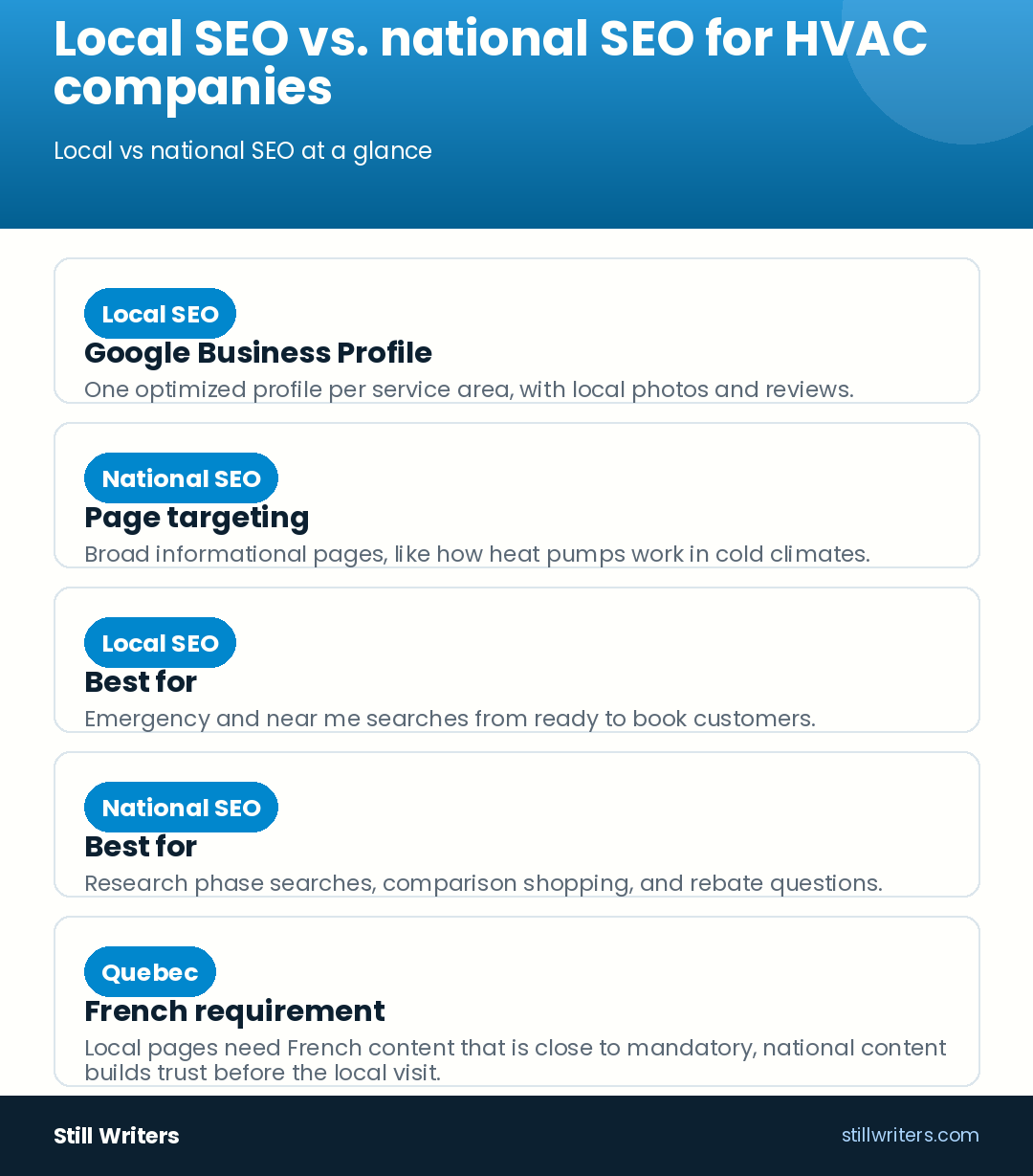
A single-location contractor in one city can lean almost entirely on local SEO and do fine. A company spread across BC, Alberta, Ontario, and Quebec doesn’t have that luxury. Each province brings different rebate programs, different seasonal patterns, and in Quebec’s case, a different language expectation. Building one generic national page and hoping it ranks in four different cities rarely works, because Google increasingly rewards pages that speak directly to a specific area. At the same time, building forty disconnected city pages with no central authority behind them wastes budget on pages that never earn trust or backlinks. The table below breaks down where each approach actually pulls its weight.
| Factor | Local SEO | National SEO |
|---|---|---|
| Google Business Profile | One optimized profile per service area, with local photos and reviews. | Not applicable, profiles are always local by nature. |
| Page targeting | City or region specific pages (“Calgary heat pump installation”). | Broad informational pages (“how heat pumps work in cold climates”). |
| Domain authority impact | Smaller individual boost, but compounds across many pages. | Larger single boost that lifts every page on the site. |
| Best for | Emergency and “near me” searches, ready-to-book customers. | Research phase searches, comparison shopping, rebate questions. |
| Quebec requirement | French-language local pages are close to mandatory. | French national content builds trust before the local visit. |
| Review management | Region-specific, tied to each Google Business Profile. | General brand reputation, less tied to one location. |
Neither column wins on its own for a company with Northline’s footprint. If you want a deeper look at the full range of tactics involved, our HVAC content and SEO services page walks through how these pieces fit together for contractors at different stages of growth.
Why does multi-province hvac marketing get complicated fast?
Running one Google Business Profile is manageable. Running four, five, or ten across provinces turns into a part-time job. Each profile needs its own set of photos, its own service area settings, its own review requests, and its own posts. Miss one and that location quietly falls behind in the map pack while competitors with fresher profiles pull ahead. This matters because 73% of Canadian shoppers Google a business before calling or walking in. If your Edmonton profile hasn’t been touched in six months while a local competitor posts weekly, that gap shows up in who gets the call.
Rebates and language make it harder, not easier
Layer on the fact that rebate programs differ by province. British Columbia has CleanBC rebates stacked on top of federal programs. Alberta runs its own set of incentives tied to provincial energy goals. Ontario has seen rebate programs come and go through its energy board and gas utilities. Quebec runs Hydro-Québec’s own efficiency programs, and Quebec customers expect to read about them in French. A generic national page that says “check your local rebates” doesn’t answer the question a homeower in Trois-Rivières actually has. National programs like the Canada Greener Homes Initiative add another layer that changes by region and by year, and keeping local pages updated with the right combination of federal and provincial rebates is a real, ongoing task. It’s not something you set up once and forget. Our article on bilingual versus English-only marketing for Quebec goes deeper into exactly how much this language gap costs companies that skip it.
None of this means you need to hire a full marketing team for every province. It means each local page and profile needs a real owner, a real update schedule, and content written specifically for that market instead of copied from your head office page with the city name swapped out. Our guide to managing Google Business Profile for HVAC companies covers the operational side of keeping multiple profiles healthy without burning out your team.
What does a hybrid strategy actually look like?
For most companies with Northline’s spread, the honest answer isn’t local or national. It’s both, working together on purpose. Local pages catch the customer who needs a repair today. National content catches the same customer three weeks earlier, while they’re still researching if they need a repair or a full replacement. Here’s how that split typically works in practice for a multi-province HVAC company:
- Local landing pages for every real service area: a dedicated page for Calgary, a separate one for Vancouver, each with local photos, local reviews, and local phone tracking.
- One Google Business Profile per physical location or clearly defined service area: not one shared profile trying to represent four cities at once.
- A national blog layer covering broad, informational topics: heat pump guides, financing explainers, and maintenance advice that ranks no matter which province the reader is in.
- Internal links connecting the two layers: a national blog post about cold-climate heat pumps links to your Calgary and Edmonton service pages, passing authority downward.
- A central hub page tying every region together: so Google understands your full national footprint instead of seeing scattered, disconnected pages.
This is exactly the structure behind our own HVAC marketing hub, which links every regional page back to a shared authority base instead of leaving each city page to fend for itself.
How should you map content across the customer journey?
Think of your website as answering three questions at three different moments. Early on, a homeowner is asking “what’s wrong with my system” or “should I repair or replace.” Later, they’re asking “who installs heat pumps near me.” At the very end, they’re asking “can this company handle my address, today.” Each of those moments needs a different type of page, and mixing them up wastes both budget and ranking potential.
| Customer journey stage | Best content type | Who owns it |
|---|---|---|
| Early research (“do I need a new furnace?”) | National blog guide, broad and educational. | Central content team, one page for all of Canada. |
| Comparing options (“heat pump vs furnace cost”) | National comparison article, sometimes with regional notes. | Central content team, linking down to local pages. |
| Ready to hire (“Calgary heat pump installer”) | Local service page with reviews and photos. | Local team or regional manager. |
| Emergency (“furnace repair near me tonight”) | Google Business Profile and local landing page. | Local team, updated constantly. |
Why the national layer still matters even if you’re local-first
A lot of contractors assume that if their local pages are strong, they don’t need a blog. That thinking misses a big chunk of the market. 53% of Canadians say a website makes a business look more credible, and a thin site with four city pages and nothing else reads as smaller than it is. A steady stream of genuinely useful national content, the kind you’re reading right now, builds trust before a customer ever reaches your service page. It also gives your local pages something to link from, which strengthens them in a way that local pages alone can’t do for themselves. Our guide to HVAC lead generation strategies for Canadian contractors shows how this kind of layered content turns into actual booked jobs instead of only traffic.
How do you avoid the common mistakes when building this?
Multi-province companies tend to fall into a handful of predictable traps. Here’s what to check before you commit budget to either layer:
- Don’t build one page and swap the city name: Google notices thin, duplicated content across your own site, and it hurts every page involved.
- Don’t skip French content for Quebec service areas: a translated English page reads as an afterthought to a Quebec customer, and it usually shows in the conversion rate.
- Don’t let old Google Business Profiles go stale: a profile with no recent photos or posts loses ground to competitors who update theirs weekly.
- Don’t ignore rebate details specific to each province: a generic rebate mention answers nothing for a homeowner comparing CleanBC and Hydro-Québec programs.
- Don’t treat your blog as separate from your service pages: link them together so authority flows both ways instead of sitting in two disconnected silos.
If you’re not sure which of these gaps applies to your company, that’s a conversation worth having before you spend another dollar on either local pages or blog content. Our team is easy to reach, and we’re happy to look at what you’ve already built across your service areas. You can also browse our full range of HVAC marketing services to see how local and national work fits together under one plan.
Frequently asked questions about local SEO vs national SEO for HVAC companies
Do I need a separate website for each province I serve? No, you don’t need separate websites. One domain with dedicated local pages per city or region, plus a shared national blog layer, works better than splitting your authority across multiple sites.
How many Google Business Profiles should a multi-province HVAC company run? Generally one per physical location or clearly defined service area. Trying to represent four provinces under one shared profile confuses Google and hurts your local rankings in every city involved.
Is national content a waste of money if most of my leads come from local searches? No. National content catches customers earlier in their decision, builds overall site credibility, and gives your local pages internal links that strengthen them too.
Do I really need French content for my Quebec service area? Yes, for a meaningful share of that market. Quebec customers expect content in French, and a page that’s only translated rather than written for that audience tends to convert worse.
How long does it take to see results from a hybrid local and national strategy? Most companies start seeing local page movement within a few months and national content gains authority more gradually, often building over six to twelve months as your blog grows.
The bottom line on HVAC web marketing
If you run an HVAC company across two or more provinces, the local versus national question isn’t really a choice you need to make. It’s a structure you need to build correctly.
Here’s the short version:
- Local pages and profiles win the “I need help now” searches in each city you serve.
- National content wins the research phase and builds trust before the local visit.
- Quebec needs real French content, not a translated version of your English pages.
- Rebate details differ by province, and generic mentions don’t answer real questions.
- The two layers should link to each other, not operate as separate projects.
We’ve built this kind of layered content for HVAC companies spread across BC, Alberta, Ontario, and Quebec, and the pattern holds up every time. Companies that treat local and national as one connected system outperform the ones that pick a side. If you want a second set of eyes on how your current site handles this split, we’d genuinely like to take a look.
What should you read next?
If you want to keep learning before you pick up the phone, here are three places to start.
- Why do Canadian HVAC companies struggle to rank on Google?: a closer look at the ranking barriers specific to Canadian contractors.
- Best HVAC SEO strategies for Canadian contractors 2026: a broader playbook covering tactics beyond the local versus national split.
- What is an HVAC marketing plan, and how do you build one?: helpful if you’re trying to fit this strategy into a bigger plan.
If you’re not ready to talk to us yet, these three resources are a solid place to keep learning first.