
Key takeaways
- Vague case studies are the clearest warning sign, a trustworthy HVAC marketing company shows you booked jobs and calls instead of “improved visibility.”
- Long contracts with no exit clause put all the risk on you, look for month to month terms or a clear cancellation window before you sign anything.
- Reporting built only on impressions and followers hides the truth, insist on call tracking and job numbers tied directly to your marketing spend.
Have you ever asked an hvac marketing company for one real number, like how many calls or booked furnace jobs a campaign actually produced, and gotten a vague answer about “engagement” instead? You’re not the only contractor who’s run into that wall. Roughly 73% of Canadian shoppers Google a business before they call it, which means your marketing dollars are supposed to turn into phone calls and booked jobs instead of clicks on a dashboard. When an agency can’t connect the two, you’re left guessing if your budget is doing anything at all. The risk of getting this wrong is real. Months of retainer fees disappear, a contract won’t let you leave, and a competitor quietly climbs past you in the map pack while you wait for results that never show up. This article walks through the checkable red flags that separate a trustworthy HVAC marketing company from one that’s better at selling itself than at selling your services.
At Still Writers, we’ve read marketing contracts and reporting dashboards for HVAC contractors from Nanaimo to Halifax, and we’ve seen the full range. Some agencies lay their numbers out plainly and welcome hard questions. Others bury the details that matter in fine print and hope you never ask. Plenty of providers out there do honest, solid work for their HVAC clients, and this isn’t a case against hiring help. It’s a checklist so you can tell a good partner from a risky one in the first real conversation.
What should an HVAC marketing company prove before you sign?
Before you hire an hvac marketing company, ask to see results tied to a specific HVAC client. A trustworthy agency can give you a name, a market, and a number, something like “42 more booked furnace inspections in Kelowna over one winter.” A red flag shows up the moment the language turns vague, phrases like “significant growth” or “improved online presence” with no context attached. If an agency can’t tell you the before and after, or won’t say what trade the client worked in, treat that as a warning, not a small formality.
Why “we grew traffic” isn’t enough
Some agencies reuse the same blog posts and web pages across dozens of clients in totally different trades, swapping out the city name and the logo. That’s how you end up with a page about “keeping your home comfortable year round” that could belong to a plumber, a roofer, or an HVAC company with equal ease. Look for portfolio work that’s actually about furnaces, heat pumps, and air conditioning, not a generic home services template. You also want to see writing that touches real HVAC topics, heat pump rebates, seasonal maintenance, refrigerant rules, not filler dressed up to look like expertise.
| Red flag | What it looks like | What a trustworthy agency does instead |
|---|---|---|
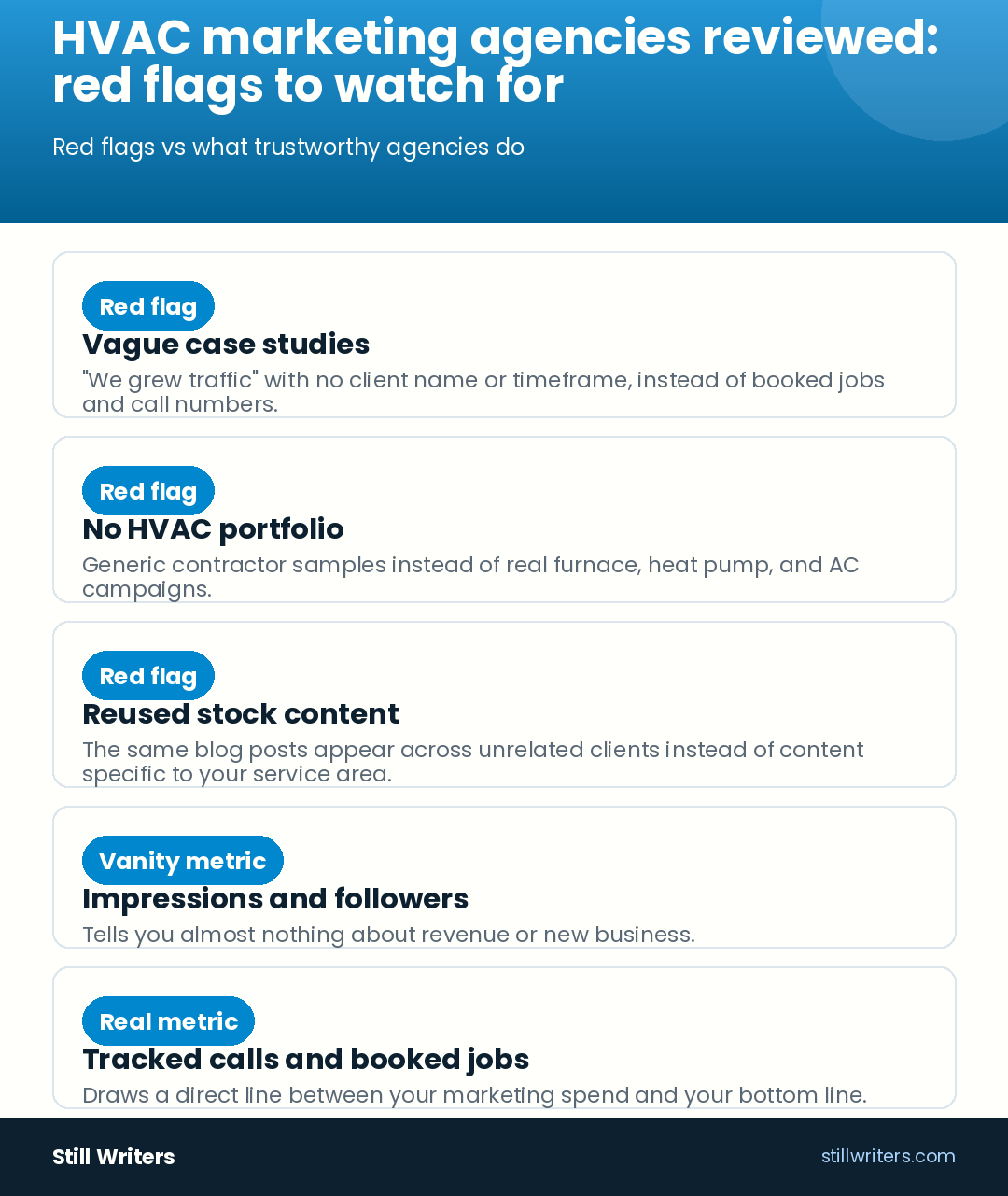
| Vague case studies | “We grew traffic” with no client name or timeframe | Shares booked jobs and call numbers tied to a named client and a date range |
| No HVAC portfolio | Generic contractor or “home services” samples | Shows real furnace, heat pump, and AC campaigns they’ve run |
| Reused stock content | The same blog posts appear across unrelated clients | Writes original content specific to your service area and equipment |
If you want a deeper look at why agencies without trade knowledge tend to fall short, we cover that angle in why generic marketing agencies fail Canadian HVAC contractors. Before you sign anything, ask any agency for three references you can actually call, and check their HVAC content and SEO services against what you see in their portfolio.
Why does ignoring Canadian specifics matter?
A lot of agencies that market to HVAC contractors are built around a template designed for American trades. That gap shows up fast once you ask a simple question. Do you write for French speaking homeowners if I operate in Quebec? Do you know the difference between a federal rebate and a provincial one like CleanBC in British Columbia? If the answer is a blank stare, that agency hasn’t done its homework on your market. The Heating, Refrigeration and Air Conditioning Institute of Canada, known as HRAI, sets the training and certification standards Canadian technicians work under. An hvac marketing company that never references bodies like HRAI or the Technical Standards and Safety Authority in Ontario probably hasn’t looked past a basic search before pitching you.
Bilingual content and rebate season blind spots
In Quebec, French language content isn’t a bonus feature. It’s a real requirement for reaching a meaningful share of homeowners, and we go deeper on that question in bilingual vs. English only marketing for Quebec. The same idea applies to rebate season. Ontario has run rebate programs through Enbridge Gas and the Ontario Energy Board, BC layers CleanBC rebates on top of federal ones, and Atlantic Canada is shifting away from oil heat toward heat pumps faster than almost anywhere else in the country. An agency that treats all of Canada like one market, or worse, like the U.S. with a different flag on the homepage, is going to miss the campaigns tied to those programs entirely. Ask if they understand where Canadians actually check a contractor’s reputation too, platforms like HomeStars and TrustedPros, beyond plain Google reviews. We compare the two approaches directly in HomeStars and TrustedPros vs organic SEO if you want the full picture.
What sales tactics should worry you?
- Guaranteed number one rankings: no agency controls Google’s algorithm, and a guaranteed top spot is a sign they’re selling a fantasy, not a strategy.
- Long lock-in contracts with no exit clause: a 12 or 24 month term with no cancellation window shifts all the risk onto you if the work doesn’t perform.
- Pressure to sign on the first call: real strategy takes research into your market and your competitors, so a same-day signature usually means a script, not a plan.
- Vague setup fees with an unclear scope: if nobody can tell you exactly what a setup fee pays for, ask for it in writing before you agree to anything.
- No named point of contact: if you can’t get the name of the person actually writing your content or managing your campaigns, you’re likely dealing with a call center, not a team.
- Discounts tied to signing today: urgency built around a phone call, rather than around your business needs, points to a sales quota, not a fit for your company.
Is your reporting showing the right numbers?
A monthly report full of impressions, follower counts, and page views can look impressive on a screen and still mean almost nothing for your business. Those numbers describe attention, not revenue. A homeowner scrolling past your Instagram post isn’t the same as a homeowner calling to book a furnace repair. Vanity metrics are easy to grow and easy to report, which is exactly why some agencies lean on them instead of the harder work of tracking calls, form fills, and booked jobs back to the marketing spend that produced them.
What good reporting actually includes
A trustworthy hvac marketing company will show you call tracking numbers tied to specific campaigns, form submissions with a source attached, and a rough cost per booked job. Canadian HVAC contractors typically pay $1,500 to $5,000 or more a month for SEO services, and content marketing tends to run in a similar range. If you’re paying that much and only getting a slide of follower growth, something in that relationship isn’t working. We break down what typical spend actually buys in what HVAC marketing costs in Canada in 2026, and it’s worth reading before your next contract renewal.
| Metric type | Example | What it actually tells you |
|---|---|---|
| Vanity metric | Impressions, followers, page views | Almost nothing about revenue or new business |
| Real metric | Tracked calls, booked jobs, cost per lead | A direct line between your spend and your bottom line |
If content is part of your package, ask what a fair rate actually looks like too. We lay out current benchmarks in content writing rates for HVAC companies, so you can spot a fee that’s out of line with the work being delivered.
How do you evaluate an HVAC marketing company before you sign?
- Ask for three live client references: call them directly and ask what results actually looked like month to month.
- Request a sample report: a real one, not a mockup, so you can see if calls and jobs are tracked or just impressions.
- Read the contract’s cancellation terms first: know exactly how and when you can leave before you talk about anything else.
- Ask about Canadian specific experience: bilingual content, provincial rebate programs, and familiarity with HRAI or provincial licensing bodies.
- Confirm who does the actual work: get a real name, beyond a sales rep, for the person managing your account day to day.
- Compare more than one quote: pricing that’s wildly out of step with the market in either direction deserves a second look.
If any of this feels overwhelming, go straight to our list of questions Canadian HVAC companies ask most before hiring an agency for a longer pre-hire checklist. When you’re ready to compare notes on your own contract or reporting, reach out to our team and we’ll walk through it with you, no pressure attached.
Frequently asked questions about HVAC marketing agency red flags
What’s the biggest red flag when hiring an HVAC marketing company? Vague case studies are the biggest one. If an agency can’t name a client, a market, and a real number like booked jobs or calls, treat that as a sign they don’t have proof their work performs.
How long should an HVAC marketing contract run? Look for month to month terms, or at most a contract with a clear cancellation window under 90 days. A long lock-in with no exit clause protects the agency, not you.
Can an agency really guarantee a first page Google ranking? No agency controls Google’s ranking algorithm, so a guaranteed number one spot isn’t a real promise. Treat that claim as a sales tactic rather than a strategy.
Do Canadian HVAC contractors need bilingual marketing content? If you operate in or near Quebec, French language content reaches a large share of homeowners you’d otherwise miss. It’s worth asking any agency directly if they can produce it.
What should HVAC marketing reports actually include? Look for tracked calls, form submissions with a source attached, and a rough cost per booked job. Impressions and follower counts alone don’t tell you if the work is paying off.
Picking an HVAC marketing company without regret
You came here because you wanted a way to tell a trustworthy HVAC marketing company from one that’s just good at selling itself. The red flags above give you a real, checkable list to work through before you sign anything.
A quick recap of what to watch for:
- Vague case studies with no client name, market, or real number attached.
- Contracts with long lock-in periods and no clear exit clause.
- No HVAC-specific portfolio or reused stock content across clients.
- No mention of Canadian factors like bilingual content, provincial rebates, or HRAI standards.
- Reporting built on impressions and followers instead of calls and booked jobs.
We built Still Writers around plain answers to questions like these, because we’d rather earn your trust with a clear conversation than a slick pitch. Our team has written HVAC content and managed campaigns across BC, Alberta, Ontario, Quebec, and Atlantic Canada, and we’re glad to show you exactly what we track and why. If you’d like a second opinion on a contract you’re already looking at, or a straightforward quote for what honest work costs, we’re an easy call to make.
What should you read next?
If you want to keep learning before you pick up the phone, here are three places to start.
- Questions Canadian HVAC companies ask before hiring a marketing agency: a longer checklist to work through before any contract talk starts.
- HVAC lead generation tools reviewed 2026: an honest look at the platforms and tools worth paying for.
- Google Business Profile for HVAC companies: an honest review: a plain look at one tool every HVAC contractor should be using correctly.
If you’re not ready to talk to us yet, these three resources are a solid place to keep learning first.