
Key takeaways
- Redesign first only if something on your site is actually broken, old looking design alone doesn’t count, think missing phone numbers, no mobile view, or a platform nobody can update.
- Content marketing wins when your site works but Google has nothing to find, no blog, no service area pages, no answers to the questions people actually search.
- Ontario contractors in the GTA carry the highest stakes, since competition for HVAC keywords there is thicker than almost anywhere else in the country.
Picture this: you have one HVAC web marketing budget left this quarter, and you have to spend it on one thing. A new website or a stack of blog posts and service pages. Not both. Which one earns its keep first? Nearly six in ten Canadian employer businesses run with four people or fewer, and a lot of HVAC shops fall into that group. When the budget is tight, you can’t fund a full redesign and a real content push in the same month. You have to pick an order. Pick wrong and you either spend thousands on a beautiful site nobody can find, or you publish blog posts on top of a site that loses visitors before they finish reading the headline.
At Still Writers, we’ve written HVAC content for contractors in Canada and the United States, and we pick up the technical side of a trade fast: licensing rules, refrigerant changes, the way a shoulder season call differs from a July emergency. That’s not the only path to good HVAC marketing help. Some specialist shops and skilled freelancers do excellent work too. What we bring is a habit of turning trade knowledge into pages that rank and copy that reads like it came from someone who has actually stood in a customer’s basement.
How HVAC web marketing splits into two different investments
A redesign and content marketing aren’t the same kind of work, even if both fall under HVAC web marketing. A redesign changes the structure of your site. Layout, navigation, mobile behavior, the platform it runs on. Content marketing adds new pages over time. Blog posts, service area pages, FAQ content, the material Google actually needs to understand what you do and where you do it. You can have a gorgeous, fast, mobile friendly site with almost nothing on it for Google to rank. You can also have a clunky old site sitting on page one because it has ten years of local content behind it. The two problems need different fixes, and mixing them up is how contractors waste a marketing budget.
Why contractors mix these two up
Most contractors judge their website the way they judge a truck. Does it look clean? Does it start every morning? A site can look fine and still be invisible to Google, or look dated and still bring in calls every week. The real question isn’t how the site looks to you. It’s what it does for a stranger searching for emergency furnace repair at midnight, and what it hands Google to work with. Our article on why your HVAC website gets clicks but not calls digs into the difference between traffic and trust. This article is about something upstream of that: which investment earns your next dollar first.
| Investment | What it actually fixes | Typical cost pattern | Typical timeline |
|---|---|---|---|
| Website redesign | Broken mobile experience, missing trust signals, an unsupported platform | One lump sum, paid once | Weeks to launch, results depend on what comes after |
| Content marketing | Thin pages, no blog, no service area coverage, weak rankings | $1,500 to $7,000 a month for content, $1,500 to $5,000 a month for broader SEO | Usually 3 to 6 months before rankings move |
Neither number is small for a shop watching every dollar. That’s exactly why the order matters. Spend on the wrong one first and you’re paying twice, once for the mistake and once for the fix. If you want a full breakdown of what each option runs in Canada, our pricing page lays out real ranges instead of vague guesses.
When should a redesign come first?
A redesign earns first priority when your site is actively working against you. More than half of Canadians say a website makes a business look more credible, and that cuts both ways. A broken or outdated one can make a legitimate company look like it’s already out of business. If your site fails on a phone screen, hides your phone number, or leaves off your TSSA or gas fitter license number, no amount of content will fix that. You need the foundation fixed before you build on top of it.
Signs your site needs surgery before content
A few situations make the redesign call easy. Your site was built on a platform that no longer gets updates, so you can’t add a page even if you wanted to. Your contact form has been silently failing for months and nobody noticed. Your site loads so slowly on mobile that half your visitors leave before it finishes. In any of these cases, more blog posts won’t save you. You’d be pouring content into a leaky bucket.
The clearest signs you need a redesign before content
- Your site isn’t mobile friendly: most searches for emergency HVAC help happen on a phone, and a site that doesn’t work there loses the call before it starts.
- Your phone number or license is missing: homeowners want proof you’re licensed and easy to reach before they’ll book anything.
- Your site runs on a platform nobody supports anymore: if your own web person can’t safely add a page, content marketing has nowhere to go.
- Your contact form or click to call button is broken: traffic without a working way to reach you is wasted traffic.
- Your site has no security certificate: browsers flag it as unsafe, and that warning kills trust before someone reads a word.
When does content marketing win the race for first dollar?
Content marketing should come first when your site already works. It loads fine on a phone, it shows your license and phone number, and nobody would call it broken. The problem is nobody can find it. Roughly 73% of Canadian shoppers research a business on Google before they call, and if your site has no blog, no service area pages, and no answers to common questions, Google has nothing to send those searchers to. A modern site with five pages on it will lose to a dated looking competitor with two hundred pages of real local content, almost every time.
Why thin content costs you the map pack
Local rankings aren’t only about having a Google Business Profile filled out. Whitespark’s annual Local Search Ranking Factors report, one of the most cited studies on what actually moves local rankings, points to the same signals again and again: relevant content, real reviews, and pages built around specific services and specific places. A contractor in the GTA competing for “furnace repair Toronto” needs a page built for that exact search, not one generic services page trying to cover every city at once. Ontario’s Greater Toronto Area is one of the most competitive HVAC markets in the country, and generic pages simply don’t hold up there. The same pattern shows up in Alberta, where contractors serving Calgary compete against dozens of established shops, and in British Columbia, where the Lower Mainland around Vancouver is just as crowded.
| Content gap | Why Google skips you | What to publish first |
|---|---|---|
| No blog | Nothing fresh signals a search engine that keeps ranking | Monthly posts answering real customer questions |
| No service area pages | You can’t rank locally in towns you never mention | One page per city or region you actually serve |
| Thin service pages | A single paragraph reads like a brochure, not an answer | Expanded pages that answer buyer questions in depth |
| No FAQ content | Long, specific searches never find a matching page | Dedicated FAQ sections or posts on niche questions |
None of this requires a redesign. It requires writing. Our piece on why Canadian HVAC companies struggle to rank on Google covers this exact gap in more depth, if you want the fuller picture of what’s usually missing.
How to decide which comes first for your business
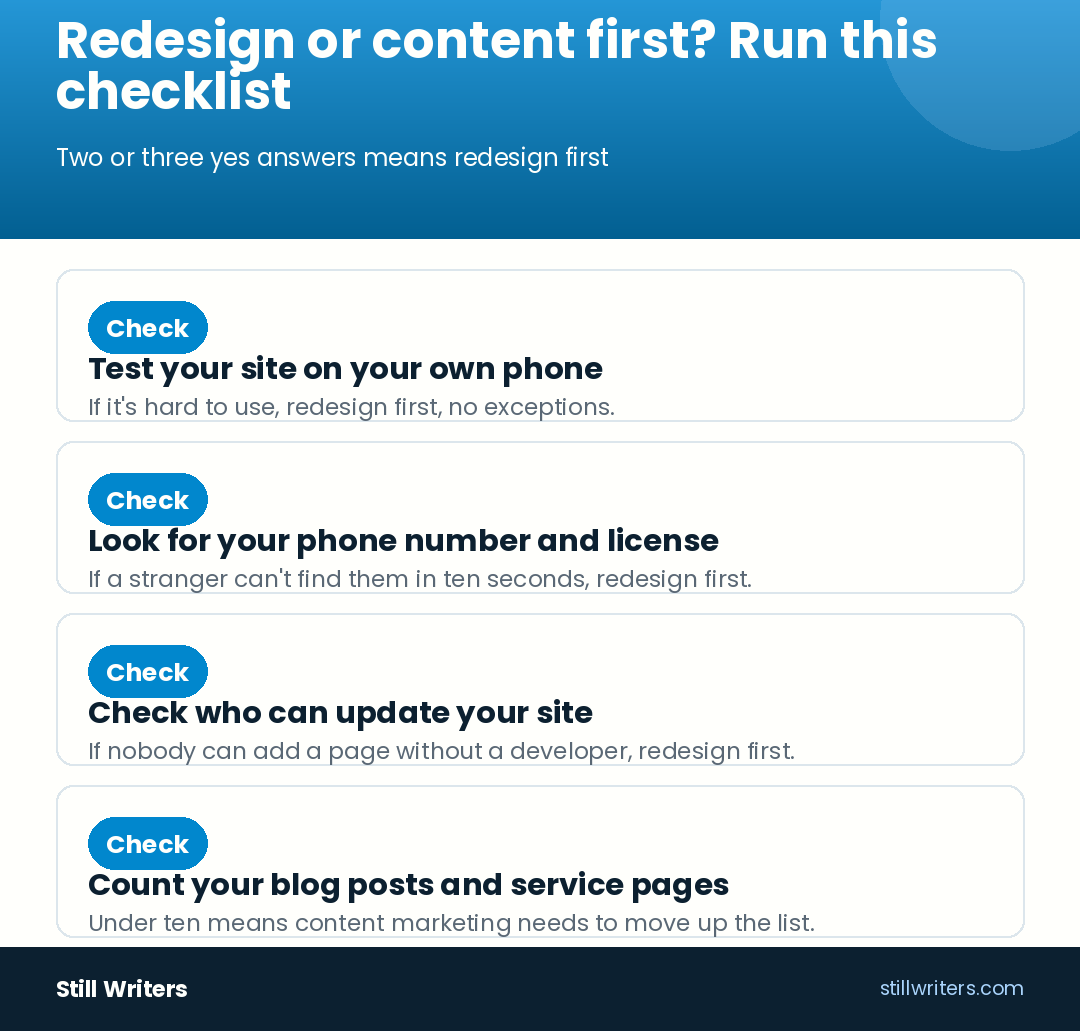
Here’s a simple way to make the call without agonizing over it.
- Test your site on your own phone: if it’s hard to use, redesign first, no exceptions.
- Look for your phone number and license: if a stranger can’t find them in ten seconds, redesign first.
- Check who can update your site: if nobody can add a page without a developer, redesign first.
- Count your blog posts and service pages: if that number is under ten, content marketing needs to move up the list.
- Search your own business name plus your city: if you don’t show up with real content, content marketing comes first.
If two or three of those point to problems with the site itself, put your money into a redesign first, then move into content once the foundation holds. If the site passes those checks but the content side comes up empty, skip the redesign and put your budget into blog posts, service pages, and local content instead. Not sure where your business lands? Our services page breaks down both kinds of work, and you’re welcome to reach out and talk it through. If budget is the real constraint here, our guide on what a small Canadian HVAC company should budget for digital marketing can help you plan the spend either way.
Frequently asked questions about HVAC web marketing
Do I need a new website before I start blogging? Not if your current site works. If it loads fine on a phone and clearly shows your phone number and license, you can start publishing blog posts and service pages right away. Save the redesign money for later.
How much should a small HVAC company budget for a redesign versus content? A redesign is usually a one time cost, while content marketing runs monthly, often between $1,500 and $7,000 depending on volume. If your monthly budget is under $2,000, most contractors get more value from steady content work than from a full rebuild.
Can content marketing work on an old, ugly website? Yes, as long as the site actually functions. Google cares more about content and local relevance than how modern your design looks. A dated site with strong service pages can still outrank a beautiful one with almost nothing written on it.
How long does it take for content marketing to start working? Most contractors start seeing movement in local rankings within three to six months of consistent publishing. Emergency and seasonal searches tend to respond faster than broad, competitive keywords.
What if I can only afford one of these this year? Pick based on what’s broken, not what’s old. If people can’t use your site on a phone or can’t find your number, fix that first. If the site works but Google has nothing to rank, put the year’s budget into content instead.
Where should your HVAC web marketing budget go first?
You came here trying to stretch one budget across two real needs, a better website and content that actually ranks. That tension doesn’t go away, but the order you tackle it in matters more than either investment on its own.
- Fix what’s broken first: a site that fails on mobile or hides your license needs a redesign before anything else.
- Write when the foundation is solid: a working site with no blog or service pages needs content, not a rebuild.
- Ontario’s GTA raises the stakes: competitive markets punish thin content and broken sites faster than quiet ones do.
- Cost patterns differ: a redesign is one payment, content marketing is an ongoing monthly investment.
- The right order saves money: guessing wrong means paying for the same problem twice.
We’ve watched contractors make both mistakes, the redesign that nobody can find and the content pile added onto a site homeowners don’t trust. We’ve also watched a client’s monthly organic visits climb sharply within six months once the order was right, content built on top of a site that already worked. We’d like to take a look at where you stand and tell you honestly which move comes first for you. Go ahead and click below to talk to a real person about it.
What should you read next?
If you want to keep learning before you pick up the phone, here are three places to start.
- Why your HVAC website gets clicks but not calls: a deeper look at what makes a site actually convert once it’s fixed.
- Why do Canadian HVAC companies struggle to rank on Google?: the content gaps that keep otherwise good sites invisible.
- What should a small Canadian HVAC company budget for digital marketing?: a practical budget breakdown for whichever investment you choose first.
If you’re not ready to talk to us yet, these three articles are a solid place to keep learning.