
Key takeaways
- Ask about HVAC specific experience before anything else, since general home services marketing does not automatically translate to furnace, AC, and heat pump searches.
- Demand proof from a Canadian HVAC client, not an American case study, because search behavior and review platforms differ enough between the two markets to matter.
- Get ownership and reporting terms in writing before you sign anything, so you are never locked out of your own website or left guessing what your money bought.
Almost three quarters of Canadian homeowners research a company online before they ever call it, according to industry data on local search behavior. That means the agency you pick to run your marketing is not a small hire you can undo quietly. It is the difference between a homeowner in Mississauga finding your number first or finding a competitor’s instead. Before you sign a contract with an hvac marketing agency in canada, you need direct answers, not a polished pitch deck. Too many HVAC owners find this out the hard way, three or four months into a contract, when the leads never show up and nobody can explain why.
At Still Writers, HVAC is one of the trades we chose to go deep on, not because it is easy, but because most marketing shops treat every home service business the same way. We learn the language of your trade, from SEER ratings to how a dispatcher actually talks to a homeowner with no heat in January, before we write a single page. Plenty of general marketing agencies do solid work. What we bring is real time spent inside the HVAC industry, in Canada and the U.S., so we are not guessing at what a homeowner in Halifax or Red Deer needs to see before they pick up the phone.
Do they actually understand HVAC, or just “home services”?
A lot of agencies list HVAC as one line item next to plumbing, roofing, and landscaping. That is a red flag on its own. Furnace repair searches spike with the first cold snap of the year. AC installation searches spike in June. Heat pump searches now carry rebate questions attached to them almost every time. A generic home services marketer treats all of that as one undifferentiated “contractor” bucket, and it shows up in the copy they produce and the keywords they chase.
Ask if the agency understands the difference between a maintenance plan pitch in Calgary and an emergency no heat call in rural Nova Scotia in February. Ask if anyone on their team knows what HRAI training standards cover, or what a TSSA certification actually means to an Ontario homeowner reading your site. You are not trying to trip anyone up. You are checking if they have spent real time learning your trade, or if they are running the same playbook they use for a roofing client and hoping it fits.
Questions that separate real HVAC experience from generic claims
Use a short list of direct questions on your first call with any agency. The answers tell you more than any pitch deck will.
| Question you ask | Answer that’s a good sign | Answer that’s a red flag |
|---|---|---|
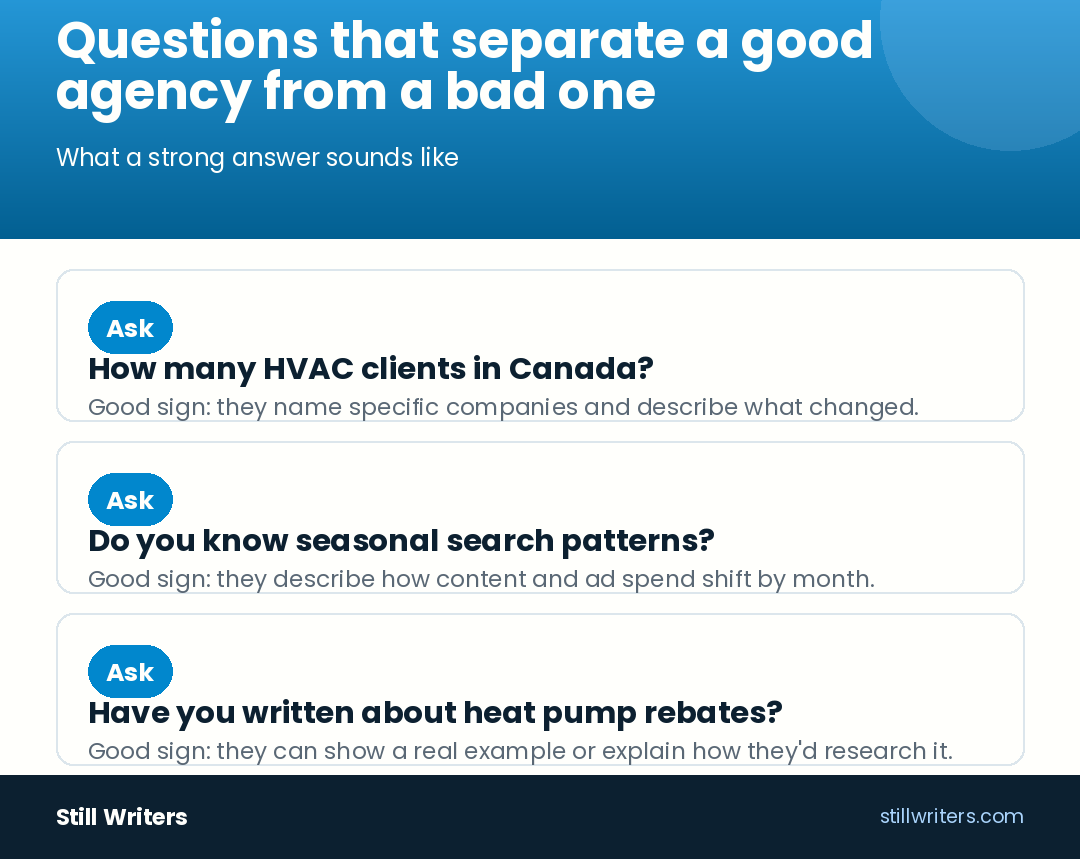
| How many HVAC clients have you worked with in Canada? | They name specific companies and describe what changed for them. | They talk in generalities about “home services experience”. |
| Do you know the seasonal search patterns for furnace and AC work? | They describe how content and ad spend shift by month. | They treat every month the same. |
| Have you written about heat pump rebates before? | They can show a real example or explain how they would research it. | They ask you to explain what a heat pump is. |
If an agency cannot answer these clearly, that does not mean they are dishonest. It usually means HVAC is new territory for them, and you would be paying for their learning curve on your dime. Check their services page or ask directly for a list of past HVAC clients before you go any further in the conversation.
Can they show you real results for a Canadian HVAC company?
Google handles roughly 86 percent of all search traffic in Canada. That number matters because it means most of what an agency does for you comes down to how well they understand Google specifically, not a mix of tools some American agencies lean on that barely apply here.
Ask for results from an actual Canadian HVAC client, by name if possible. A screenshot of traffic growth from a plumbing company in Ohio tells you nothing about what will happen for a furnace company in Red Deer or Dartmouth. Ranking factors, review platform habits, and even how homeowners phrase their searches shift enough between the two countries that American case studies are close to useless as proof of anything.
What “real results” should actually include
A credible agency should show more than a chart with a line going up and to the right. Ask them to walk you through phone call numbers, form submissions, and where those leads came from geographically. Whitespark, an Edmonton based company that publishes the industry’s most cited Local Search Ranking Factors report, is a useful reference point if you want to sanity check what actually moves local rankings versus what an agency claims moved the needle for you.
If you run crews across more than one city, for example between Calgary and Edmonton, ask how their reporting breaks results out by location. A single blended number covering two very different markets hides more than it reveals about where your budget is actually working.
Who owns your website and content if you leave?
This question gets skipped more than any other, and it is the one that costs HVAC owners the most later. Some agencies build your site on a platform only they control. If you leave, your site and your content history leave with them. You start over from zero, including the reviews, backlinks, and ranking history your business earned over years.
A little more than half of Canadians, 53 percent say a website makes a business look more credible, per research from CIRA. That website is a real business asset. Treat ownership of it the same way you would treat ownership of a service truck or a piece of equipment on your balance sheet.
- Ask who holds the domain registration. It should sit in your company’s name, not the agency’s.
- Ask what happens to blog content if you leave. You paid for those pages, so you should keep them.
- Ask if the website lives on a platform you can move. A closed system that only the agency can edit is a lock in, not a convenience.
- Ask for login access from day one. You should never need to beg for admin access to your own website.
Price matters too, but it is not the whole picture. If you want a sense of typical ranges, our pricing page is a fair starting point, but ownership terms matter just as much as the number on the invoice. This overlaps with contract language, and we cover the exact clauses to watch for in our breakdown of what an HVAC marketing agency in Canada actually charges. That article gets into the fine print. This one is about making sure you ask the ownership question at all, before you are three months into a contract and realize you never did.
What should their reporting actually look like?
A monthly PDF full of jargon is not a report. It is filler designed to look like activity. Before you sign anything, ask exactly what a report will contain and how often you will actually see one.
What a healthy reporting cadence looks like
Most solid agencies report monthly, with a short call or written summary tied to real outcomes: phone calls, form fills, booked jobs, and where those leads originated. Quarterly deep dives work fine for strategy check ins, but monthly is the minimum for HVAC, because seasonal shifts happen fast and you need to catch problems before an entire season gets wasted.
| Reporting habit | What it usually means | What to do about it |
|---|---|---|
| Monthly call plus written summary | The agency is comfortable being questioned. | This is the standard to expect. |
| Dashboard access only, no calls | You get raw numbers but no context. | Ask for at least one scheduled review call per quarter. |
| Vague quarterly recap, no raw numbers | You cannot verify what actually happened. | Push for call tracking and form data, not summaries alone. |
Ask specifically if call tracking is included. A lead that calls your office because of an ad or a ranked page should show up somewhere in a report. If an agency cannot tie their work back to actual phone calls and booked jobs, you are being asked to trust the process on faith alone, and that is not a fair trade for your marketing budget.
It also helps to ask about realistic timelines up front. SEO in particular is slow. Most HVAC companies should expect three to six months before rankings move in a meaningful way, and closer to six to twelve months before that turns into steady, dependable lead flow. An agency that promises page one rankings in a few weeks is selling you a story, not a strategy. Read more about why this timeline runs longer than most owners expect in our piece on why Canadian HVAC companies struggle to rank on Google.
Do they understand provincial rebates and bilingual rules?
Canada is not one market. What works in Surrey does not automatically work in Sydney, Nova Scotia, and the rebate landscape changes by province and sometimes by utility. Close to 274,000 heat pump installations across Canada have been funded through federal rebate programs, with cold climate units built for extreme cold making up most of that total. If your marketing content ignores rebates entirely, you are leaving one of the biggest reasons homeowners search for HVAC companies right now sitting on the table.
Provincial and language questions worth asking directly
- Ask if they track federal programs like the Canada Greener Homes Initiative and can explain how it layers with provincial rebates in your area.
- Ask how they handle Quebec if you operate there. French language content is a real requirement for a meaningful share of that market, not a nice to have add on.
- Ask if they adjust messaging by region. An Alberta furnace replacement pitch and an Atlantic Canada oil to heat pump conversion pitch are different conversations entirely.
- Ask how they stay current. Rebate programs change often enough that content written a year ago can quietly go stale and start giving homeowners the wrong numbers.
None of this means every agency needs a French speaking writer on staff or a specialist in every province. It means they need a process for finding this information and updating content when it changes. That is a very different thing from an agency that has simply never thought about it. You can see how this looks across our own Canadian market pages, and for a broader look at how this plays out province by province, our honest review of the Canadian HVAC market in 2026 is a useful companion read.
You should also ask how they think about review platforms. HomeStars and TrustedPros carry real weight with Canadian homeowners the way Angi and HomeAdvisor do in the U.S. An agency that only knows the American platforms is going to miss a channel that matters here. We go deeper on how these platforms stack up against organic search in our comparison of HomeStars and TrustedPros versus organic SEO, if that is a decision you are weighing too. If you would rather talk through any of this directly, our contact page gets you to a real person, not a form that disappears into a queue.
Frequently asked questions about hiring an HVAC marketing agency in Canada
How long should I trial an agency before deciding if it is working? Give a new agency at least three months before judging results, and six months for a fair read on SEO specifically. Anything shorter does not give search engines enough time to respond to real changes on your site.
Should I hire a specialist HVAC agency or a general local marketing firm? A specialist usually gets you faster results because they already understand seasonal demand and trade specific keywords. A strong general firm can still work well if they are upfront about learning your industry and can show a real plan for doing it.
What is a reasonable number of case studies to ask for? Two or three relevant examples are enough. Focus more on the depth of detail they can share about each one than on the total count they hand you.
Do I need a bilingual agency if I only operate in Ontario or Alberta? No. Bilingual capability matters most if you operate in Quebec or serve a meaningful French speaking population elsewhere. Outside those cases, it is not a deciding factor.
What is the biggest mistake HVAC owners make when choosing an agency? Signing based on price alone before asking about ownership, reporting, and past HVAC specific results. A cheaper contract that leaves you locked out of your own website ends up costing more in the long run.
Questions to ask an HVAC marketing agency in Canada
You came here because you did not want to find out the hard way that an agency was not the right fit, three months and several thousand dollars into a contract. The questions above exist so you catch problems before you sign, not after.
Here is what to keep in front of you before your next call with an agency:
- Confirm real HVAC experience, not general home services claims.
- Ask for Canadian proof, not American case studies.
- Get ownership of your website and content in writing.
- Set a reporting cadence before you sign, ideally monthly with real numbers attached.
- Ask about provincial rebates and bilingual needs if they apply to where you operate.
We have sat on both sides of this conversation, working with HVAC companies across Canada who came to us after a rough first agency experience, and others who came to us first and never looked elsewhere. Some of those companies had already talked to two or three other agencies before choosing us, and that is a good instinct, not an insult. Ask hard questions of anyone you are considering, us included. If you would rather talk it through with a real person than read one more article, click below and we will walk through your specific situation together.
What should you read next?
If you want to keep learning before you pick up the phone, here are three places to start.
- Agency vs. DIY marketing: what it actually costs Canadian HVAC contractors to go it alone: helpful if you are still deciding if an agency is the right move at all before you start interviewing them.
- Why your HVAC website gets clicks but not calls: a good look at what happens after you hire the right agency and still are not seeing the phone ring.
- The best HVAC marketing ideas Canadian contractors are actually using in 2026: useful context for judging if an agency’s proposed strategy actually matches what is working right now.
If you are not ready to talk to us yet, these three resources are a solid place to keep learning.