
Key takeaways
- The Canadian HVAC market is growing fast, but unevenly, with most of the gains going to contractors who show up early in a homeowner’s search, not to the industry as a whole.
- The heat pump shift has changed what homeowners actually type into Google, so a marketing plan built for furnace and AC keywords alone is already out of date.
- The labour shortage is now a marketing problem too, because contractors need a website and reputation strong enough to recruit technicians, on top of customers.
Ask five HVAC contractors across Canada how business is going right now and you will get five different answers. Some are turning away work every week. Others are struggling to find a single new customer, let alone a technician to send out on the job. Both of those things are true at the same time, and that tension is the real story of the HVAC market in 2026. The Canadian HVAC market is worth close to USD 5.98 billion this year and is on track to keep growing at a healthy pace, yet a lot of that growth is landing on a smaller group of contractors who figured out how people search for help now. If your company is not one of them yet, the gap between you and them gets wider every quarter you wait.
At Still Writers, we spend our days reading reports like this one, then turning them into content and marketing plans for HVAC companies from Victoria to Halifax. What we bring to the table is a habit of digging into an industry’s real numbers and real search behaviour before we ever touch a website, built from years of writing for contractors across both Canada and the U.S. Plenty of other agencies do solid work in this space, and plenty of contractors do just fine handling marketing in house. But too many HVAC websites still read like they were written by someone who has never set foot on a job site, and homeowners can tell. This review is our honest look at where the industry actually stands, not a pitch.
How big is the Canadian HVAC market right now?
Start with the size of the thing. The Canadian HVAC market sits at roughly USD 5.98 billion in 2026, and it is projected to reach USD 8.85 billion by 2031. That works out to an annual growth rate above 8%, which is fast for an industry most people assume is mature and boring. Furnaces and central air still make up a big share of that revenue, but the growth line is being pulled upward by something else entirely: heat pumps, retrofits, and a wave of replacement work as older systems reach the end of their life.
Canada also had 1,079,188 small businesses with 1 to 99 employees as of December 2024, and that group makes up 98.2% of all employer businesses in the country, according to Innovation, Science and Economic Development Canada. Most HVAC contractors fall squarely into that small business category. That matters, because it means most of your competitors are running lean operations with small marketing budgets, and a handful of well funded franchises and larger regional players are the exception, not the rule. The HVAC marketing landscape in most Canadian cities still has real gaps a smaller company can win.
Where the growth is actually coming from
A big chunk of new demand is tied directly to federal and provincial rebate programs pushing homeowners toward electrification. Programs run through Natural Resources Canada’s Canada Greener Homes Initiative have helped fund close to 274,000 heat pump installations across the country, with cold climate units built for extreme temperatures making up the majority of those. That is not a niche trend anymore. It is a meaningful share of total system replacements happening right now, and it looks different depending on where you operate. A contractor in Calgary is fielding very different calls than one in coastal British Columbia or one in Nova Scotia, where oil heat has been the default for decades and the switch to a heat pump is a bigger relative jump for the homeowner.
| Metric | Figure | What it means for contractors |
|---|---|---|
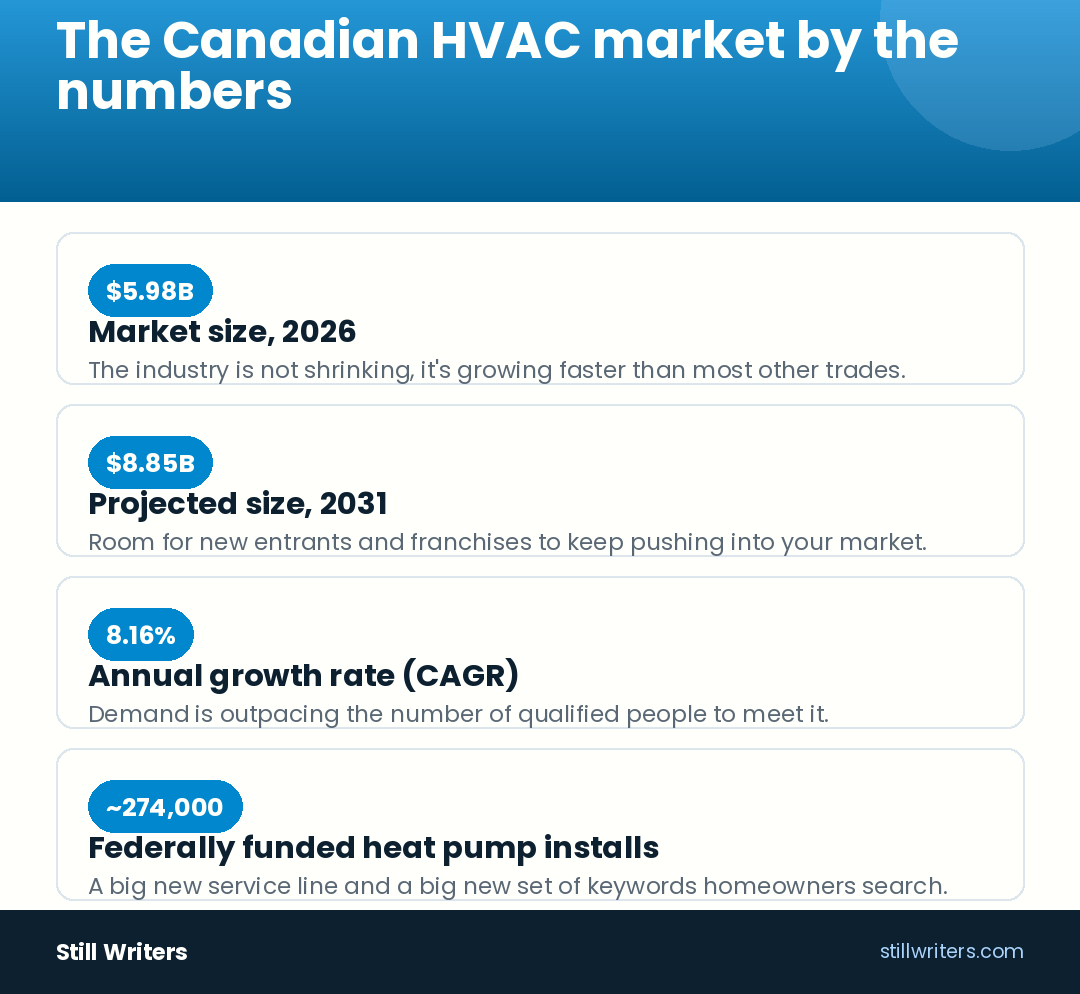
| Market size, 2026 | USD 5.98 billion | The industry is not shrinking. It is growing faster than most other trades. |
| Projected size, 2031 | USD 8.85 billion | Room for new entrants and franchises to keep pushing into your market. |
| Annual growth rate | 8.16% CAGR | Demand is outpacing the number of qualified people to meet it. |
| Federally funded heat pump installs | Roughly 274,000 | A big new service line, and a big new set of keywords homeowners search for. |
| HVAC technicians employed nationally (2023) | 46,100 | Not enough people to cover the growth above, which is pushing wages and recruiting costs up. |
The pattern across every province is roughly the same, even if the pace differs. British Columbia and Alberta are ahead on heat pump adoption because of provincial incentives layered on top of federal ones. Ontario has the biggest single market in raw dollar terms, thanks to the size of the Greater Toronto Area. Quebec has its own rebate structure through Hydro Quebec and a real requirement for French language content that a lot of national campaigns quietly ignore. Atlantic Canada is smaller in absolute numbers, but the shift away from oil heat there is arguably the biggest behavioural change happening in the country right now.
What’s actually going well in the Canadian HVAC industry?
It is not all doom and gloom, and a fair review has to say so. A handful of things are genuinely working in contractors’ favour this year.
Demand is not the problem. Between rebate driven electrification, an aging housing stock, and a run of extreme weather events in several provinces, homeowners have more reasons to call an HVAC company than they did five years ago. Roughly 72% of Canadians already research a purchase on Google before buying, and Google itself handles about 86% of all search traffic in the country. That means the path to a new customer is well worn and well understood. If you show up in the right spot on that path, you get the call. The strategy does not have to be complicated. It has to be consistent, and a lot of contractors still are not doing the basics well, which leaves room for a smaller company to look better online than a bigger competitor down the street.
Trust platforms have also matured. Homeowners lean on HomeStars and TrustedPros the same way Americans lean on Angi or HomeAdvisor, and 53% of Canadians say a website makes a business look more credible in the first place. A contractor with a clean website, a real review history, and a listing on both of those platforms is doing more to win trust than most people give credit for. That is a genuinely good story, and it is one a lot of contractors have not fully taken advantage of yet.
The challenges: what’s actually working against contractors
Now for the honest part of the review. A few things are working against contractors right now, and none of them are going away on their own.
- The technician shortage is real and structural. Job Bank Canada rates this occupation as facing a strong risk of labour shortage nationally through 2033, with about a quarter of the current workforce already aged 50 or older and heading toward retirement.
- Customer acquisition and technician recruiting now compete for the same budget line. A careers page that looks like an afterthought sends a signal to job seekers, and in a tight labour market that signal costs you.
- Franchise competition is intensifying in almost every metro area. Larger, well capitalized brands are buying up local operators or opening new territories in cities like Vancouver and Edmonton, and they usually arrive with bigger ad budgets than the independent shops already operating there.
- AI powered search results are cutting into organic traffic. Roughly 58% of Google search pages now show an AI Overview at the top, and organic click through rates can drop by up to 61% when one appears, according to Forbes reporting on Google’s search changes.
- Rising material and labour costs are squeezing margins. That leaves less room in the budget for marketing, right at the moment marketing has become harder to get right.
What’s changing fast: the shifts reshaping HVAC marketing
A few forces are moving quickly enough right now that a marketing plan built even two years ago is probably already behind. These are the ones worth paying attention to.
Homeowners are searching for different things
The heat pump shift is more than a product change. It is a language change. Homeowners used to search almost entirely for furnace repair, AC installation, and duct cleaning. Now a growing share of searches involve rebate programs, cold climate performance, and direct comparisons between systems. A contractor whose website only targets the old keyword set is invisible for a big and growing slice of local demand.
| What homeowners searched for before | What homeowners search for now |
|---|---|
| Furnace repair near me | Heat pump installer near me |
| AC installation cost | Heat pump vs air conditioner cost |
| Furnace replacement financing | Heat pump rebate Canada 2026 |
| HVAC company reviews | Best HVAC company for cold climate heat pumps |
| Central air maintenance plan | Does a heat pump work in a Canadian winter |
That right column is where a lot of the future search volume lives, and most local contractor websites still barely mention it. Writing genuinely useful content around those newer questions, instead of only a sales page, is one of the more reliable ways to catch that traffic before a franchise competitor does. Our own breakdown of what HVAC SEO actually costs digs into how much budget it realistically takes to build that kind of content library.
AI search is changing how you get found at all
Search engines used to just send people to a list of ten blue links. Now a growing share of queries get answered directly on the results page by an AI generated summary, before the user ever scrolls down to a website. That is a real shift in how visibility works, and it rewards businesses whose information is clear, consistent, and easy for an AI system to pull from, beyond old style keyword matching. We have written a full explanation of why so many Canadian HVAC companies struggle to rank on Google if you want the deeper version of this problem.
The practical upside is that being genuinely useful now doubles as good SEO and good AI visibility. Answering the questions homeowners actually ask, in plain language, tends to get pulled into both regular search results and AI summaries. That is a rare case where doing the right thing and doing the profitable thing point the same direction.
Franchises are professionalizing the competition
The other fast moving shift is competitive, not technical. Franchise brands have gotten a lot better at marketing over the last few years, and they are expanding into markets that used to be dominated by independent shops. That includes smaller cities, beyond the big metros. A contractor in Kelowna or Red Deer who was comfortable relying on word of mouth for the last decade is now competing with a franchise that runs paid ads, has a polished website, and shows up first for the exact searches described above.
How should you evaluate your own marketing right now?
Given all of that, here is a practical checklist for where to focus first.
- Audit your keyword targeting for the heat pump shift. If your site content still leans entirely on furnace and AC language, you are missing a growing share of demand.
- Check how your business appears in AI generated answers. Search a few of your own core services and see if an AI Overview shows up, and if your business is anywhere in the sources it pulls from.
- Look at your careers page like a job seeker would. If it would not convince you to apply for a technician role, it will not convince anyone else either.
- Compare your online reputation to the franchise operating nearest you. Review count, review recency, and website quality all matter more than they did five years ago.
- Get a clear number on what you are actually spending, and what it is producing. Our pricing page breaks down realistic ranges if you want a benchmark to compare against.
If any of that checklist feels overwhelming to tackle alone, that is normal. It is also exactly the kind of work our services are built around. That can mean rebuilding your keyword strategy, writing content that actually answers homeowner questions, or making sure your business shows up cleanly in both traditional search and the newer AI powered results. Reach out if you want a second set of eyes on where you currently stand.
Frequently asked questions about the Canadian HVAC market
Is the HVAC market in Canada actually growing? Yes. Industry estimates put the market at close to USD 5.98 billion in 2026, growing toward USD 8.85 billion by 2031. Most of that growth is tied to heat pump adoption, retrofit work, and rebate programs pushing homeowners to replace older systems sooner than they otherwise would.
Why is the heat pump shift such a big deal for marketing? It changes the language homeowners use to search. People now look up rebate amounts, cold climate performance, and direct comparisons between heating systems, beyond furnace repair or AC installation. A contractor whose content only targets the older keywords misses a growing share of that demand.
How bad is the technician shortage really? Job Bank Canada rates HVAC mechanics as facing a strong risk of labour shortage nationally through 2033, driven largely by an aging workforce. About a quarter of current technicians are already 50 or older, which means recruiting is becoming as urgent a marketing task as customer acquisition.
Are franchises actually taking market share from independent HVAC companies? In many cities, yes. Franchise brands have improved their marketing significantly and are expanding into smaller markets that used to be dominated by independent contractors relying mostly on word of mouth and repeat customers.
Does AI search mean SEO does not matter anymore? No, it means SEO looks different now. AI Overviews are pulling a growing share of clicks away from traditional search results, but businesses with clear, genuinely useful content still show up in both regular search and AI generated summaries. The fundamentals of being helpful and easy to find have not disappeared, they have just gotten more competitive.
What the HVAC market means for your marketing
You came here wanting a straight answer on where the Canadian HVAC industry actually stands, not another sales pitch dressed up as an article. Hopefully this gave you that.
- The market is growing, but growth is going disproportionately to contractors who adapted early.
- Heat pumps have changed the keywords homeowners actually search for.
- The labour shortage is now a marketing and recruiting problem at the same time.
- AI search is changing how visibility works, not eliminating it.
- Franchise competition is intensifying in cities of every size, beyond the big metros.
We built Still Writers around writing for trades people actually trust, using real research instead of generic filler, because we have watched too many good contractors lose ground to competitors with worse service but better content. You do not need a massive budget to compete well. You need a plan built around how homeowners and future technicians actually search today, not five years ago. If that sounds like something worth a conversation, we would be glad to talk it through with you.
What should you read next?
If you want to keep learning before you pick up the phone, here are three places to start.
- What does HVAC marketing cost in Canada in 2026?: a realistic breakdown of budgets, so you know what to expect before you start comparing quotes.
- What is HVAC digital marketing, and does your company actually need it?: a good next read if you are still deciding if a bigger marketing push makes sense for your business.
- The best HVAC marketing ideas Canadian contractors are actually using in 2026: practical tactics other contractors are running right now, based on what is actually working.
If you are not ready to talk to us yet, those three articles are a solid place to keep learning at your own pace.