Key takeaways
- Rebate programs run on government schedules, not marketing schedules, so a blog post written the day a program launches can be wrong within months.
- Most HVAC companies publish rebate content once and never touch it again, which means it goes stale at the exact moment homeowners search hardest.
- Treating rebate pages as ongoing maintenance, not a one-time project, is what separates strong hvac contractor marketing from content that quietly hurts your credibility.
Picture a homeowner in Kelowna who just heard a heat pump rebate is closing at the end of the month. They type it into Google at 9 p.m. on a Tuesday, land on your blog post from two years ago, and read about a rebate amount that no longer applies. That single moment, not your homepage, not your Google ads, decides if they call you or your competitor. This is the part of hvac contractor marketing that gets ignored the most: rebate content isn’t a “write it once” task. It’s a maintenance job with a deadline you don’t control, and skipping it costs you the exact leads who are ready to buy right now.
At Still Writers, we’ve watched this pattern repeat across almost every HVAC company we’ve worked with in Canada. Good contractors, sharp technicians, solid reputations, all sitting on rebate pages that quietly went out of date. Plenty of agencies write a rebate post and move on to the next deliverable, and some of them do genuinely strong work otherwise. Where we focus differently is treating rebate content as a living asset that gets checked against government program updates on a schedule, not left to chance.
Why rebate season breaks the average hvac contractor marketing plan
Most marketing calendars get built around seasons. Furnace tune-ups in the fall, AC checks in the spring, maybe a heat pump push in early summer. That structure makes sense for weather-driven demand. It falls apart completely when you add rebates, because rebate programs don’t follow seasons. They follow budget cycles, political decisions, and program caps that can close early if funding runs out.
The Canada Greener Homes Initiative is the clearest national example. It has helped drive real heat pump adoption across the country, including cold-climate units built to handle prairie and Atlantic winters. But the program’s rules, funding status, and eligible equipment lists have shifted more than once since launch. A contractor in Red Deer who wrote a detailed guide to the federal rebate in 2023 and never opened that page again is now handing homeowners outdated information, sometimes on the exact page ranking highest for their most valuable local search terms.
The provincial layer makes it worse
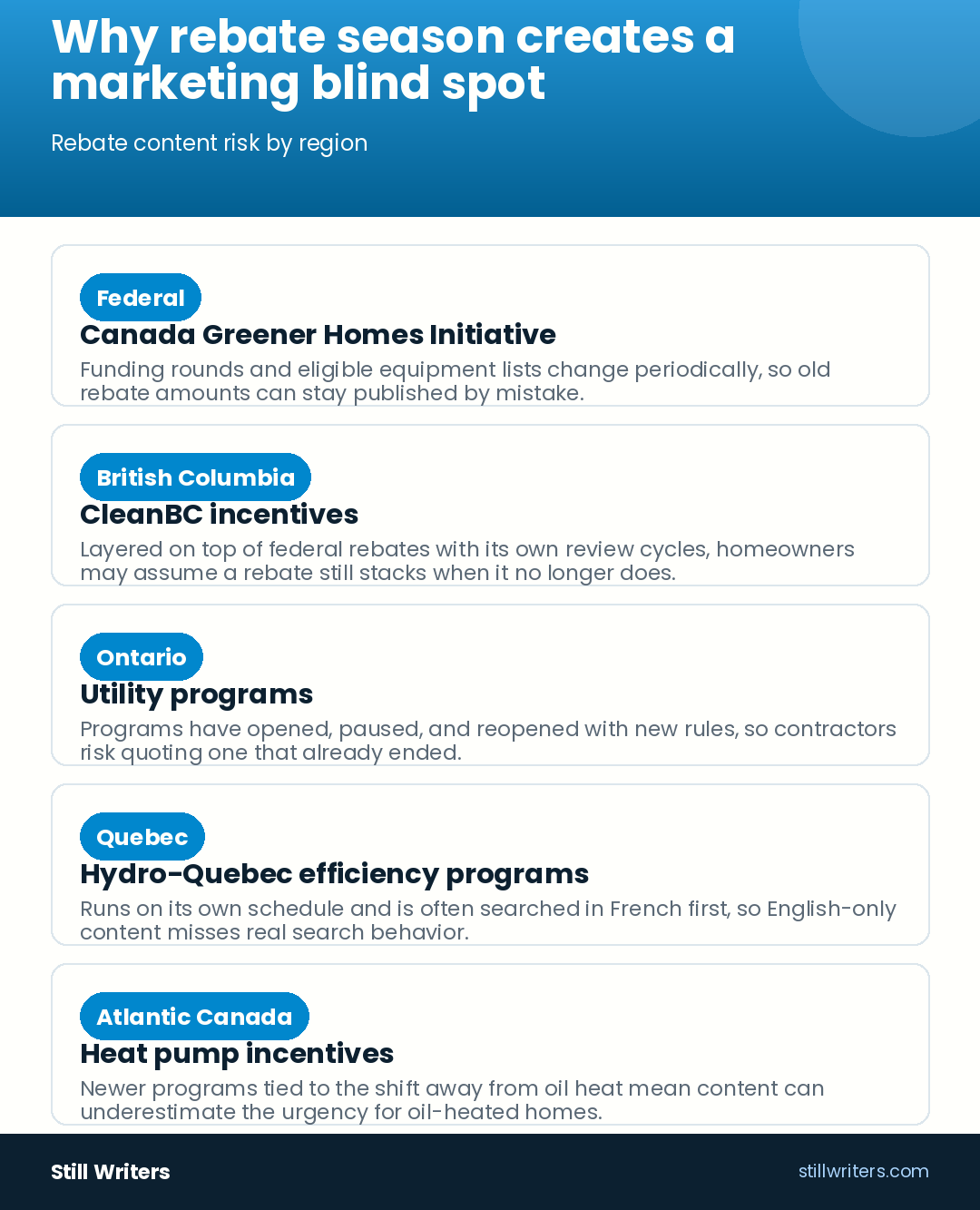
Federal programs are only half the picture. British Columbia has run its own CleanBC incentives on top of federal rebates. Ontario has seen utility-run programs through Enbridge Gas come and go. Quebec homeowners lean on Hydro-Quebec’s own efficiency offers, often searched in French first. Atlantic Canada, where oil heat has stuck around longer than almost anywhere else in the country, has its own mix of provincial and utility programs pushing homeowners toward heat pumps for the first time. Stack a federal program on top of a provincial one, and you get two separate expiry dates, two separate eligibility lists, and two separate reasons your content can go wrong at different times.
This is exactly the kind of layered, multi-jurisdiction problem that a national content strategy has to plan for from day one, instead of treating each province as an afterthought. It’s also why a generic lead generation strategy built for one region rarely holds up once you try to run it across the country.
| Region | Rebate layer | Typical timing pattern | Marketing risk if content isn’t reviewed |
|---|---|---|---|
| Federal (all provinces) | Canada Greener Homes Initiative | Funding rounds, application windows, and eligible equipment lists change periodically | Old rebate amounts or closed application windows stay published |
| British Columbia | CleanBC provincial incentives | Layered on top of federal rebates, with its own review cycles | Homeowners think a rebate is stackable when it no longer is |
| Ontario | Utility programs (historically through Enbridge Gas) | Programs have opened, paused, and reopened with new rules | Contractors quote a program that already ended |
| Quebec | Hydro-Quebec efficiency programs | Runs on its own schedule, often searched in French first | English-only content misses the actual search behavior |
| Atlantic Canada | Provincial and utility heat pump incentives | Newer programs tied to the shift away from oil heat | Content underestimates how urgent this is for oil-heated homes |
Alberta doesn’t fit neatly into this table, which is its own lesson. Calgary and Edmonton homeowners often search for federal rebates alongside heat pump content aimed at extreme cold performance, since Alberta hasn’t layered on the same kind of provincial incentive that BC or Quebec have. A contractor running HVAC marketing in Calgary needs a different rebate message than one working in Kelowna, even though both are technically covered by the same federal program.
Why do most rebate pages only get published once?
Rebate content usually gets created for one reason: a program launches, it gets attention, and someone on the marketing side rushes to publish something before competitors do. That’s a reasonable instinct. The problem is what happens after. Once the post is live, it moves off the to-do list. Nobody puts a reminder on the calendar to check it again in three months. Nobody assigns ownership for watching the government program page for changes.
That’s the blind spot. Marketing teams, in-house and agency alike, tend to plan content as a series of finished projects instead of a set of living pages that need upkeep. A blog post about kitchen remodeling trends can sit untouched for years and lose nothing. A rebate post can’t. The moment a program’s eligibility rules shift, that page becomes actively misleading, and it’s often still the top result homeowners find.
The search spike happens at two moments, not one
Search interest around a rebate program isn’t steady. It spikes hard right when a program launches, when word spreads that money is available. Then it goes quiet for months. Then it spikes again right before the program closes, when homeowners realize a deadline is approaching and rush to qualify. Those two windows are when your content matters the most, and they’re also the two moments a stale page does the most damage. Roughly 86% of search traffic in Canada runs through Google, so if your rebate page isn’t accurate when that second wave of urgent searches hits, you’re losing calls to whoever’s page is current, even if your company is the better fit for the job.
This same pattern shows up in shoulder season lead generation, where demand comes in bursts tied to weather instead of a steady curve. Rebate season just adds a second, government-driven burst on top of the weather-driven one, and most content calendars were never built to track both at once. Homeowners in Vancouver chasing a CleanBC deadline behave the same way as homeowners in Halifax chasing an oil-to-heat-pump incentive. They search hard, fast, and close to a deadline.
What this blind spot actually costs your business
It’s tempting to treat an outdated rebate page as a small problem, a minor housekeeping item. In practice it costs more than most contractors realize.
- Lost calls at the highest-intent moment: a homeowner ready to buy right now leaves your site because the numbers don’t match what they read elsewhere.
- Damaged trust: quoting an expired rebate makes your company look careless, even if the mistake was just an old blog post nobody updated.
- Wasted ad spend: paid traffic sent to a stale rebate page converts worse, since the page contradicts what the homeowner already knows from a government website.
- Review platform fallout: homeowners who feel misled about a rebate are more likely to mention it in a review on HomeStars or TrustedPros, the two platforms most Canadian buyers check before hiring.
- Slower rankings recovery: Google can be slow to re-crawl and re-rank a page once it starts losing clicks, so the damage doesn’t just disappear the day you fix the content.
How rebate rules shift across Canadian provinces
Canada’s rebate landscape isn’t one program. It’s a patchwork of federal, provincial, and utility incentives that all move independently. Understanding that patchwork is a big part of doing hvac contractor marketing well in this country, and it’s a piece most generic marketing advice skips entirely.
Close to 274,000 heat pump installations across Canada have already been funded through federal rebate programs, with cold-climate units built for extreme winters making up most of that total. That’s a huge base of homeowners who found a contractor through rebate-driven research. Some of them are due for maintenance now. Some are telling neighbors about their experience. If your rebate content is still accurate and helpful, you show up in both conversations. If it’s stale, you show up in neither.
Quebec needs its own approach, not a translation
Quebec deserves its own callout here. Hydro-Quebec runs efficiency programs on a different schedule than the rest of the country, and a meaningful share of homeowners search for this content in French first, not English. A rebate page that only exists in English, or one that’s simply translated word for word, misses how people actually search in that province. This connects directly to the broader question of if Quebec needs a different marketing approach, and rebate content is one of the clearest places where the answer is yes.
| Approach | What happens at program launch | What happens near the deadline | Long-term result |
|---|---|---|---|
| One-time rebate post | Ranks well briefly, captures early interest | Often shows outdated amounts or a program that already closed | Slowly loses trust and rankings over months |
| Maintained rebate content | Ranks well and stays accurate as details firm up | Updated to reflect the real deadline, captures the urgent second wave | Builds compounding trust and steady organic traffic |
The difference between those two rows isn’t writing quality. It comes down to having an owner who checks the page against the actual government or utility source on a set schedule.
How to check if your rebate content has a blind spot
You don’t need a big audit to find out if this is a problem for your company. Run through this checklist against your own site.
- Pull up every page that mentions a rebate: most contractors are surprised how many old posts, service pages, and even homepage sections mention a specific dollar figure.
- Check the publish or last-updated date: if it’s older than the program’s last known rule change, treat it as outdated until proven otherwise.
- Compare your numbers against the official source: the federal government page, your provincial program, or your local utility, not a competitor’s blog.
- Look for stacking claims: pages that say a federal and provincial rebate can be combined need extra scrutiny, since stacking rules change often.
- Assign an owner: someone on your team, or your content partner, needs to own checking these pages on a recurring basis long after launch.
- Set a review cadence: once a quarter is a reasonable minimum, with an extra check any time you hear a program might be closing.
This is the kind of ongoing work that’s easy to plan for but easy to skip once the initial excitement of a rebate launch wears off. If you’d rather have someone else own this calendar, our HVAC content services are built around exactly this kind of ongoing maintenance rather than a one-time blog post. You can also talk to us directly if you want a quick read on how many rebate pages on your own site might already be out of date.
Canada’s HVAC industry is made up mostly of small operators. Small businesses with fewer than 100 employees make up 98.2% of all employer businesses in Canada, and most HVAC companies fall well inside that group. That matters here because small teams rarely have a dedicated person watching government program pages for changes. It’s not a lack of care. It’s a lack of time, which is exactly why rebate content maintenance gets skipped in the first place.
Frequently asked questions about rebate marketing
How often should HVAC companies update rebate content? Check your rebate pages at least once a quarter, and again any time you hear a program might be changing or closing. Programs like the Canada Greener Homes Initiative and provincial incentives don’t announce changes on a fixed schedule, so a set review habit catches problems before homeowners do.
What happens if outdated rebate information stays on a website? Homeowners lose trust the moment they spot a number that doesn’t match what they’ve read on a government or utility site. Some will just leave. Others will mention it in a review on HomeStars or TrustedPros, which affects future customers too.
Which rebate programs matter most for Canadian HVAC contractors? The federal Canada Greener Homes Initiative matters everywhere. On top of that, contractors need to track their own province’s layer, CleanBC in British Columbia, utility programs in Ontario, Hydro-Quebec offers in Quebec, and the newer heat pump incentives showing up across Atlantic Canada.
Should HVAC companies write one rebate page or many? One well-maintained hub page covering federal rebates, with clearly separated sections for your specific province, usually works better than scattering rebate mentions across many old blog posts you’ll never remember to update.
Can outdated rebate content hurt SEO rankings? Yes. Pages that lose visitor trust tend to see people leave quickly, and that behavior signals to Google that the page isn’t serving searchers well anymore, which can drag rankings down over time.
Close the HVAC contractor marketing blind spot for good
You came here because a rebate post you wrote once has probably gone stale without anyone noticing. That’s a normal outcome of treating rebate content as a single project instead of a recurring task.
Here’s the short version of what actually fixes it.
- Rebate programs run on their own schedule, completely separate from your content calendar.
- A page written at launch is almost guaranteed to be wrong within months.
- Search demand spikes twice, at launch and right before a deadline.
- Provincial layers like CleanBC, Ontario utility programs, and Hydro-Quebec add extra dates to track.
- Assigning real ownership and a review cadence is what turns a liability into a lead source.
Still Writers builds rebate content as a maintained asset from the start, not a post we hand off and forget. Our team tracks federal and provincial program changes so your pages get updated before a stale number costs you a call, and we’ve built this process specifically around how fragmented Canada’s rebate landscape actually is. If you want a partner who treats rebate season as an ongoing job instead of a one-time deliverable, we’d like to talk with you.
What should you read next?
If you want to keep learning before you pick up the phone, here are three places to start.
- Best HVAC blog content ideas to fill your 2026 content calendar: a good next step for building a calendar that treats rebate content as ongoing work instead of a one-off post.
- Content writing rates for HVAC companies: what should you pay in 2026?: useful context if you’re weighing what ongoing rebate maintenance should reasonably cost.
- Why do Canadian HVAC companies struggle to rank on Google?: explains some of the ranking problems that stale, unmaintained pages like old rebate posts tend to create.
If you’re not ready to talk to us yet, these three resources are a solid place to keep learning.