
Key takeaways
- Generalist freelance writers typically charge $0.08 to $0.20 a word, but that rate rarely covers HVAC-specific research or accuracy checks.
- Specialized HVAC content writers usually run $0.30 to $0.75 a word or more, and the gap pays for licensing knowledge, rebate program accuracy, and SEO structure.
- Monthly content retainers for writing alone typically land between $800 and $4,500, well below the broader content marketing spend that also covers strategy and promotion.
How much should a blog post about heat pump rebates actually cost you? It’s a fair question, and most Canadian HVAC owners never get a straight answer. You call around, get quotes ranging from $50 to $500 for a single article, and nobody explains why. That gap is confusing, and it makes it easy to either overpay a generalist agency or underpay someone who has never written about a two stage furnace. Getting quality hvac marketing services starts with understanding what you’re actually buying when you pay for content writing, past the sticker price on a quote.
We’ve spent years writing for HVAC contractors across Canada and the U.S., and one thing keeps surprising new clients: how fast a good technical writer can learn a niche industry once they’ve done it a few times. We’ve picked up the details of ductless mini splits, TSSA gas fitter rules, and provincial rebate programs the same way our clients did, by digging in and asking the right questions. Plenty of writers and agencies out there do solid work in this space too, and this article isn’t meant to talk you out of shopping around. It’s meant to help you understand what you’re paying for so you can compare quotes with confidence.
Why content writing rates for HVAC marketing services vary so much
A blog post about “signs your furnace needs repair” and a service page about mini split installation with rebate eligibility details are not the same job. Yet plenty of quotes treat them like they are. The rate a writer charges usually reflects three things: how long the piece takes to research, how much technical accuracy is on the line, and how well the writer understands search structure. A generalist can write fast because they skip the research. A specialist charges more because they don’t.
What separates a cheap writer’s rate from a specialized HVAC writer’s rate
Here’s what you’re actually paying for when a quote looks higher than you expected.
- Research time: a specialized writer checks manufacturer specs, SEER ratings, and code requirements before writing a single sentence.
- Technical accuracy: getting refrigerant types, BTU sizing, or venting requirements wrong can make your company look unreliable, or worse, mislead a homeowner.
- Rebate and licensing knowledge: a writer who understands how the Canada Greener Homes Initiative works, or how HRAI certification factors into a homeowner’s trust, writes copy that doesn’t need a rewrite from your service manager.
- SEO structure: a page built around how homeowners actually search, with headers, internal links, and a clear answer near the top, earns rankings a generic write up won’t.
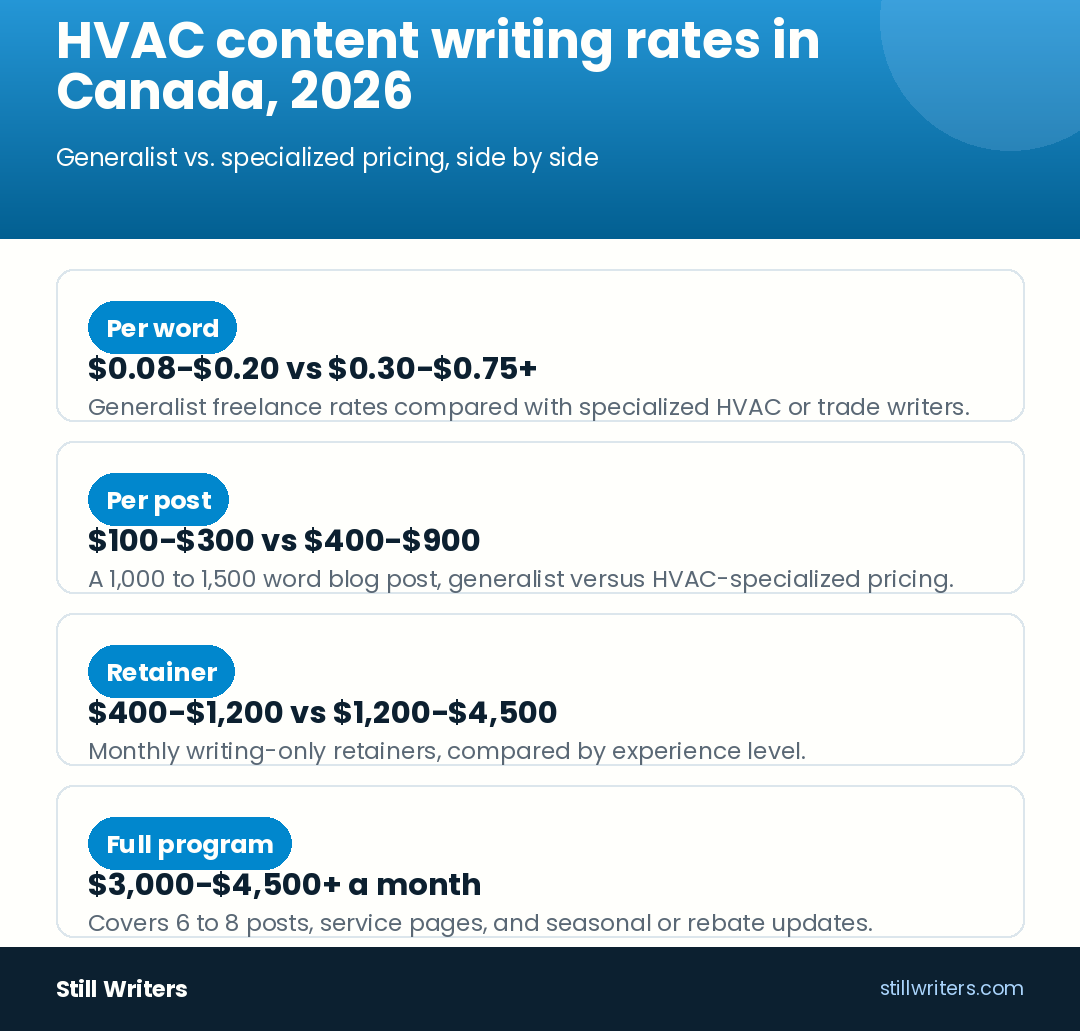
| Pricing model | Generalist freelance writer | Specialized HVAC or trade writer |
|---|---|---|
| Per word | $0.08 to $0.20 | $0.30 to $0.75+ |
| Per blog post (1,000 to 1,500 words) | $100 to $300 | $400 to $900 |
| Per service page | $150 to $400 | $500 to $1,200 |
| Monthly retainer (writing only) | $400 to $1,200 | $1,200 to $4,500 |
This article focuses only on what writing costs, not what a full agency retainer looks like once you add SEO management, ads, or reporting on top. For that fuller picture, our breakdown of what an HVAC marketing agency in Canada actually charges covers tiered retainers in detail.
What’s a fair per-word rate for HVAC content in 2026?
A commonly cited industry range puts general freelance writer pay at $50 to $150 an hour across Canada. That’s a starting point, not the final number, because hourly pay only tells you part of the story. What matters more is how many well researched, accurate words that hourly rate produces.
Think about it this way. A generalist writer who bills $50 an hour might produce 500 words of general, low-research content in that time, working out to roughly $0.10 a word. A specialized HVAC writer billing $100 an hour but spending real time checking rebate eligibility, code language, and product specs might only produce 250 to 300 words in that hour, which puts their effective rate closer to $0.35 to $0.45 a word. Neither number is wrong. They’re pricing two different products. This is typical industry math based on standard hourly rates, not a formal published per-word statistic, so treat it as a planning guide rather than a fixed price.
Per-article and per-blog-post flat rates
Most HVAC companies don’t pay per word in practice. They pay a flat rate per article, because it’s easier to budget. A standard 1,000 to 1,500 word blog post from a generalist runs $100 to $300. The same post from a writer who actually understands ductless systems, cold climate heat pumps, or provincial rebate rules typically runs $400 to $900, sometimes more for a deeply researched cornerstone piece meant to rank for competitive keywords.
A Calgary contractor writing about furnace maintenance ahead of an Alberta winter needs different depth than a generic “top 5 furnace tips” post. A Winnipeg or Saskatoon shop writing about extreme cold reliability needs content that speaks to that urgency specifically, not a copy paste version of an Ontario article with the city name swapped. Real regional detail takes real research time, and that shows up in the price.
What do per-page rates look like for HVAC service pages?
Service pages carry more weight than blog posts because they’re the pages that actually convert. A “furnace repair” page or a “heat pump installation” page needs to answer a homeowner’s questions, build trust, and rank locally, all at once. That’s a harder job than a blog post, and the rate reflects it.
- Basic service page: a generalist writer will typically charge $150 to $400 for a page with light research and generic copy.
- Specialized service page: a trade focused writer runs $500 to $1,200 for a page that includes accurate technical detail, local SEO structure, and clear calls to action.
- Location-specific service pages: a page built for a specific city, say a Vancouver heat pump page that references CleanBC rebates alongside federal ones, costs more because it needs region-specific accuracy, not a template with the city name changed.
- Rebate and program pages: pages explaining current rebate programs need frequent updates as programs change, which is often priced as ongoing maintenance rather than a one-time fee.
A page written for a BC market like Vancouver and a page written for a smaller Prairie town both need this level of care, even if the search volume behind them is very different.
How do monthly content retainers price out?
A monthly content retainer bundles a set number of posts or pages into a recurring price. This is where a lot of confusion happens, because “content marketing” and “content writing” get used interchangeably when they aren’t the same thing. Published research puts general Canadian content marketing costs at $1,500 to $7,000 a month, but that figure usually includes strategy, editing, publishing, and sometimes promotion on top of the raw writing. Writing alone, without those extras, tends to cost less.
Typical writing-only retainer tiers
| Tier | What’s typically included | Monthly range |
|---|---|---|
| Starter | 2 to 4 blog posts, no service pages | $800 to $1,500 |
| Growth | 4 to 6 posts plus 1 to 2 service pages | $1,800 to $3,000 |
| Full content program | 6 to 8 posts, service pages, seasonal and rebate updates | $3,000 to $4,500+ |
An Ontario contractor in the GTA competing against dozens of other HVAC companies usually needs the Growth or Full tier just to keep pace with search competition. A smaller Prairie shop in a less saturated market, say in Saskatchewan or Manitoba, can often start at the Starter tier and grow into more once the content is proving itself. If you want the full picture on total marketing spend, including SEO, ads, and content together, our guide to what HVAC marketing costs in Canada lays that out. And if you’re still weighing hiring a writer against doing it yourself, our agency vs. DIY marketing cost breakdown covers that decision directly.
How do you evaluate a content writing quote without overpaying?
A low quote isn’t always a bad deal, and a high quote isn’t always a good one. Here’s how to actually compare them.
- Ask what’s included in the word count: some quotes cover only a first draft, with revisions billed separately.
- Ask about HVAC-specific experience: a writer who can name the difference between a single stage and variable speed compressor will write faster and more accurately than one learning on your dime.
- Check if SEO structure is built in: headers, internal links, and keyword placement should be part of the writing process, not an add-on. Our breakdown of HVAC SEO costs explains how writing and SEO work together without overlapping in price.
- Ask for a sample specific to trades content: general marketing writing samples don’t tell you if someone can handle technical HVAC topics accurately.
- Confirm rebate and program accuracy is part of the deal: programs change, and outdated rebate information on your site can frustrate customers and damage trust.
Close to 274,000 heat pump installations across Canada have been funded through federal rebate programs so far, and most of those homeowners searched for information before booking. Content that gets the rebate details wrong loses that trust fast. If you want a straightforward number for your shop, our pricing page lays out current rates, or you can talk to our team directly about what a realistic content budget looks like for your market and goals.
Frequently asked questions about HVAC content writing rates
What’s a fair per-word rate for HVAC blog content in Canada? Generalist writers typically charge $0.08 to $0.20 a word, while specialized HVAC or trade writers run $0.30 to $0.75 a word or more. The higher rate usually reflects research time and technical accuracy, more than raw writing speed.
Why do specialized HVAC writers cost more than generalist freelancers? Specialized writers spend extra time verifying technical details, rebate program rules, and licensing requirements before they write. That research time slows down output, which raises the effective per-word or per-project rate compared to general content writing.
How many words does a typical HVAC service page need? Most effective HVAC service pages run 600 to 1,200 words, enough to answer common homeowner questions, build trust, and give search engines enough context to rank the page for relevant local searches.
Should you pay per project or set up a monthly retainer? Per-project pricing works well if you only need occasional content. A monthly retainer usually makes more sense once you’re publishing consistently, since it gives you a predictable budget and keeps a writer familiar with your business over time.
Do content writing rates include SEO and keyword research? It depends on the writer or agency. Some rates include basic on-page SEO structure as part of the writing process, while deeper keyword research and strategy are often priced separately. Always ask what’s included before comparing quotes.
Ready to price out real HVAC content writing?
You came here trying to figure out if a $150 blog post or a $600 blog post is the better deal, and now you have a real framework for answering that question yourself.
- Generalist rates run lower, but they skip the research that trade content actually needs.
- Specialized HVAC writers cost more per word, and that difference pays for accuracy, rebate knowledge, and SEO structure.
- Per-article and per-page flat rates are more common in practice than strict per-word billing.
- Monthly retainers for writing alone typically cost less than the broader “content marketing” figures you’ll see quoted elsewhere.
- The cheapest quote and the best value are rarely the same thing.
Our writers have built content for HVAC companies from Vancouver to Halifax, and one pattern holds steady across every market: contractors who invest in accurate, well researched content see fewer awkward customer questions and more calls from people who already trust what they read. We’ve made plenty of mistakes over the years figuring out what actually works for this industry, and we’re glad to share that experience so you don’t have to learn it the hard way. If you’d like a straight answer on what your content should cost, we’re happy to talk it through with you.
What should you read next?
If you want to keep learning before you pick up the phone, here are three places to start.
- What does HVAC marketing cost in Canada in 2026?: see how content writing fits into your total marketing budget alongside SEO and ads.
- What does an HVAC marketing agency in Canada actually charge?: compare writing-only pricing against full agency retainers.
- Best HVAC blog content ideas to fill your 2026 content calendar: figure out exactly what to write once you’ve set your budget.
If you’re not ready to talk to us yet, these three resources are a solid place to keep learning.