
Key takeaways
- HomeStars and TrustedPros work best for companies with little or no online history, because homeowners use these platforms to vet a contractor they’ve never heard of before booking a quote.
- Organic SEO tends to catch people earlier in their search, including emergency and repair calls, while HomeStars and TrustedPros tend to attract homeowners already comparing quotes for bigger replacement jobs.
- Most established HVAC companies get the best return from running both, but the split of your budget should shift as your reputation and your rankings grow.
Picture two HVAC companies in the same province, both hunting for marketing for HVAC contractors that actually pays off. One puts its next thousand dollars into a HomeStars profile and a stack of review requests. The other spends it on a service area page and a Google Business Profile cleanup. Six months later, their phones are ringing for completely different reasons. That’s the real choice behind this comparison, HomeStars and TrustedPros against organic SEO, and it’s one of the most common budget questions a Canadian HVAC owner asks us. Get it wrong and you either burn cash on reviews nobody sees, or you wait months for rankings that never quite arrive. Get it right, and every dollar starts pulling its own weight within a season, not a year.
We’ve spent years building websites and content for trades companies, and one pattern keeps showing up. The contractors who grow fastest aren’t the ones who pick a side and stick to it forever. They match the tool to where their business actually stands, then they change course as things shift. We’ve watched a single Ontario HVAC client’s organic traffic climb from a handful of monthly visitors to over 900 site visits within six months of a proper content and technical overhaul, and we’ve also watched brand new companies win their first ten jobs almost entirely off a strong HomeStars profile before their website ever ranked for anything. Good agencies south of the border and here in Canada can help with either path. What matters more than who you hire is understanding which lever to pull first.
What do HomeStars and TrustedPros actually cost you?
HomeStars and TrustedPros are the two platforms most Canadian homeowners check before they call an HVAC company they don’t already know. Think of them as the Canadian version of the review-and-quote sites American homeowners use, except built around Canadian trades, Canadian reviews, and in TrustedPros’ case, a screened contractor network. Neither platform publishes a fixed price list, and that’s on purpose. Most pricing is either subscription-based, tied to a profile tier, or lead-based, where you pay per qualified quote request that lands in your inbox.
In practice, a contractor investing seriously in one of these platforms usually lands somewhere between a small monthly software bill and a modest part-time ad budget, often a few hundred dollars a month once you add profile upgrades, featured placement, and lead credits together. That’s a much smaller number than most agency retainers, which is exactly why brand new companies gravitate toward these platforms first. You’re not paying for months of content production. You’re paying to look legitimate, right now, to someone already typing “HVAC company near me” into a search bar.
How the two platforms actually differ
HomeStars leans heavier on public reviews and a directory-style browsing experience. TrustedPros leans more on a matching and quote-request model, where homeowners describe a job and get connected to a shortlist of contractors. A lot of established companies in Vancouver and the Toronto area run both at once, because they serve slightly different homeowner habits. Some people browse. Some people want three quotes by Friday.
| Approach | Typical monthly investment | What you’re actually paying for |
|---|---|---|
| HomeStars or TrustedPros paid profile | Often a few hundred dollars a month, through subscription tiers or per-lead credits | A verified badge, featured placement, and visibility to homeowners already comparing quotes |
| Organic SEO, agency managed | $1,500 to $5,000 or more a month | Service area pages, technical fixes, Google Business Profile management, and ongoing content |
| Organic SEO, DIY or freelancer | $50 to $150 an hour | Piecemeal content and technical work, usually at a slower and less predictable pace |
Neither number tells you which option is right for your company. It only tells you what each path actually costs, so you can compare that against what your business needs most right now.
What does organic SEO cost, and how fast does it start working?
Organic SEO means owning your spot in Google’s regular search results, not the map pack listings and not a paid ad. It’s the service area pages, the blog posts, the Google Business Profile, and the technical groundwork that let your own website show up when someone searches for a furnace repair or an AC install in their city. Building it properly usually costs a similar range to a solid agency retainer, and it takes real time before it pays off. Most Canadian HVAC companies see meaningful movement in rankings and calls somewhere between four and eight months, not four and eight weeks.
That timeline is the trade-off. Google handles roughly 86 percent of all search traffic in Canada, which means almost every homeowner searching for help is starting there, no matter if they end up on your site, a directory listing, or an ad. If your site isn’t set up to catch that search, you’re relying entirely on paid channels and review platforms to fill the gap. We’ve written a longer piece on why Canadian HVAC companies struggle to rank on Google if you want to understand the specific technical and content gaps that slow this down.
Why the slower start is also the bigger payoff
Once a service page ranks, it keeps ranking without a new invoice every time someone clicks it. That’s fundamentally different from a lead platform, where the visibility stops the moment you stop paying. Over two or three years, a company that built organic rankings early usually pays less per lead than one still buying featured placement on a review site. The catch is that “early” has to actually happen. Companies that keep pushing SEO off for one more quarter tend to keep pushing it off indefinitely, and their competitors in Burnaby or Mississauga end up owning that search real estate instead. Full pricing detail for this specific channel lives in our HVAC SEO cost breakdown.
What kind of leads does each channel actually bring in?
This is the part most contractors never get told, and it matters more than either price tag. HomeStars and TrustedPros tend to reach homeowners who are already in comparison mode. They’ve decided they need a new furnace, a full AC replacement, or a bigger renovation job, and they’re actively lining up three or four quotes before they pick anyone. That’s valuable work, but it’s also work you’re bidding on directly against your competitors, often on price.
Organic SEO tends to catch people earlier, and sometimes at a completely different moment. Someone whose furnace just died on a Tuesday night in February isn’t browsing a review directory first. They’re typing “furnace not working” or “emergency HVAC repair” straight into Google, and if your service page shows up, you get that call before anyone else even knows the job exists.
- HomeStars and TrustedPros leads: skew toward planned, bigger-ticket jobs like full system replacements, where homeowners are comparing multiple quotes on price and reputation.
- Organic SEO leads: capture a wider mix, including emergency repairs, maintenance calls, and homeowners searching before they’ve even settled on replacing versus repairing.
- Review platform leads: often come with less price loyalty, since the homeowner is deliberately shopping around by design.
- Organic search leads: tend to convert at a higher rate once they land on your site, if your site actually gives them a reason to call instead of just information to read.
That last point matters enough that we wrote a whole article about it. A lot of Canadian HVAC sites get plenty of visitors and almost no phone calls, and the reason usually isn’t traffic. It’s what happens after someone arrives. We cover the fixes in why your HVAC website gets clicks but not calls, which pairs well with this comparison if organic search is the path you’re leaning toward.
Which one should you prioritize first?
The honest answer depends on where your company actually stands today, not on which option sounds more impressive. A three-year-old company in Kelowna with zero online reviews is in a completely different position than a fifteen-year-old company in the Greater Toronto Area that already answers thirty calls a week.
A simple framework by company stage
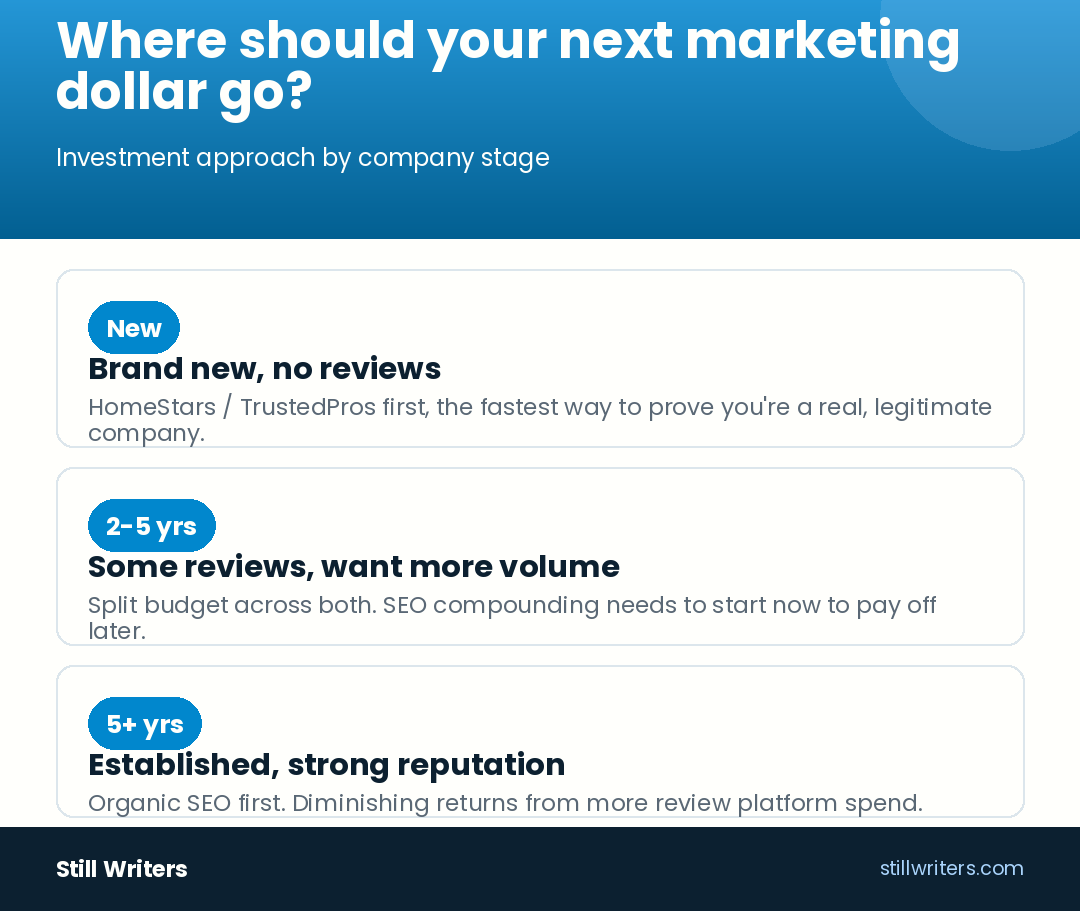
If you’re brand new, or you’ve never asked for reviews, start with HomeStars and TrustedPros. You need proof you’re real before you need volume. A handful of strong, honest reviews and a complete profile will do more for your credibility in three months than a half-built website will do in a year. 53 percent of Canadians say a website makes a business look more credible, but a website with no traffic and no reviews doesn’t close that gap on its own. A review platform does it faster.
If you’re established, with a few years of jobs behind you and a decent trickle of word-of-mouth work, organic SEO should move up your priority list. You already have the trust signals. What you’re missing is volume, and specifically the volume that comes from people searching before they’ve decided who to call. This is also the stage where most companies benefit from splitting budget across both channels instead of picking one.
| Company stage | Where the next dollar should go | Why |
|---|---|---|
| Brand new, no reviews | HomeStars / TrustedPros first | Fastest way to prove you’re a real, legitimate company |
| 2 to 5 years, some reviews, want more volume | Split budget across both | Reviews are working, but SEO compounding needs to start now to pay off later |
| Established, 5+ years, strong reputation | Organic SEO first | Diminishing returns from more review platform spend, bigger upside capturing emergency and early-stage search |
This isn’t a permanent split. Companies that build strong organic rankings often dial back their review-platform spend over time, once their own website starts pulling its own leads. Our guide to the best HVAC lead generation strategies for Canadian contractors in 2026 walks through how to layer these channels together as your budget grows.
How do you avoid wasting money on either one?
Both paths can fail quietly if you treat them as a one-time purchase instead of an ongoing practice. A HomeStars profile with three reviews from 2022 does almost nothing. A service page written once and never touched again slowly loses its ranking as competitors update theirs.
- Respond to quote requests fast: homeowners comparing quotes on HomeStars or TrustedPros usually book whoever answers first, not whoever has the lowest price.
- Ask for reviews after every job, big or small: a steady drip of recent reviews matters more than a handful from years ago.
- Keep your Google Business Profile current: hours, service areas, and photos all feed into local rankings, and a stale profile quietly loses ground.
- Write for the searches homeowners actually type: “furnace repair” and “AC installation” pull different intent, and your pages should match that.
- Track where your calls actually come from: without that data, you’re guessing which channel deserves more of next quarter’s budget.
If you’re not sure which channel your business needs most right now, that’s a conversation worth having before you spend another dollar. Our team can walk through your current setup and tell you honestly where the gap is, through our contact page, or you can look at the full menu of what we build through our services page.
Frequently asked questions about HomeStars, TrustedPros, and organic SEO
Is HomeStars or TrustedPros better for HVAC contractors in Canada? Neither is universally better. HomeStars leans on public reviews and browsing, while TrustedPros leans on matching homeowners to a shortlist of quotes. A lot of established companies run profiles on both, since they reach slightly different homeowner habits.
How much should an HVAC contractor budget for HomeStars or TrustedPros? Most contractors land somewhere in the low hundreds of dollars a month once profile upgrades and lead credits are added together. That’s much lower than a typical agency SEO retainer, which is part of why brand new companies often start there.
How long does organic SEO take to bring in HVAC leads? Most Canadian HVAC companies see meaningful movement somewhere between four and eight months. It depends on how competitive your city is and how much technical and content work your site needed before you started.
Can organic SEO replace review platforms completely? It can reduce your reliance on them over time, but it rarely replaces them entirely. Homeowners still check reviews before hiring, even if they found you through a Google search first.
Do HomeStars and TrustedPros leads convert better than website leads? They convert at different stages of the buying process, not necessarily at different rates. Review platform leads usually arrive already comparing quotes, while organic search leads can arrive at any stage, from an emergency call to early research.
Marketing for HVAC contractors: choose with confidence
You came here trying to figure out where your next marketing dollar should actually go, beyond just which platform sounds more popular. That answer depends less on the platform and more on where your company stands today.
Here’s the short version of what you just read.
- HomeStars and TrustedPros build trust fast for companies with little or no online history.
- Organic SEO captures a wider range of searches, including emergency and repair calls that review platforms rarely see.
- Review platform leads skew toward comparison shopping, while organic leads arrive at every stage of the buying decision.
- Most established companies eventually run both, shifting the split as their own rankings grow stronger.
- Neither channel works as a one-time purchase, both need ongoing attention to keep paying off.
We’ve built organic search programs and content for HVAC companies across Canada and the U.S. for years, and we’ve sat across the table from owners at every stage of this decision, from a two-person shop in Kamloops with no reviews yet to a twenty-truck operation in the GTA trying to squeeze more calls out of an already busy week. Some of that work has come from partnering with agencies who specialize in review platform management, and some of it has been building the organic side from the ground up ourselves. We’re happy to give you a straight answer about which one your business needs first, even if that answer isn’t the one you expected. Click below and let’s talk it through.
What should you read next?
If you want to keep learning before you pick up the phone, here are three places to start.
- What does HVAC marketing cost in Canada in 2026?: a full breakdown of every major channel’s price range, so you can see how HomeStars, TrustedPros, and SEO stack up against ads and social.
- Why your HVAC website gets clicks but not calls: essential reading if you decide organic SEO is your priority, since traffic alone won’t grow your business.
- Agency vs. DIY marketing: what it actually costs Canadian HVAC contractors to go it alone: a closer look at if you can realistically build either channel yourself or if you need outside help.
If you’re not ready to talk to us yet, those three articles are a solid place to keep building out your plan.