
Key takeaways
- Shoulder season lead drops are real, and it is more than a bad month, because search volume for repair and install queries genuinely falls once the weather stabilizes in spring and fall.
- Marketing built only to chase demand spikes creates its own gap, since pausing spend during the quiet months costs you the ranking and momentum you need for the next rush.
- Maintenance plans, off season content, and evergreen SEO smooth out the curve, so you walk into summer and winter with leads already booked instead of starting from zero.
Picture your phone in January. A cold snap rolls through Saskatchewan, temperatures drop past minus thirty five, and furnaces start failing across the province. Your crew is booked solid for two weeks straight and you’re turning away work. Then April shows up. The calls slow to a trickle and your schedule opens wide. If your hvac contractor marketing plan only exists to catch that January rush, you already know what comes next. A slow, quiet spring drains your cash flow right when you can least afford it, and the same thing happens again every October before the heating season kicks back in.
We’ve worked with HVAC companies from small two truck operations in rural Manitoba to larger crews running install teams across Nova Scotia, and one pattern shows up almost every time we open a new client’s search data. The company did not actually lose customers during their slow months. They lost visibility, one quiet month at a time, until the phone stopped ringing right when they needed it to start again. Plenty of agencies understand seasonal planning well. What we’ve built at Still Writers is a habit of reading your actual search trends instead of guessing at when your slow months start, so the plan matches your real market instead of a generic calendar someone copied from a different industry.
Why do HVAC leads actually drop in spring and fall?
The dip is not in your head. Search volume for terms like “furnace repair” and “ac installation” genuinely falls once extreme weather passes. Nobody searches for emergency heating help in May, and almost nobody searches for AC repair in October. The urgent demand that drove your winter and summer calls simply is not there yet, and no amount of clever marketing invents it out of thin air.
That does not mean nobody is searching at all. It means they are searching for different things. In March and April, homeowners search for spring tune ups, duct cleaning, and air quality checks. In September and October, they search for furnace inspections, filter replacement tips, and if their system will survive another winter. The volume for these terms sits lower than a full blown emergency search, but it is far from zero, and it rewards the contractor who actually shows up for it.
How much does search volume actually fall in the shoulder months?
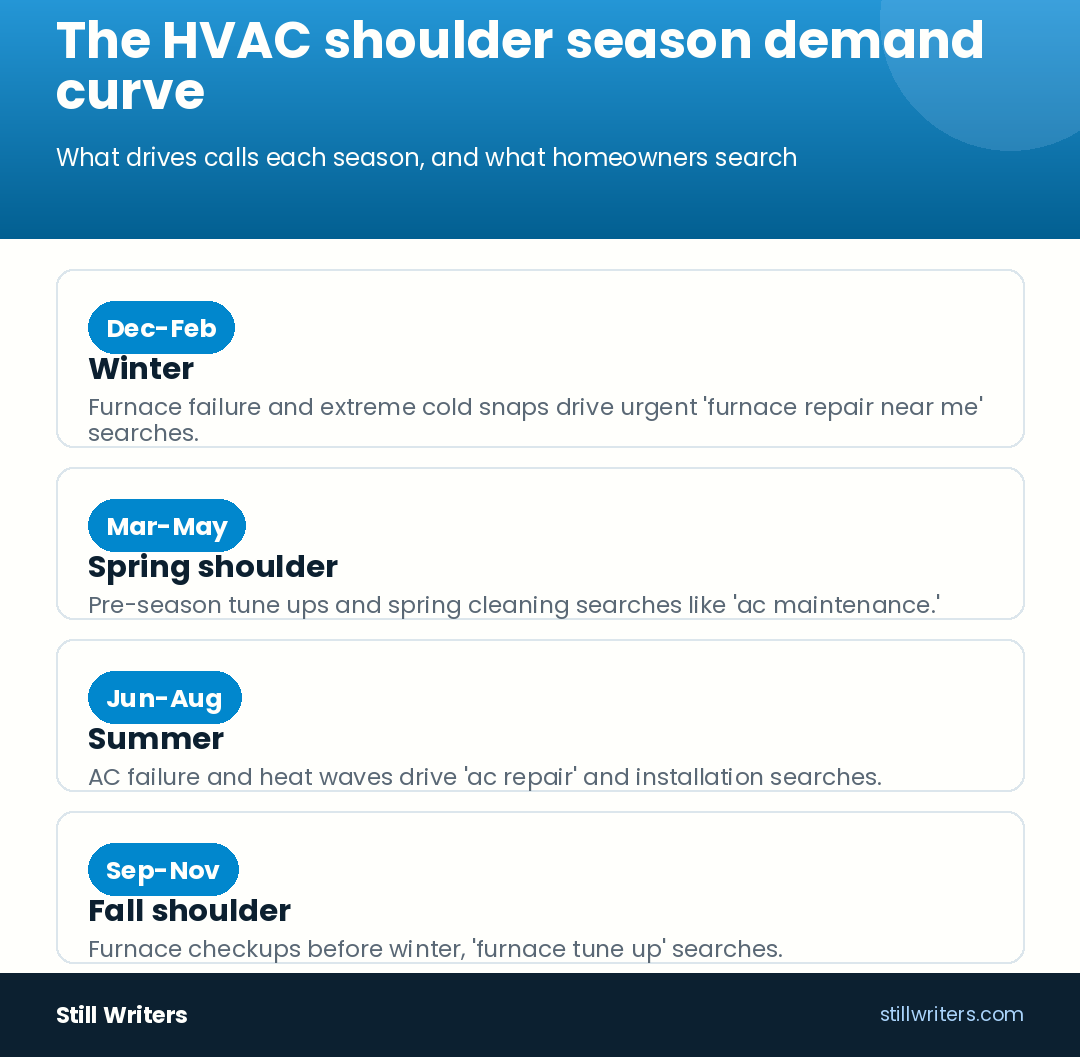
The table below shows the general pattern across most Canadian markets. Exact numbers vary by city and by year, but the shape of the curve holds steady almost everywhere, from Alberta to Atlantic Canada.
| Season | What drives the calls | What homeowners typically search |
|---|---|---|
| Winter (Dec to Feb) | Furnace failure, extreme cold snaps | “furnace repair near me,” “no heat emergency” |
| Spring shoulder (Mar to May) | Pre season tune ups, spring cleaning | “ac maintenance,” “duct cleaning cost” |
| Summer (Jun to Aug) | AC failure, heat waves | “ac repair,” “ac installation cost” |
| Fall shoulder (Sep to Nov) | Furnace checkups before winter | “furnace tune up,” “heating inspection” |
Look at the pattern closely. Every season still carries some search volume. The shoulder months just shift the intent from repair to maintenance. A contractor whose plan only targets repair keywords misses that shift completely and ends up fighting for scraps in a category that was never going to be busy in April anyway. If you want a broader view of how lead generation should work across a full calendar year instead of just the busy months, our guide to HVAC lead generation strategies for Canadian contractors breaks down the channels worth investing in beyond search alone.
Why does marketing built only for demand spikes leave you stuck?
Here’s the trap. When leads slow down in April, plenty of HVAC owners pull back hard. They cut the ad budget, they stop publishing content, and they wait for summer to pick back up on its own. It feels like the responsible move when cash is tight and jobs are scarce. It also guarantees the next slow season hits just as hard, because nothing was built during the quiet months to soften it.
SEO does not respond to demand the moment you turn it on. It works on a lag. Google needs weeks or months to crawl your content, decide if it’s useful, and rank it above your competitors. Publish an article about air conditioner tune ups in June, right when everyone else does too, and you’re competing against pages that have already been live and earning trust for months. Publish that same article in March, and it has time to climb the rankings before the June rush even starts.
Why ranking takes months to rebuild once you pause
Pausing content or ads does more than freeze your rankings in place while you wait things out. It lets them slide. Competitors who keep publishing and keep running ads take the positions you vacated, and search engines start favoring their pages because those pages stayed active while yours went quiet. Close to 72 percent of Canadians research a purchase on Google before they buy, so a few months of lost visibility during your shoulder season means a few months of homeowners finding a competitor instead of finding you.
The same thing happens with reviews. Whitespark’s Local Search Ranking Factors report, one of the most cited studies on what actually moves local map pack rankings, points to review volume and recency as major factors in who shows up at the top. If you stop asking for reviews during your slow months because you’re running fewer jobs, your review velocity slows down right when a competitor, who kept a steady flow of maintenance calls going, keeps collecting fresh ones every week.
What can you do to smooth out the shoulder season dip?
You can’t manufacture demand that isn’t there yet. You can capture more of what does exist and set yourself up to rank before the next spike arrives. Here’s what actually works for contractors across Canada.
- Sell maintenance plans hard in the shoulder months: a spring AC tune up plan or a fall furnace inspection plan turns a slow month into booked revenue, and it gives you a real reason to call past customers when the phones go quiet.
- Publish off season content before demand arrives: an article on preparing your furnace for winter, published in August, has time to rank before homeowners start searching for it in October.
- Keep evergreen SEO running all year: blog posts, service pages, and location pages keep earning traffic long after you publish them, so a steady content schedule keeps paying off even in months when ad spend gets tight.
- Shift ad budget instead of killing it entirely: if you have to cut paid spend during a slow month, move it toward maintenance plan promotions or review generation rather than pulling it completely.
- Text or email past customers with seasonal reminders: a simple message asking them to book a fall tune up fills your calendar without needing a single new lead from Google.
- Ask for reviews after every job, even the small ones: a steady flow of reviews through the quiet months keeps your Google Business Profile active instead of stalling for weeks at a time.
What does a shoulder season content calendar look like?
Timing matters as much as the content itself. Publishing the right article at the wrong time wastes the work you put into it. Here’s a rough calendar that works for most Canadian markets, adjusted for a few regional differences.
Building the calendar around your region
In the Prairies, where Calgary and Edmonton compete for search visibility along with smaller Saskatchewan and Manitoba markets, winter urgency runs so strong that shoulder season content needs to lean into reliability and preparedness messaging heading into fall. Homeowners there already know what minus forty feels like, so content built around “will my furnace survive this winter” tends to perform well in September and October, well before the actual cold arrives.
In Atlantic Canada, the shoulder season story looks different. Nova Scotia, New Brunswick, PEI, and Newfoundland have relied on oil heat for decades, and the shift toward heat pumps is a bigger change there than in almost any other part of the country. Nationally, close to 274,000 heat pump installations have been funded through federal rebate programs, with cold climate units built for extreme cold making up most of them, largely driven by Natural Resources Canada’s Greener Homes Initiative. That transition creates its own kind of shoulder season demand: homeowners researching if a heat pump makes sense for their home, long before they’re ready to book an install. Content built around that question, published well ahead of the fall and spring rush, captures leads that pure repair keywords never reach in that region.
| Month | What’s happening in the market | What to publish or promote |
|---|---|---|
| February | Winter demand still peaking in colder regions | Start drafting spring tune up content and maintenance plan offers |
| March to April | True spring shoulder season begins | Publish AC tune up and duct cleaning content, launch maintenance plan promotions |
| May | Early AC season starts to ramp up | Push installation cost content and heat pump comparison guides |
| August | Summer demand still strong in most regions | Draft furnace prep and heat pump readiness content for fall |
| September to October | True fall shoulder season begins | Publish furnace tune up content and oil to heat pump transition guides for Atlantic Canada |
| November | Winter demand ramping up again | Push emergency service messaging and review requests from fall jobs |
Notice the pattern running through all of this. Content gets written a month or two before the season it targets, not during it. That lead time is what lets it actually rank in time to matter. Homeowners in Vancouver researching heat pump rebates behave differently than homeowners in rural Manitoba worried about a furnace lasting through February, but the underlying principle holds everywhere in Canada: publish ahead of demand, never during it.
How do you avoid the mistakes that make shoulder seasons worse?
Most of the damage during shoulder season is self inflicted, and it usually comes from decisions made out of short term panic rather than a bad market. Here’s what to watch for before your next slow stretch.
- Don’t pause content production entirely: even one article a month during the quiet season keeps your site active instead of stale.
- Don’t cut your entire ad budget to zero: a smaller budget aimed at maintenance plans still keeps your name in front of homeowners who are actively researching.
- Don’t stop asking for reviews just because job volume drops: review requests cost you nothing and keep your profile fresh in the eyes of both customers and search engines.
- Don’t wait until the season starts to write about it: by the time everyone is searching, you’re competing against pages that published months before you did.
- Don’t treat every province the same way: a Saskatchewan winter prep campaign and a Nova Scotia heat pump education campaign solve different problems, even if they run in the same month.
If you’re not sure where your own shoulder season gaps sit, our HVAC marketing services start with a look at your actual search data, and you can always reach out to talk through what your slow months look like. If you want to see what an ongoing plan actually costs before you commit to anything, our pricing page lays out the options plainly. For a broader look at tactics beyond seasonal timing, our roundup of HVAC marketing ideas Canadian contractors are using in 2026 covers more ground.
Frequently asked questions about shoulder season HVAC leads
What is a shoulder season in HVAC marketing? It’s the period between your peak seasons, usually spring before AC demand starts and fall before heating demand starts. Call volume drops because the urgent need for repair or install has not arrived yet, even if maintenance demand is still around.
Why does search volume for HVAC services drop in spring and fall? Homeowners search based on real need. Almost nobody searches for emergency furnace repair when it’s fifteen degrees outside, so overall repair and install search volume genuinely falls. Maintenance and inspection searches take over instead, just at a lower volume than the peak seasons.
Should you pause paid ads during your slow season? Pulling all your ad spend during a slow month usually costs more than it saves. A smaller budget aimed at maintenance plans or review generation keeps your name visible without the full spend of peak season.
How far ahead should you publish seasonal HVAC content? Aim for six to eight weeks before the season you’re targeting. Content published in August has time to rank before homeowners start searching for furnace prep in October.
Do maintenance plans actually help with shoulder season leads? Yes. A maintenance plan gives you a reason to schedule work during your slow months instead of waiting around for an emergency call, and it builds a recurring revenue base that doesn’t depend on the weather cooperating.
Build HVAC contractor marketing that works all year
You started reading this because your slow months feel like they’re bleeding you dry, right when you need steady cash flow the most. That frustration is fair, and it’s fixable with the right plan in place.
Here’s what to take with you:
- Shoulder season lead drops are real, driven by genuine changes in search volume.
- Pausing marketing spend during quiet months costs you ranking and momentum you’ll need later.
- Maintenance plans turn slow months into scheduled, predictable revenue.
- Content published ahead of demand has time to rank before the rush actually hits.
- Reviews and evergreen SEO keep working even when your ad spend gets tight.
We’ve built campaigns for HVAC companies across Canada and the U.S., from a two truck shop in rural Manitoba to a multi crew operation running install teams across the Maritimes, and the seasonal pattern looks remarkably similar everywhere once you know what to look for in the data. Good agencies exist all across this industry, and plenty of them handle seasonal planning well. What tends to set apart the ones who actually fix the shoulder season problem is that they build the content calendar around your specific market months before the season starts, not after the phone has already gone quiet. If that sounds like the plan you need, talk to us below.
What should you read next?
If you want to keep learning before you pick up the phone, here are three places to start.
- The best HVAC marketing ideas Canadian contractors are actually using in 2026: a broader look at tactics beyond seasonal timing, useful once your shoulder season plan is sorted.
- HVAC lead generation tools reviewed: what’s worth using in 2026: helps you pick tools that support a year round marketing plan instead of just a seasonal push.
- What is HVAC digital marketing, and does your company actually need it?: a good starting point if you’re still deciding how much of this to bring in house versus hire out.
If you’re not ready to talk to us yet, these three articles are a solid place to keep learning.