
Key takeaways
- Google Business Profile and Local Services Ads should be the first two tools you set up, since most homeowners search there before they call anyone.
- Review platforms like HomeStars, TrustedPros, and Google reviews win the job for you, often before a customer compares a single price.
- A basic CRM and a review request tool matter more than which ad platform you pick, because slow follow up loses more jobs than weak marketing does.
Picture this. A homeowner in Calgary types “furnace repair near me” into Google at 9 p.m. on a Tuesday. Three companies show up. She calls the first two, gets voicemail on one and a slow callback on the other, and books the third. None of this had anything to do with which company does better work. It came down to which hvac lead generation tools were actually working in the background, catching the lead and getting a real person on the phone fast. If you’re trying to figure out which tools are worth paying for in 2026, and which ones are just noise, you’re in the right place.
Still Writers has written for HVAC contractors from Surrey to Halifax, and one pattern holds true everywhere. The tools matter less than how consistently a company uses them. We’ve spent years learning the HVAC industry itself, so we know the difference between a lead tracking tool built for a two truck operation and one built for a company running crews across three provinces. Plenty of other agencies and consultants do solid work in this space too. This is an honest look at what these tool categories actually do, what they cost, and who they fit best.
What Google Business Profile and Local Services Ads actually do for HVAC leads
Start here, because these two tools come straight from Google, and Google handles roughly 86% of all search traffic in Canada. If your company shows up when someone searches for emergency furnace repair, you’re already ahead of most competitors.
Google Business Profile is the free listing that shows up in Google Maps and the local map pack. It shows your reviews, your hours, your service area, and photos of past jobs. It costs nothing to claim, but it takes real time to keep updated. Companies that post updates, answer reviews, and add photos regularly tend to outrank ones that set up the listing once and never touch it again.
How Local Services Ads work, and what they cost
Local Services Ads sit above the regular search results, and above regular Google Ads too. You only pay when a customer calls or messages you through the ad, not for every click. Budgets for a single city HVAC company usually run somewhere between $500 and $2,000 a month, though busy markets like Calgary push that higher during peak season.
A brand new company with no reviews yet gets more value from building up its Google Business Profile first. Local Services Ads work best once you already have a handful of reviews, since Google leans on them heavily to decide who gets shown.
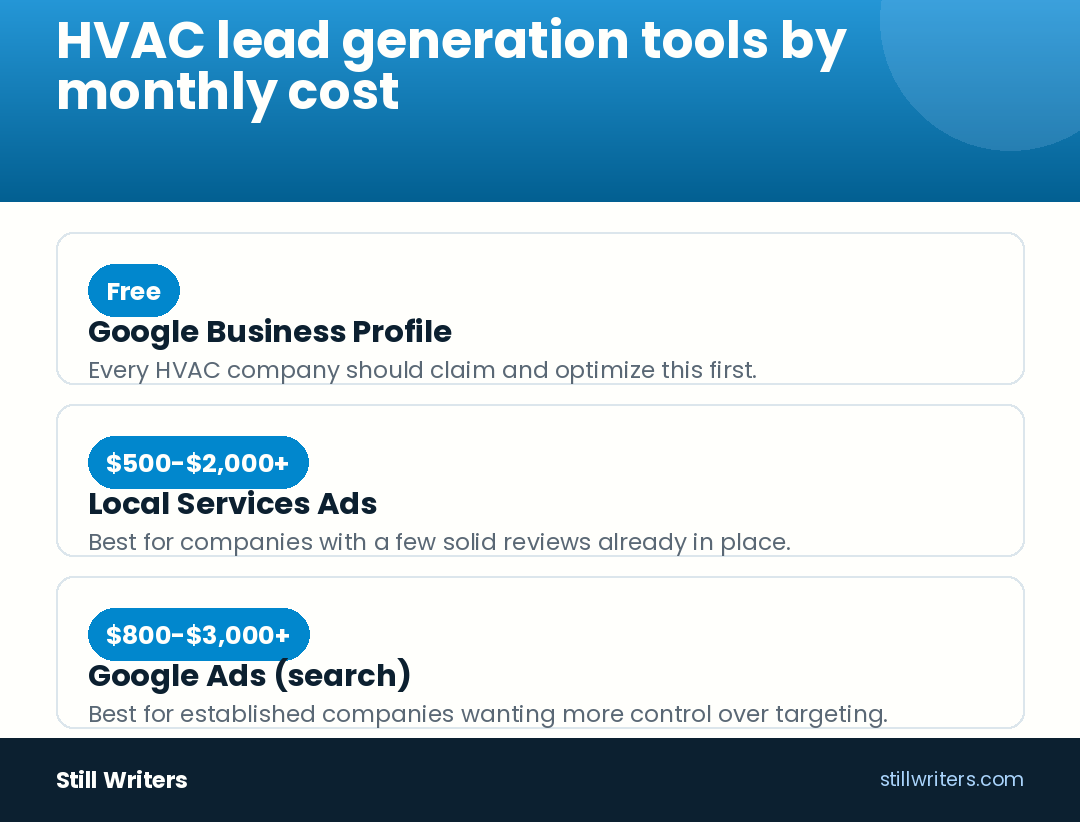
| Tool | Typical monthly cost | Best fit |
|---|---|---|
| Google Business Profile | Free, plus your time | Every HVAC company, from brand new to established |
| Local Services Ads | $500 to $2,000 or more | Companies with a few solid reviews already in place |
| Google Ads (search) | $800 to $3,000 or more | Established companies wanting more control over targeting |
If you want a full breakdown of what these numbers look like across a whole marketing budget, our guide to what HVAC marketing costs in Canada walks through it region by region.
Do review platforms like HomeStars and TrustedPros still matter?
Yes, and probably more than most HVAC owners want to admit. Roughly 73% of Canadian shoppers Google a business before calling, and what they find there decides a lot. HomeStars and TrustedPros are the two platforms Canadian homeowners actually check before hiring a contractor, similar to how Angi works south of the border.
These platforms aren’t free. Paid tiers usually run a few hundred dollars a month for better placement and lead alerts, and unhappy customers can post reviews you can’t remove even if you disagree with them. That’s the tradeoff. You’re paying for visibility on a site homeowners already trust, not for control over what gets said about you.
Google reviews sit alongside all of this, and they carry real weight in local rankings too. Whitespark, an Edmonton based company that studies what actually moves local search rankings every year, points to reviews as one of the strongest signals Google uses to decide who shows up first in the map pack, based on its annual Local Search Ranking Factors report.
Which platform is worth paying for first?
A brand new company usually gets more value from a free HomeStars or TrustedPros profile plus a steady stream of Google reviews, before paying for premium placement anywhere. An established company with a strong reputation already built often finds the paid tiers pay for themselves, since they show up higher right when a homeowner is comparing three or four companies at once. We’ve gone deeper on this exact tradeoff in our comparison of HomeStars and TrustedPros against organic SEO, if you want the fuller picture.
Why a simple CRM keeps HVAC leads from falling through the cracks
- A CRM catches leads that come in after hours. Most HVAC emergencies happen at night or on weekends, and a lead sitting in an inbox until Monday morning is a lead that already called someone else.
- It tracks where each job actually came from. Without this, you’re guessing if that new furnace install came from a Google Ads click, a HomeStars profile, or a neighbor’s recommendation.
- It reminds your team to follow up. A quote sent once and never followed up on rarely turns into a signed job by itself.
- It keeps your reviews coming in. Many CRMs can trigger a review request automatically once a job is marked complete, instead of relying on a technician to remember.
- It scales with you. A basic setup that works for one truck can usually grow into something a multi province company still relies on, as long as you pick a tool built to grow.
You don’t need anything complicated here. A simple CRM, sometimes just a shared spreadsheet with reminders at first, beats no system at all. Given that 88.4% of Canadian businesses have fewer than 20 employees, most HVAC companies reading this are still small enough that a basic system covers what they need. You don’t need software built for a call center. You need something that stops leads from getting forgotten.
How do review request and text automation tools help you close more jobs?
Review request tools do one job well. They send a text or email right after a job is done, asking the customer for a review while the work is still fresh in their mind. This matters more than it sounds like it should. A technician asking for a review in person feels awkward for a lot of homeowners, and most simply forget once the truck pulls away.
What these tools actually cost
| Automation level | Typical monthly cost | What it handles |
|---|---|---|
| Manual, technician asks in person | Free | Inconsistent, depends entirely on the technician remembering |
| Basic automated texting tool | $50 to $150 | Sends a review request automatically after each job |
| Full review and reputation software | $150 to $400 or more | Requests reviews, tracks mentions across platforms, and reports on trends |
For a company running one or two trucks, the basic tier usually covers it. Companies managing crews across Alberta and BC, or answering calls in more than one province, tend to get more value out of the fuller platforms, mostly because they need one dashboard instead of checking HomeStars, TrustedPros, and Google separately for every location. A company based out of Victoria running a second crew in Nanaimo, for example, benefits from one dashboard showing review activity in both places instead of switching between logins all day.
Paid ads or organic content: how do you choose?
Google Ads and Meta ads get you in front of people fast. Organic content, meaning your website, blog, and search rankings, takes months to build but keeps working long after you stop actively promoting it. Neither one fully replaces the other, and most established HVAC companies eventually run both.
Paid ads make the most sense if you need calls this month, you’re entering a new city, or you’re testing which services actually convert before investing in a bigger content strategy. Organic content works better as a long term asset, and it’s often why Canadian HVAC companies struggle to rank on Google in the first place, since it takes consistent effort most owners don’t have time for between service calls.
Common mistakes companies make with paid ads
- Turning ads on and off based on how busy you feel. Google’s system needs consistent spending to learn who converts, and starting and stopping resets that progress.
- Sending ad traffic to a generic homepage. A dedicated page for the exact service being advertised converts far better than a general services page, and it’s a common reason a website gets clicks but not calls.
- Skipping a budget for tracking. If you can’t tell which ad or platform brought in a job, you’re guessing where to spend next month.
- Ignoring organic content entirely. Paid ads stop working the moment you stop paying. Content and reviews keep bringing in calls even during a slow month for ad spend.
Budget wise, SEO services in Canada typically run $1,500 to $5,000 a month, and a full agency retainer for a company with little existing brand recognition often lands between $2,500 and $7,500 a month. Paid ad spend sits on top of that, separate from any management fee. If you’re trying to figure out where your own budget should go first, our services page breaks down what each piece actually involves, and you can always contact us for a plain answer about your specific market.
Frequently asked questions about HVAC lead generation tools
What’s the best lead generation tool for a brand new HVAC company? Start with a free Google Business Profile and a HomeStars or TrustedPros listing. Both cost nothing to set up, and they give you a foundation of reviews before you spend money on ads.
Do I need a CRM if I only run one or two trucks? Yes, even a basic spreadsheet with reminders counts. The goal is making sure a lead never sits unanswered overnight, and a simple system does that just as well as an expensive one at this size.
Are Google Ads or Meta ads better for HVAC leads? Google Ads usually wins for HVAC, since people search for repairs the moment something breaks. Meta ads work better for planned purchases like a full system replacement, where a homeowner is still comparing options over a few weeks.
How much should review automation software cost? Basic texting tools that request reviews automatically after a job typically run $50 to $150 a month. Fuller reputation platforms that also track multiple review sites run higher, usually $150 to $400 a month or more.
Should I use HomeStars, TrustedPros, or just focus on Google reviews? Most companies end up using all three over time. Google reviews matter most for local search rankings, while HomeStars and TrustedPros catch homeowners who specifically vet contractors before hiring.
Choosing the right HVAC lead generation tools for 2026
You came here trying to figure out which tools actually help an HVAC company get more calls, without wasting money on the wrong ones.
- Google Business Profile and Local Services Ads give you visibility where homeowners already search.
- HomeStars, TrustedPros, and Google reviews decide who gets the call once a homeowner is comparing options.
- A simple CRM stops good leads from getting forgotten after hours or on busy days.
- Review request and text automation tools keep new reviews coming in without relying on a technician’s memory.
- Paid ads and organic content both matter, just on different timelines.
We’ve built content and marketing plans for HVAC companies of every size, from a single truck outfit in Red Deer to teams juggling crews across Alberta and BC. What we’ve learned is that the tools matter far less than having someone who understands the HVAC industry helping you pick the right ones for where your company actually is right now. If you’d like a second opinion on your current setup, we’d love to hear from you.
What should you read next?
If you want to keep learning before you pick up the phone, here are three places to start.
- What is HVAC digital marketing, and does your company actually need it?: a good starting point if you’re not sure any of this applies to your business yet.
- Agency vs. DIY marketing: what it actually costs Canadian HVAC contractors to go it alone: useful if you’re weighing running these tools yourself against hiring it out.
- Questions Canadian HVAC companies ask before hiring a marketing agency: worth reading once you’re close to picking up the phone and asking someone for help.
If you’re not ready to talk to us yet, these three resources are a solid place to keep learning.