
Key takeaways
- Rebate content goes stale fast, and the federal Canada Greener Homes Grant closing to new applicants is proof that a page written once and forgotten can quietly mislead every homeowner who reads it.
- French content is a real requirement, not a nice extra, for any contractor serving Quebec or the French speaking parts of New Brunswick, and skipping it costs you calls you never even know you missed.
- HRAI membership and provincial gas fitter licenses build trust that generic DIY pages skip, because homeowners comparing three quotes look for proof of credentials before they pick up the phone.
The Canada Greener Homes Grant is closed to new applicants, but a quick search still turns up Canadian HVAC websites advertising it like it’s open for business today. That one outdated line costs a company credibility with every homeowner who checks the government page before they call. This is the real risk of skipping a hvac marketing agency and writing everything in house: it’s not wasted hours, it’s wrong information sitting in public for months. Add French language requirements in parts of Quebec and New Brunswick, provincial rebate rules that shift every budget cycle, and licensing details a lot of contractors forget to mention, and DIY marketing in Canada carries risks a generic content calendar was never built to catch. Get one of these wrong and you look unreliable before a customer even picks up the phone.
We’ve written for HVAC companies from British Columbia to the Maritimes, and one thing holds true across every province: content that doesn’t reflect how a region actually regulates and rebates HVAC work reads as generic, even when the grammar is clean. Plenty of freelancers and generalist marketing shops do solid work on tone, keywords, and design. Where we’ve found the real gap is fluency in the details that matter here, gas fitter license numbers, HRAI credentials, and the fact that a rebate program can close between your spring campaign and the same summer. Getting those details right takes more than good writing. It takes someone who tracks Canadian HVAC regulation the way you track your own service calls.
What DIY marketing actually misses for Canadian HVAC companies
A lot of DIY HVAC marketing advice floating around online comes from generic templates built for the U.S. market. The advice about blogging consistently or collecting Google reviews still applies here. What it skips is everything that makes a Canadian HVAC company’s marketing legally accurate and locally credible. Four gaps show up again and again on contractor-built websites, and each one is specific to running an HVAC business in Canada.
Bilingual content for Quebec and parts of New Brunswick
If you install or service equipment anywhere near Quebec or the Acadian regions of New Brunswick, a chunk of your searching customers are typing in French first. A DIY website usually has one language, built once, and never revisited. Getting French content right means more than running a page through translation software. It means writing service descriptions, rebate explanations, and safety language the way a French speaking homeowner actually talks about their furnace or heat pump, not the way a machine translated it. A contractor who skips this loses calls before a competitor even shows up in the search results.
Getting rebate programs right, province by province
Rebate programs are the single easiest thing for a DIY site to get wrong, because they change on a schedule nobody outside the industry tracks. The Canada Greener Homes Grant closed to new applicants, yet plenty of contractor websites still list it as a live incentive. Meanwhile, provincial programs keep moving in their own direction. CleanBC still runs active rebates for BC homeowners upgrading to heat pumps, and SaskEnergy runs its own residential equipment replacement rebate for Saskatchewan customers, with different eligibility rules and different dollar amounts than what BC offers. A page that lumps all of this together, or worse, repeats last year’s numbers, sends a homeowner into a sales call with the wrong expectations. That’s a bad first impression you don’t get to walk back.
HRAI and gas fitter licensing as trust signals
In the U.S., a license badge is a nice touch. In Canada, provincial gas fitter certification is the difference between a legal installation and one that voids a homeowner’s insurance. Membership with the Heating, Refrigeration and Air Conditioning Institute of Canada, known as HRAI, tells a homeowner you’re part of a recognized trade body, more than a name painted on a truck. DIY sites frequently skip this entirely, or bury it on an about page nobody scrolls to. It belongs on your homepage, your service pages, and your quote request form.
GST/HST details on invoicing and pricing pages
Homeowners comparing quotes want to know if a price includes tax. Per the Canada Revenue Agency’s rules for GST/HST on home construction and installation work, registered contractors have to charge and collect tax on most installation labor, and the tax becomes payable based on when the invoice is issued or when payment is due, whichever comes first. Very few DIY contractor sites explain any of this to a customer, which leaves people confused about a quote that suddenly grows once tax gets added. A short, accurate line about how tax applies to your quotes builds more trust than another paragraph about your years of experience.
| Marketing task | Typical DIY approach | What a Canada-focused agency handles differently |
|---|---|---|
| Rebate pages | Written once, rarely updated, often mixes federal and provincial programs together | Reviewed on a schedule, split by province, updated when a program like the Greener Homes Grant changes status |
| French content for Quebec or New Brunswick | Skipped, or run through free translation software | Written in French for the local market, not machine translated |
| Licensing and HRAI credentials | Mentioned once on an about page, if at all | Built into homepage, service pages, and quote forms as a trust signal |
| GST/HST on pricing pages | Left out entirely, leading to confused quote calls | Explained in plain language next to pricing and quote request forms |
A contractor in Kelowna selling heat pump conversions has to talk about CleanBC rebates accurately, while a two-person shop in Saskatoon is dealing with a completely different set of provincial programs and a market where extreme winter cold, not shoulder season AC demand, drives most of the calls. A DIY site built off one generic template treats both the same way. That’s the gap a hvac marketing agency is built to close.
How much do rebate mistakes actually cost you?
It’s tempting to think an outdated rebate page is a small thing. In practice, it costs you two ways. First, you lose the homeowner who catches the mistake and assumes your whole business is careless. Second, you lose the lead who never converts because the numbers on your site don’t match what a government rebate calculator tells them. Roughly 72% of Canadians research a purchase on Google before buying, which means most of your leads are already fact-checking you against official sources before they ever call.
Two provinces, two very different rebate pictures
British Columbia layers CleanBC provincial rebates on top of whatever federal programs remain active, which means a BC-based contractor needs to track two moving targets at once. Saskatchewan runs its own SaskEnergy equipment replacement rebate, a program that looks nothing like BC’s and changes on its own schedule. A contractor writing marketing content for both provinces from a single template is going to get one of them wrong eventually. That mistake shows up in a quote call, not a spreadsheet, and by then the damage is already done.
Trust signals your website should have and DIY pages often skip
- HRAI membership badge: shows homeowners you belong to a recognized national trade association, more than a local outfit with a nice logo.
- Provincial gas fitter license number: a specific, checkable credential that a homeowner can verify if they want to.
- WCB or workers’ compensation coverage: tells a commercial customer or property manager you’re covered if something goes wrong on the job.
- Liability insurance details: a short line stating your coverage amount removes a common objection before it comes up.
- Review platform links: Canadian homeowners lean on HomeStars and TrustedPros the way American homeowners lean on Angi, so linking to your verified profiles on those two sites carries more local weight than a generic review widget.
- Accurate rebate disclaimers: a simple line telling homeowners that rebate amounts change and to confirm current details before they book, which protects you from complaints later.
What does DIY marketing actually cost, once you count your own time?
Most contractors think of DIY marketing as free because no invoice shows up. That’s only true if your own time has no value. Say you spend six hours a month writing blog posts, updating rebate pages, and answering review comments. If your billable rate as a licensed technician runs somewhere around $100 an hour in a market like Kelowna or Victoria, that’s $600 a month of your own labor spent on content instead of service calls. In a smaller Saskatchewan market where an owner-operator’s time might be worth closer to $85 an hour, six hours still works out to roughly $510 a month, and that’s before counting the leads lost to an outdated rebate page or a missing HRAI badge.
Comparing the real cost side by side
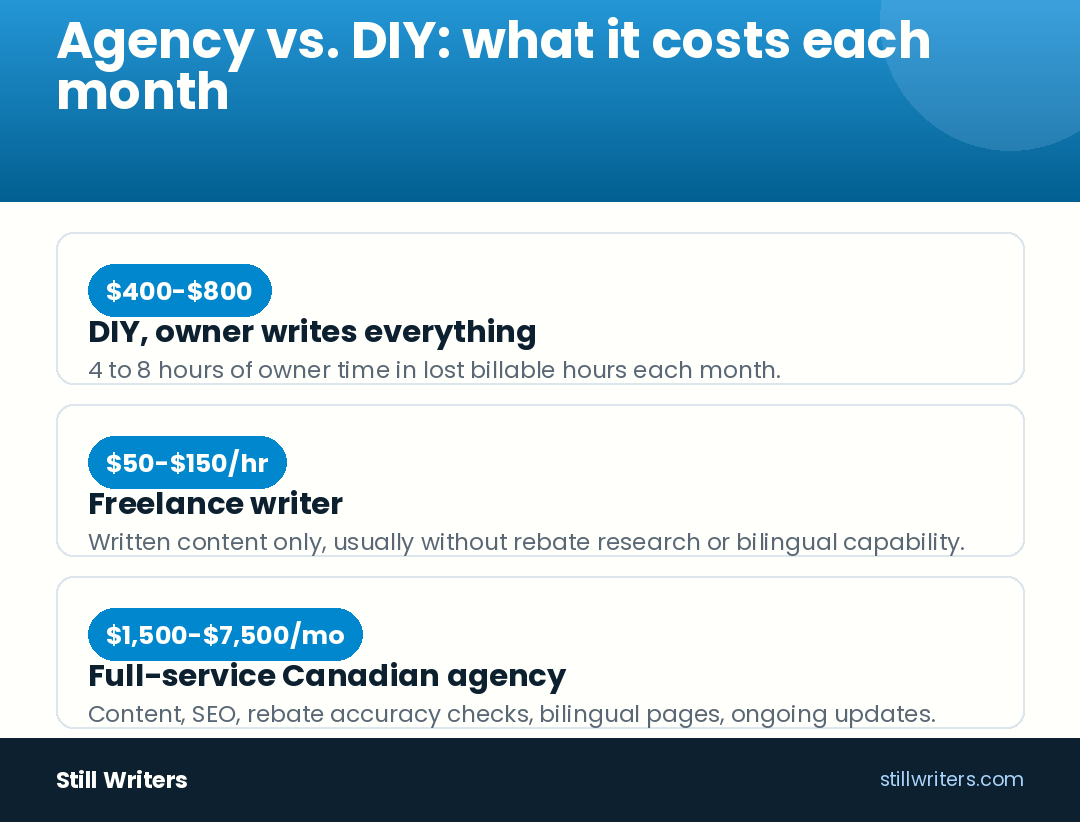
| Approach | Monthly time or spend | What’s included |
|---|---|---|
| DIY, owner writes everything | 4 to 8 hours of owner time, roughly $400 to $800 in lost billable hours | Blog posts, rebate pages, review responses, whatever fits between service calls |
| Freelance writer | $50 to $150 per hour | Written content only, usually without provincial rebate research or bilingual capability |
| Full-service Canadian HVAC content and SEO agency | $1,500 to $7,500 per month depending on scope | Content, SEO, rebate accuracy checks, bilingual pages where needed, ongoing updates |
Those agency ranges line up with what Canadian digital marketing generally costs across industries, and HVAC work sits toward the higher end because of the research required to keep rebate and licensing content accurate. You can compare exact numbers for this industry on our HVAC SEO cost breakdown if you want a closer look at what drives the range up or down.
How do you decide if DIY marketing still makes sense for your company?
- Count your provinces: if you work in more than one province, or near a French speaking region, a single DIY template is already stretched thin.
- Check your last rebate update: if you can’t remember the last time you reviewed your rebate page, assume it’s wrong.
- Look for your credentials: if your HRAI membership and gas fitter license aren’t visible within one click of your homepage, homeowners are missing them too.
- Ask about your tax language: if your pricing page doesn’t mention GST/HST at all, customers are left guessing at the real cost of a quote.
- Add up your own hours: multiply the hours you spend on content each month by what your time is actually worth, then compare that to what a dedicated content team costs.
If most of those checks came back as a problem, it’s worth a conversation. Our services cover exactly these gaps for Canadian HVAC companies, and you can see how we approach the market as a whole on our HVAC marketing hub page. If you want to compare notes on your specific situation, reach out and talk to someone directly before you spend another month guessing at rebate numbers.
Frequently asked questions about hiring a Canadian HVAC marketing agency
Do I need a hvac marketing agency if I already write my own website content? It depends on how many provinces you serve and how often your rebate and licensing content gets reviewed. If you’re a single-province shop with simple pricing, DIY content can work fine as long as someone checks it regularly. Once you add a second province, French language needs, or complex rebate stacking, the risk of an outdated or inaccurate page grows fast.
How often do HVAC rebate programs in Canada change? More often than most contractors update their websites. The federal Canada Greener Homes Grant closed to new applicants, while provincial programs like CleanBC in British Columbia and SaskEnergy’s rebate in Saskatchewan continue on their own separate timelines. A quarterly review of your rebate pages is a reasonable minimum.
Do I need French content if my HVAC company doesn’t serve Quebec? If you serve the French speaking parts of New Brunswick or areas near the Quebec border, yes, French content matters even if Quebec itself isn’t your main market. A lot of contractors assume French content only applies inside Quebec’s borders, and that assumption costs them calls in bilingual regions.
What should my HVAC invoices and pricing pages say about GST/HST? At minimum, state clearly if your quoted prices include tax or not, and note that GST/HST applies to installation labor under CRA rules. A short, plain-language line here prevents confused customers and awkward conversations once the final invoice arrives.
Is HRAI certification worth mentioning on my website? Yes. HRAI membership and your provincial gas fitter license are two of the fastest trust signals a homeowner can check before booking. They belong somewhere visible, not buried on an about page nobody reads.
Why a Canadian HVAC marketing agency avoids costly mistakes
You came here because DIY marketing looked like the cheaper option, and on paper, it can be. The real cost shows up later, in the rebate page that quotes a program that closed months ago, the missing HRAI badge, or the pricing page that never mentions tax.
Here’s a quick recap of what actually separates a Canada-specific approach from a generic DIY template:
- Rebate content needs regular review: programs like the Greener Homes Grant can close without warning.
- French content matters in Quebec and parts of New Brunswick: tone and accuracy count as much as translation.
- HRAI membership and gas fitter licensing belong front and center: not buried on an about page.
- GST/HST language on pricing pages matters: it prevents confused, frustrated customers at invoice time.
- Your own time spent writing content has a real dollar value: that’s true even without an invoice attached.
We’ve built our process around exactly these gaps because we’ve seen what happens when a good HVAC company gets buried by a competitor with cleaner, more accurate content. Some of that work is technical writing about tax rules and rebate programs. Some of it is simply making sure a homeowner in Prince George sees the same care in your content that they’d get from your technicians on a service call. Either way, getting it right takes ongoing attention, not a one-time website build. If you’re ready to see what that looks like for your company, the button below gets you talking to a real person, not a chatbot.
What should you read next?
If you want to keep learning before you pick up the phone, here are three places to start.
- What does HVAC marketing cost in Canada in 2026?: a closer breakdown of pricing if the cost comparisons in this article left you wanting more detail.
- What is HVAC digital marketing, and does your company actually need it?: useful if you’re still deciding if digital marketing belongs in your budget at all this year.
- Why do Canadian HVAC companies struggle to rank on Google?: a good next read if rebate and licensing content is only part of your ranking problem.
If you’re not ready to talk to us yet, these three resources are a solid place to keep learning.