
Key takeaways
- Most Canadian HVAC companies lose page one because they have one general website instead of a real page for every city they serve.
- Thin or copied content keeps you invisible on Google, since search engines can tell when a page reads the same as ten other contractors.
- A messy Google Business Profile costs you the map pack, the small box of three listings that pulls in most local calls in your area.
Type “furnace repair” into Google from a driveway in Mississauga, and a national franchise shows up first, every time. Your company might have served that street for fifteen years, and Google still can’t find you. Google handles about 86% of all search traffic in Canada, so if you’re not on that first page, you’re invisible to almost everyone looking for a technician right now. That’s the real problem behind HVAC SEO marketing for independent Canadian shops. You’re not losing to bad service. You’re losing to a ranking gap you can’t see yet. This article shows you exactly where that gap sits and how to close it, market by market, from Toronto to Trois Rivieres.
At Still Writers, we’ve spent years writing for contractors across Canada and the U.S., from small two truck HVAC shops to multi province service companies. We’re not the only content team that understands the trades. Plenty of good agencies do solid work in this space too. What we’ve learned from working inside this industry is that ranking problems are rarely about effort. Most owners work hard. Their websites just aren’t built to compete, and that’s a structural problem, not a personal one.
What’s really behind your HVAC SEO marketing problem?
Most HVAC owners assume ranking is about trying harder at SEO. Buy more keywords, post more often, hope for the best. That thinking is backward. The real question isn’t how hard you’re working. It’s where the gap sits between your site and the company sitting above you on page one.
Think of every keyword you want to rank for as a race with a finish line. Somewhere ahead of you, a competitor already crossed it. Gap selling means you stop guessing and start measuring the exact distance between where you are and where they are. Once you can see the gap, you can build a plan to close it instead of spending money on problems that were never the real issue.
Six gaps that keep Canadian HVAC companies stuck
We reviewed the pattern across dozens of Canadian HVAC websites, and the same six gaps show up again and again. Some companies have one or two of these problems. Many have all six at once.
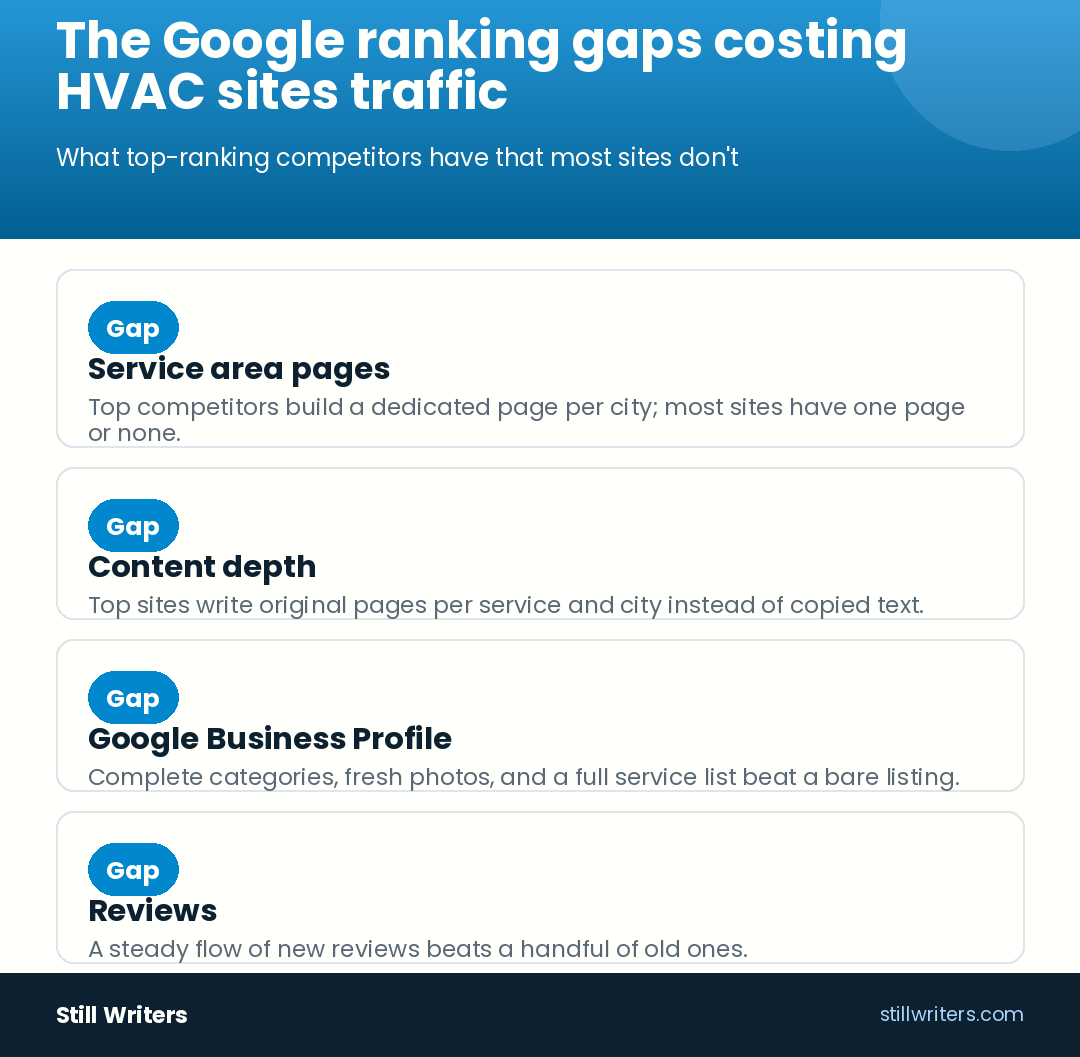
| Ranking gap | What top ranking competitors have | What most HVAC sites are missing |
|---|---|---|
| Service area pages | A dedicated page for every city and neighborhood served | One general service area page, or none at all |
| Content depth | Original pages written for each service and each city | Copied manufacturer text or thin, duplicate pages |
| Google Business Profile | Complete categories, fresh photos, and a full service list | A bare listing with a name, address, and phone number |
| Reviews | A steady flow of new reviews added every month | A handful of old reviews and no plan to get more |
| French language content | Full French pages built for Quebec markets | English only, even on pages meant for Quebec towns |
| Marketing budget | Dedicated SEO spend, often $2,500 to $7,500 a month | Whatever is left after trucks, parts, and payroll |
You can see this pattern across the country. Companies that rank well in competitive metros usually built a full HVAC marketing presence market by market, not one page trying to cover everywhere at once.
Why do national franchises always seem to outrank you?
Most Canadian HVAC companies are small businesses. Across the country, 88.4% of Canadian businesses have fewer than 20 employees, and HVAC contractors fit that pattern closely. A two truck operation in Ontario and a national franchise with fifty locations show up on the same results page for a search like emergency furnace repair. Only one of them has a marketing department.
Real SEO work costs money. Agencies typically charge $1,500 to $5,000 or more a month for ongoing SEO, with content marketing running a similar range on its own. Franchises budget for that as a fixed cost, the same way they budget for fuel or insurance. Independent owners often treat marketing as whatever’s left over. That’s not a criticism of the owner. It’s simple math, and it explains a lot of the gap on page one. If you want a full breakdown of what this actually costs across Canada in 2026, we covered every number in our HVAC marketing cost guide, and our HVAC SEO cost article breaks the SEO piece down on its own.
Competitive metros look different, but the pattern repeats
The Greater Toronto Area is Canada’s largest HVAC market, and it’s a brutal one. Furnace and AC contractors in Mississauga and Toronto compete against national brands, well funded local shops, and manufacturer owned service divisions, all on the same results page. The same squeeze plays out from Calgary to Edmonton. Bigger cities usually mean a bigger budget sitting on the other side of the gap, no matter the province.
How do you close the content and service area gap?
- Build one page per service area: a company serving Mississauga, Brampton, and Vaughan needs three real pages, not three mentions on one page.
- Write for the person, not the crawler: describe the exact furnace brands, home types, and problems common to that specific area.
- Cut copied manufacturer text: Google can tell when ten HVAC sites use the identical paragraph about how a heat pump works.
- Add local proof to every page: a photo from a real job, a short project story, or a review from that neighborhood builds trust fast.
- Update old pages twice a year: stale pricing or a discontinued rebate program tells both readers and Google that a page has been neglected.
What does a real Google Business Profile and reviews strategy look like?
Whitespark, an Edmonton based company that studies local search ranking factors every year, has tracked the same pattern for over a decade. Reviews and a complete Google Business Profile move the needle on map pack rankings more than almost anything else you control directly.
Google Business Profile completeness checklist
| Profile element | Complete profile | Incomplete profile |
|---|---|---|
| Categories | Primary and secondary categories matched to every service offered | Just HVAC contractor and nothing else |
| Photos | Fresh job photos added most months | A logo and one old stock photo |
| Services list | Every service named on its own line | A vague one line description |
| Posts | Weekly updates, offers, and seasonal reminders | No posts at all |
| Questions and answers | Common questions answered by the owner | Left blank or answered by strangers |
Reviews matter beyond Google too. About 73% of Canadian shoppers Google a business before they call, and plenty of them also check HomeStars or TrustedPros, the two platforms Canadian homeowners use most to vet a contractor. If your profile on those sites sits empty while a competitor has forty reviews, you’ve already lost some trust before the phone even rings. A short, simple system, like a text message sent to every customer after the job, closes this gap faster than most owners expect.
The French language gap in Quebec markets
A lot of Ontario based head offices treat Quebec as an afterthought, and it shows on their websites. A French page that reads like a rough translation of an English resume will lose to a competitor who wrote for the person searching in French from the start. If you serve towns near Trois Rivieres, Sherbrooke, or Quebec City, you need real French content built for that market, not a translated copy of your English site pasted into a new page. A page that names Hydro Quebec’s efficiency rebates directly will beat a generic page that only talks about savings in the abstract. This single gap knocks a meaningful share of Quebec search traffic off the table for companies that skip it, and it’s one of the easiest gaps on this list to close once you commit to it.
How do you know if you’re ready to close the gap?
Before you spend a dollar on marketing, look honestly at where you stand today. A few short questions usually reveal exactly which gap is costing you the most calls.
- You have fewer than five reviews per location: that’s a sign your reviews strategy needs work before anything else.
- Your service pages read the same for every city: copied content will not outrank a competitor writing for each area on its own.
- Your Google Business Profile is missing photos or posts: an empty profile tells Google you’re not active right now.
- You serve Quebec without a French page: that’s a gap a bilingual competitor will exploit fast.
- You don’t know your current ranking position: you can’t close a gap you haven’t measured first.
If you recognized your company in more than one of those bullets, you’re not alone. Most Canadian HVAC companies check at least two boxes. Closing the gap usually takes a mix of real content work and steady, ongoing SEO. Our services page breaks down how we handle both pieces together, and our content writing services in Canada page goes deeper into how we write pages that don’t sound like everyone else’s. If you’d rather just talk it through first, contact us and we’ll tell you plainly if there’s a gap worth closing.
Frequently asked questions about HVAC SEO marketing
Why doesn’t my HVAC company show up on Google at all? Most likely your website has one page trying to cover every city you serve, thin content, or an incomplete Google Business Profile. Google can’t rank a page for a city it never mentions by name. A few missing pieces usually explain most of the gap.
How long does it take to rank higher on Google for HVAC keywords? Most Canadian HVAC companies see real movement in local rankings within three to six months of fixing service area pages, content, and their Google Business Profile. Competitive markets like the GTA can take longer. Steady work beats a quick fix that fades within a season.
Do I really need a French page if I only get a few Quebec customers? Yes, if any part of your service area touches Quebec. French search is a real, common behavior in that market, not a translation formality. A well written French page often outranks a translated English one in the same market.
Can I fix my Google Business Profile myself without an agency? Yes, a lot of it. Adding photos, filling out every service category, and posting updates costs time, not money. Where owners usually get stuck is combining that work with a service page and reviews strategy that actually work together.
Do AI Overviews on Google make ranking even harder for HVAC companies? They add a new layer, yes. Around 58% of search results pages now show an AI Overview at the top, and that can pull clicks away from a ranking you worked hard for. Ready to call searches like emergency furnace repair near me still send real traffic your way even when an Overview appears.
Fix your HVAC SEO marketing gap before a competitor does
You came here because your phone isn’t ringing as much as it should, and you know competitors down the street are getting calls that could be yours.
Here’s a quick recap of what you just learned.
- Ranking gaps are specific and measurable: they aren’t a mystery you have to guess at.
- Service area pages matter most: dedicated pages beat one generic page every time.
- Google Business Profile and reviews win the map pack: a complete profile and steady reviews move rankings fast.
- Quebec needs real French content: a translated afterthought can’t compete with a page built for that market.
- Budget explains most of the franchise gap: national brands usually outspend independent shops, they don’t necessarily outwork them.
We’ve watched HVAC companies go from a handful of website visits a week to hundreds within months, just by closing gaps like the ones in this article. We didn’t do it with tricks or shortcuts. We did it by writing pages Google could actually understand and trust, built by people who know the trade. If you’re ready to see what that gap looks like for your company, click below and talk to a real person on our team, not a bot.
What should you read next?
If you want to keep learning before you pick up the phone, here are three places to start.
- What is HVAC digital marketing, and does your company actually need it?: a good starting point if you’re still deciding if you want to invest at all.
- What does HVAC marketing cost in Canada in 2026?: useful once you’re ready to put a real number next to a plan.
- Best HVAC lead generation strategies for Canadian contractors in 2026: shows you what to do once your rankings start climbing.
If you’re not ready to talk to us yet, those three resources are a solid place to keep learning at your own pace.