
Key takeaways
- Digital marketing for HVAC companies is six pieces working together, your website, SEO, content, your Google Business Profile, paid ads, and social media.
- You probably need it now if referrals have slowed down, you keep losing bids to companies that show up first on Google, or your slow season feels longer every year.
- Timing matters more in Canada than people think, because Alberta’s shoulder seasons and Atlantic Canada’s shift away from oil heat both change when homeowners start searching.
Your phone used to ring itself. A furnace call here, an air conditioner tune up there, mostly from neighbours and past customers. Now it sits quiet more often, and you’re left wondering if that’s normal or a warning sign. In Canada, Google handles roughly 86 percent of all search traffic, so when a homeowner in Red Deer or Moncton has a furnace problem, most of them type it into Google before they call anyone. That’s the real reason digital marketing for HVAC companies matters right now. It isn’t a trend you can skip. It’s where your next customer already is, looking for someone to answer.
At Still Writers, we watched one HVAC client’s organic traffic grow from a handful of daily visits to a steady stream in under a year, just by fixing the basics most companies never get around to. We work with HVAC companies across Canada and the United States, and that range has taught us this industry has its own language, its own busy seasons, and its own trust signals that a generic marketing shop often misses. Plenty of agencies do good work in this space. What we bring is a team that has spent years learning HVAC specifically, instead of running a template built for restaurants or law firms.
What is digital marketing for HVAC companies?
Digital marketing for HVAC companies is the mix of online tools that bring in calls and bookings without you knocking on doors. It’s made of several pieces, and each one does a different job.
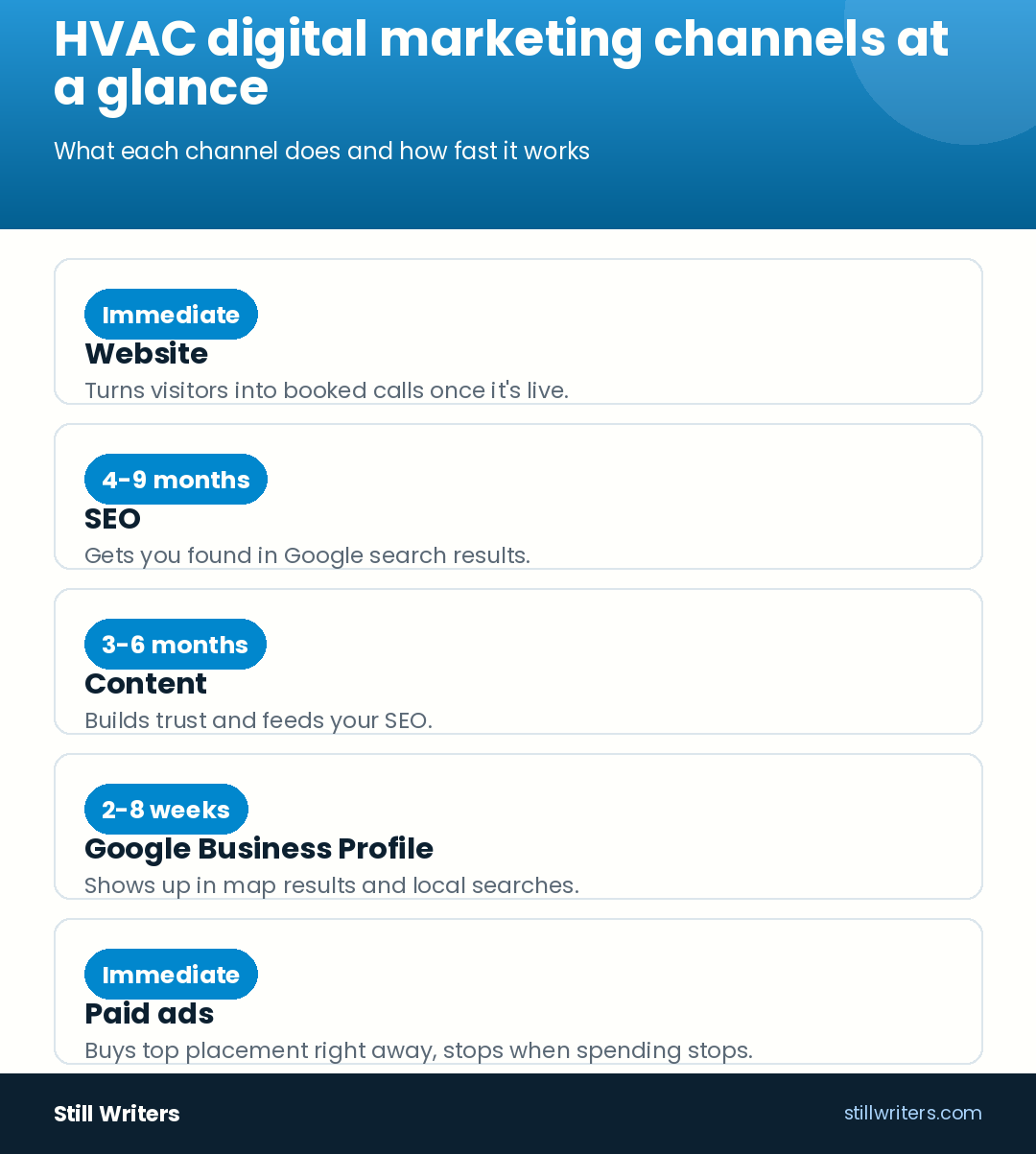
Your website is the foundation. It’s the page a homeowner in Halifax or Calgary lands on after searching for a furnace repair. SEO, short for search engine optimization, is the ongoing work that gets that website to show up when someone searches for HVAC help nearby. Content means the blog posts, service pages, and plain answers to buyer questions that build trust and support your SEO at the same time. Your Google Business Profile is the free listing that shows your hours, reviews, and location right on Google Maps. Paid ads put you at the very top of the search results instantly, for a price, and stop the moment you stop paying. Social media keeps your name in front of past customers and builds a bit of local recognition over months, not days.
How these pieces work together
None of these channels do much on their own. A polished website with no SEO behind it sits unseen on page four of Google. A strong Google Business Profile paired with a slow, outdated website loses the click anyway, because the homeowner bounces off the page before calling. Paid ads can fill your calendar fast, but the leads dry up the day your budget runs out, unless SEO and content are quietly building in the background too. That’s the honest answer to what digital marketing for HVAC companies actually is. It’s a system, and the pieces support each other.
| Channel | What it does | Typical time to see results |
|---|---|---|
| Website | Turns visitors into booked calls | Immediate once it’s live |
| SEO | Gets you found in Google search results | 4 to 9 months |
| Content | Builds trust and feeds your SEO | 3 to 6 months |
| Google Business Profile | Shows up in map results and local searches | 2 to 8 weeks |
| Paid ads | Buys top placement right away | Immediate, stops when spending stops |
| Social media | Keeps your name in front of past customers | Ongoing, slow build |
If you want to see how these pieces come together for an HVAC company specifically, Still Writers’ digital marketing services page breaks down what’s included and how the channels get bundled, if you’re a small crew in one province or a company operating in several.
Do you actually need digital marketing right now?
Maybe your phone still rings enough most weeks. Maybe you’re busy every spring and fall and don’t want to spend money on something that feels optional right now. So how do you actually know if today is the day, or if it can wait?
Start with your leads. If most of your new customers used to come from referrals, and that pipeline has slowed down, that’s the first signal. Word of mouth still matters, but fewer homeowners ask a neighbour before they search online. About 53 percent of Canadians say a website makes a business look more credible, and roughly 72 percent of Canadians research a purchase on Google before they make it. If you don’t have a website, or yours hasn’t been touched since 2013, homeowners in Lethbridge or Saint John notice before they ever pick up the phone.
Losing bids is the clearest sign of all
The second signal is losing bids you should be winning. If you quote a fair price and still lose the job, ask why. Often it’s because three other HVAC companies showed up above you on Google and got the call first. Homeowners rarely scroll past the first few results. They call whoever answers their question fastest, and that’s usually whoever ranks highest.
The third signal is your slow season stretching longer every year. If your off season used to last six weeks and now drags on for three months, that’s not bad luck. It usually means your competitors are staying visible year round while you go quiet between busy seasons, and homeowners forget your name by the time they need you again.
When can digital marketing wait a little longer?
- Full calendar: if you’re already booked out for six weeks and turning down jobs, more leads won’t help you yet.
- Strong referral base: if repeat customers and word of mouth still fill most of your schedule, you have room to plan instead of rushing.
- Limited crew: if hiring is your real bottleneck instead of lead flow, your budget is better spent on training or a new technician first.
- Recent launch: a brand new company often needs a few months of completed jobs and real reviews before marketing dollars go far.
- No clear offer yet: if you haven’t decided what makes your company different from the next HVAC crew, fix that before you pay to attract more attention.
How does the now versus later decision play out for real HVAC companies?
Timing looks different depending on where you operate, and that surprises a lot of owners. A company in Alberta and a company in Atlantic Canada are chasing the same kind of customer, but their calendars don’t match.
In Alberta, the quiet stretch tends to land in late spring, right before summer air conditioning calls pick up. That gap is a smart window to fix your Google Business Profile, add service pages, and get your SEO moving before the phone gets busy again. Skip that window, and you’re trying to build visibility at the exact moment you’re too slammed to answer the extra calls anyway.
In Nova Scotia and New Brunswick, a different shift is underway. Many homes there still run on oil heat, and federal rebate programs have funded close to 274,000 heat pump installations across Canada, with cold climate units built for the coldest days making up most of those projects. That shift changes what homeowners search for. Companies showing up for heat pump installation searches early are picking up jobs that used to go automatically to oil furnace technicians. Meanwhile, in Calgary, heat pumps now account for a much bigger share of furnace replacements than they did just a few years ago, which tells you this shift isn’t only an Atlantic Canada story.
Why a national view still needs local timing
This is why a one size fits all marketing calendar rarely works for a Canada wide HVAC company. Your SEO and content plan should follow your actual busy seasons, province by province, not a generic template built around one region’s weather.
| Region | Typical quiet stretch | What that means for marketing timing |
|---|---|---|
| Alberta | Late spring, before AC season starts | Good window to build SEO and content before the busy season hits |
| Nova Scotia and New Brunswick | Mid winter, once heating systems are already running | Good window to run ads and collect reviews for the next heating season |
| Ontario and Quebec (for comparison) | Similar shoulder patterns, but far more competitors | SEO usually takes longer to show results because more companies compete for the same searches |
How do you evaluate a digital marketing plan without wasting money?
- Ask for a written plan: a real proposal lists specific channels and steps, not a vague promise to handle your marketing.
- Ask how long results take: anyone promising overnight SEO rankings is guessing, or being dishonest with you.
- Check their HVAC experience: ask for other HVAC clients specifically, instead of general contractors or home services companies.
- Confirm what you own: your website, your content, and your Google Business Profile should belong to you, not the agency.
- Ask about reporting: you should see plain numbers each month, calls booked and where those leads came from, instead of a fancy looking dashboard alone.
If you want a deeper look at how HVAC companies generate leads across the country, Still Writers’ guide to lead generation strategies for Canadian contractors covers this in more detail. And if you’re ready to talk through your own situation, our contact page gets you in front of a real person, not a form that disappears into a queue.
Frequently asked questions about digital marketing for HVAC companies
What does digital marketing for HVAC companies actually include? It includes your website, SEO, content like blog posts and service pages, your Google Business Profile, paid search ads, and social media. Most successful HVAC companies use several of these together instead of picking just one channel.
Is digital marketing worth it for a small HVAC company? Yes, if referrals have slowed or you’re losing bids to companies ranking higher on Google. Small companies often see the biggest gains, because a fixed Google Business Profile and a clear website can outperform a bigger competitor’s outdated setup.
How is digital marketing different from just having a website? A website is one piece of the puzzle. Digital marketing also covers getting that website found through SEO, building trust with content, staying visible on Google Maps, and running ads if you want faster results.
How long does digital marketing take to work for an HVAC company in Canada? Google Business Profile changes can show results in weeks. SEO and content usually take 4 to 9 months to build real momentum. Paid ads work immediately but stop producing leads the day you stop paying for them.
Can a one person HVAC company handle digital marketing without an agency? Some owners manage the basics themselves, like claiming their Google Business Profile and asking happy customers for reviews. SEO, content, and ad management take more time than most solo owners can spare, which is when outside help starts to pay for itself.
Is digital marketing for HVAC companies worth it?
You came here wondering if your quiet phone and lost bids meant something, or if you were overthinking it. For a lot of HVAC owners across Canada, it means the same thing: customers are searching, and someone else is answering first.
Here’s a quick recap of what to remember.
- Digital marketing is six connected pieces, not one single tactic.
- Referrals slowing down and lost bids are the clearest signs you need it now.
- A full calendar or a brand new business are valid reasons to wait a little longer.
- Timing should follow your region’s real busy seasons, not a generic national calendar.
- A good plan is written down, honest about timelines, and leaves you owning your own website and content.
Still Writers has spent years writing for HVAC companies specifically, from small crews in one province to companies running campaigns in several markets at once. We’ve learned what makes a homeowner pick up the phone, and what makes them scroll past you without a second thought. You don’t need to figure this out alone, and you don’t need to guess at what’s working. Talk to us, and we’ll tell you honestly if now is the right time for your company or if it can wait a little longer.
What should you read next?
If you want to keep learning before you pick up the phone, here are three places to start.
- What does HVAC marketing cost in Canada in 2026?: once you know you need it, this breaks down real numbers so you can budget properly.
- Best HVAC lead generation strategies for Canadian contractors in 2026: a closer look at the specific tactics behind the channels covered here.
- Still Writers’ HVAC marketing hub: browse examples and market pages from HVAC companies we work with across Canada.
If you’re not ready to talk to us yet, these three resources are a solid place to keep learning at your own pace.